How to Do a Competitive Analysis on Social Media In 6 Steps: Expert’s Insights
Gen Z averages about 6.5 seconds per post, while millennials average 8.3 seconds before disengaging. What it means is brands are competing for attention that disappears almost instantly. In such a scenario, running a competitive analysis the right way can help you capture that attention. But most teams get this wrong. They collect data, compare follower counts, and call it a day. That kind of analysis doesn’t tell you what to post next. What actually works is breaking down competitor conten


Gen Z averages about 6.5 seconds per post, while millennials average 8.3 seconds before disengaging.
What it means is brands are competing for attention that disappears almost instantly.
In such a scenario, running a competitive analysis the right way can help you capture that attention.
But most teams get this wrong. They collect data, compare follower counts, and call it a day. That kind of analysis doesn’t tell you what to post next. What actually works is breaking down competitor content, spotting patterns in what performs, and translating those insights into clear actions.
This guide shows you how to do competitor analysis the right way along with insights from Haley Correll, senior director of Content and Channel Strategy at American Red Cross.
Key takeaways
-
Identify your competitors: Choose a small, relevant mix of direct, indirect, content, and creator competitors that compete for the same audience attention, not just the same product category.
-
Analyze their content strategy: Break down competitors’ content systems, including pillars, formats, hooks, posting cadence, and branding style, to understand the repeatable patterns behind their performance.
-
Analyze their engagement quality: Look beyond likes and follower counts to evaluate conversation depth, saves, shares, sentiment, and interaction to understand how strong their audience connection really is.
-
Benchmark performance against key metrics: Compare competitors using meaningful metrics like engagement per impression, saves, shares, retention, and growth to see what actually drives results.
-
Spot gaps and opportunities: Find strategic advantages by identifying topics, formats, and audience questions competitors are missing or underusing.
-
Use these competitive insights to guide your strategy: Turn competitor insights into action by doubling down on what works, fixing weak areas, and repeating the analysis regularly to stay competitive.
What is social media competitive analysis (and what most people get wrong)
Social media competitive analysis is the process of studying your competitors’ content, performance, and strategy to understand what actually drives attention and engagement in your space.
Most people reduce it to tracking follower counts or average engagement. I’ve done that too, and it tells you almost nothing useful. Knowing a competitor gets 20% engagement than other brands in the industry doesn’t explain why it happens or how to replicate it.
Instead, you need to look at:
- Content distribution patterns, like whether they rely more on reels, carousels, or text posts.
- Audience behavior signals, such as which posts get saves, shares, or meaningful comments.
- Positioning gaps, like topics or formats no one is fully owning yet.
Why conducting a social media competitive analysis matters more in 2026
What works and what doesn’t work on social media has changed a lot over the last couple of years.
Haley shared her insights on how this impacts competitor analysis —
Competitive analysis used to be a reporting exercise. It was something you included in monthly reports for leadership or stakeholders. Today, it has evolved into strategic intelligence.
What’s changed is the focus. It’s no longer about comparing follower counts or surface-level engagement. It’s about understanding why content performs. That means looking at things like hook strength, content format, storytelling style, and how brands are actually interacting with their audience.
And so I think today the most valuable competitive analysis looks at creative signals and audience behavior and not just metrics, which is what we used to see.
Here are four reasons why I think social media competitor analysis is a must-do for any brand leveraging social media.
Distribution matters more than creation
Creating good content is table stakes now. What actually drives results is how often you show up, how you repurpose ideas across formats, and how well your content is optimized for discovery.
Execution speed is now a growth lever
Look at your favorite brands on social media. Be it Duolingo, Netflix, or ClickUp. These brands are good at one thing amongst others — they’re the fastest. Fast at jumping on trends, fast at testing variations, fast at doubling down on what works. Competitive analysis helps you spot these patterns early so you’re not always reacting late.
Social platforms are now search engines
People are actively searching on Instagram, TikTok, and LinkedIn. That means your competitors are not just competing for attention, but for discoverability. The right keywords, formats, and topics matter more than ever.
Content lifespan is unpredictable
Some posts disappear in hours, others resurface days later through recommendations. When you analyze competitors, you start to see which content keeps getting traction over time, and you can optimize your content strategy with these insights.
How to conduct a comprehensive social media competitive analysis?
Here’s a step-by-step process on how to analyze competitors on social media.
1. Identify your competitors
Before you analyze anything, you need the right competitors in your list. Here, I try to zero in on accounts that fight for the same attention as my brand does. One easy way I break it down is by categorizing competitors into:
- Direct competitors: Brands offering the same product or service as my brand. These are my obvious competitors.
- Indirect competitors: Brands solving the same problem in a different way. For example, a social media tool competing with agencies.
- Content competitors: Accounts competing for the same attention, even if they don’t sell the same thing. This includes media pages, niche communities, and educational accounts.
- Creator competitors: Individual creators understand hooks, storytelling, and audience engagement better than many brands. I try to include them to get more understanding of what’s working in the industry.
How to find your competitors
- Social search: Search your core keywords directly on Instagram, LinkedIn, TikTok, or YouTube. Look at — top posts, accounts that show up repeatedly, and creators dominating your niche.
- Google search: Search for terms like: “Top [your niche] brands”, “Best [your category] tools”, “Top creators in [your niche]”
- Audience overlap: Check who your audience already follows and tagged accounts and collaborations
- Content signals: Look at posts in your niche with high engagement. Then track who created them. These are often your real competitors in the feed.
2. Analyze their content strategy
This is one of the most important steps of your social competitor analysis. Here’s how Haley said she goes about it at American Red Cross —
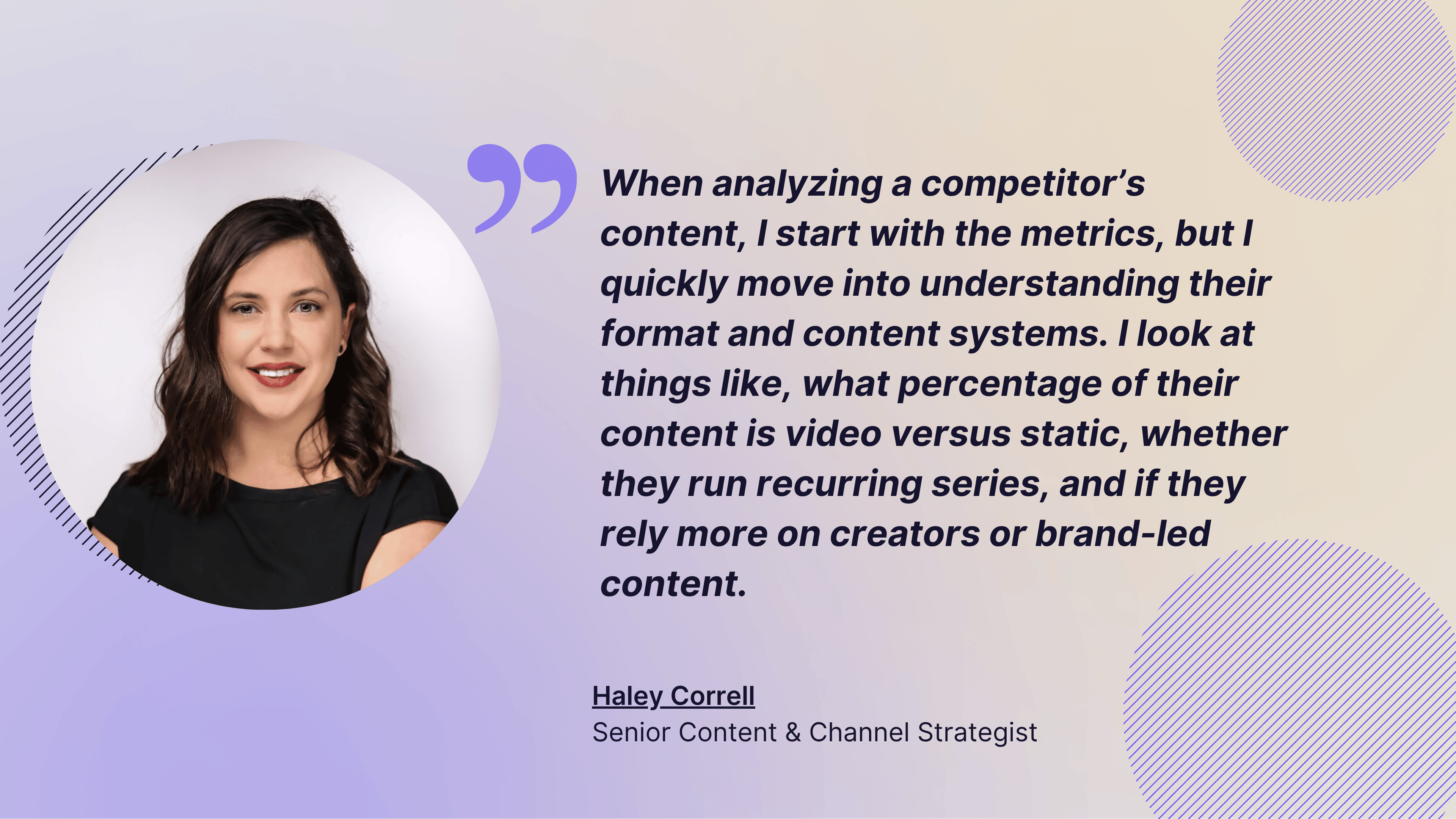
When analyzing a competitor’s content, I start with the metrics, but I quickly move into understanding their format and content systems. I look at things like, what percentage of their content is video versus static, whether they run recurring series, and if they rely more on creators or brand-led content. I also pay attention to their voice. Is it educational, emotional, or promotional?
What you start to notice is that high-performing brands aren’t posting randomly. They operate within repeatable frameworks. Once you understand that structure, the performance metrics begin to make a lot more sense, and you can see exactly what’s driving results
Content pillars
I use Socialinsider to automatically get insights into which content pillars my competitors are using and the engagement they are getting for each.
Here’s what it looks like.
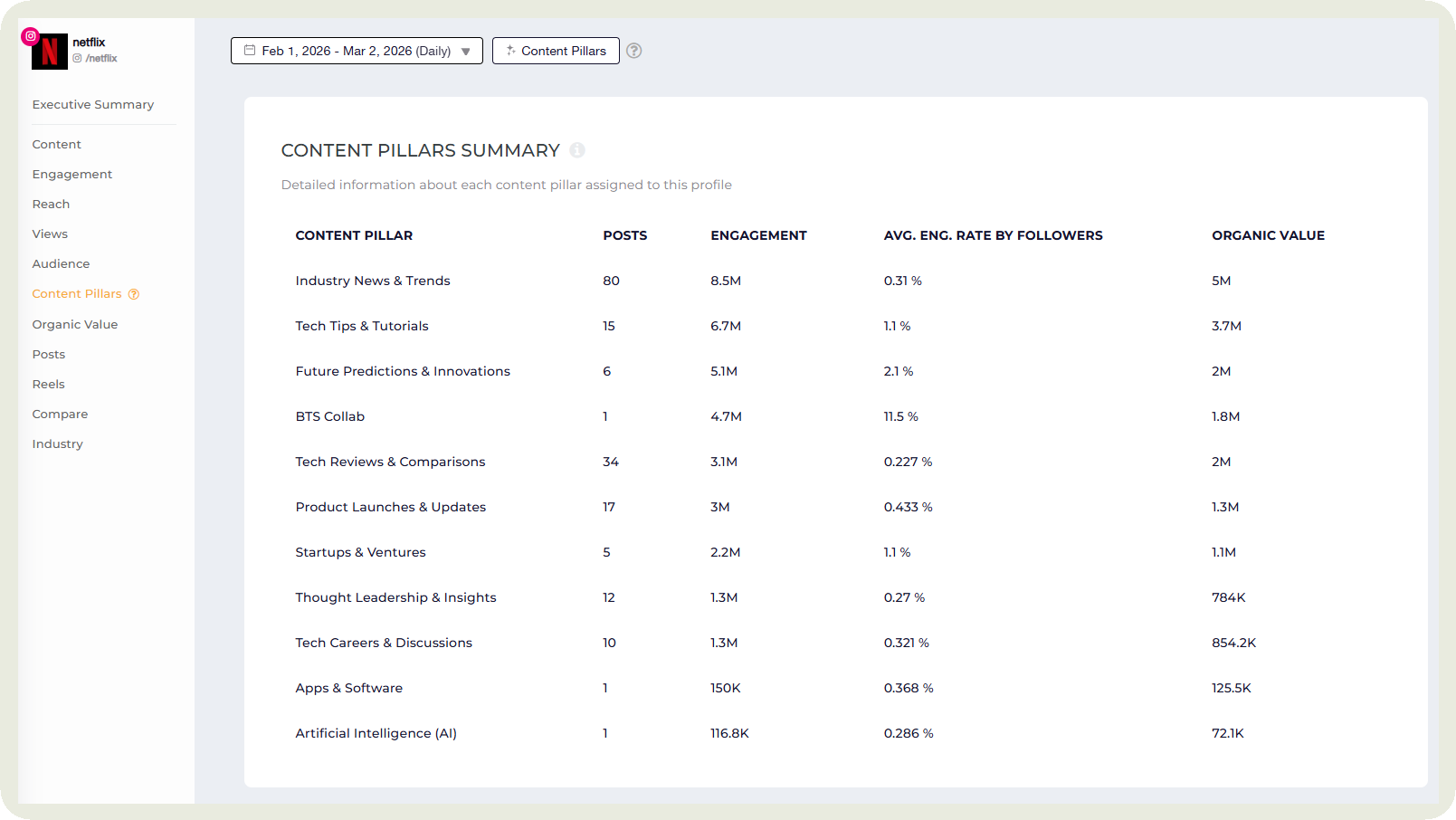
These are the questions I further ask to get deeper insights:
- Are the pillars broad or niche? Some competitors stay broad to reach a wider audience. Others go deep into a niche and build authority there. If someone is posting only about ‘LinkedIn growth for founders,’ that’s a clear niche play.
- Do they own a specific angle? The best-performing accounts don’t just pick topics, they pick a point of view. For example, two brands might talk about social media, but one focuses on data-backed insights while another leans into bold opinions.
- What are the existing gaps? Find pillars that are underutilized or ones that none of the competitors are yet taking advantage of, but they are worth experimenting with.
Content formats
While short-form videos may work great on Instagram, long-form videos would be winning on YouTube.
By looking at what your competitors are focusing on, you can get a general idea of audience preferences on different platforms.
Socialinsider gets you this data quickly.
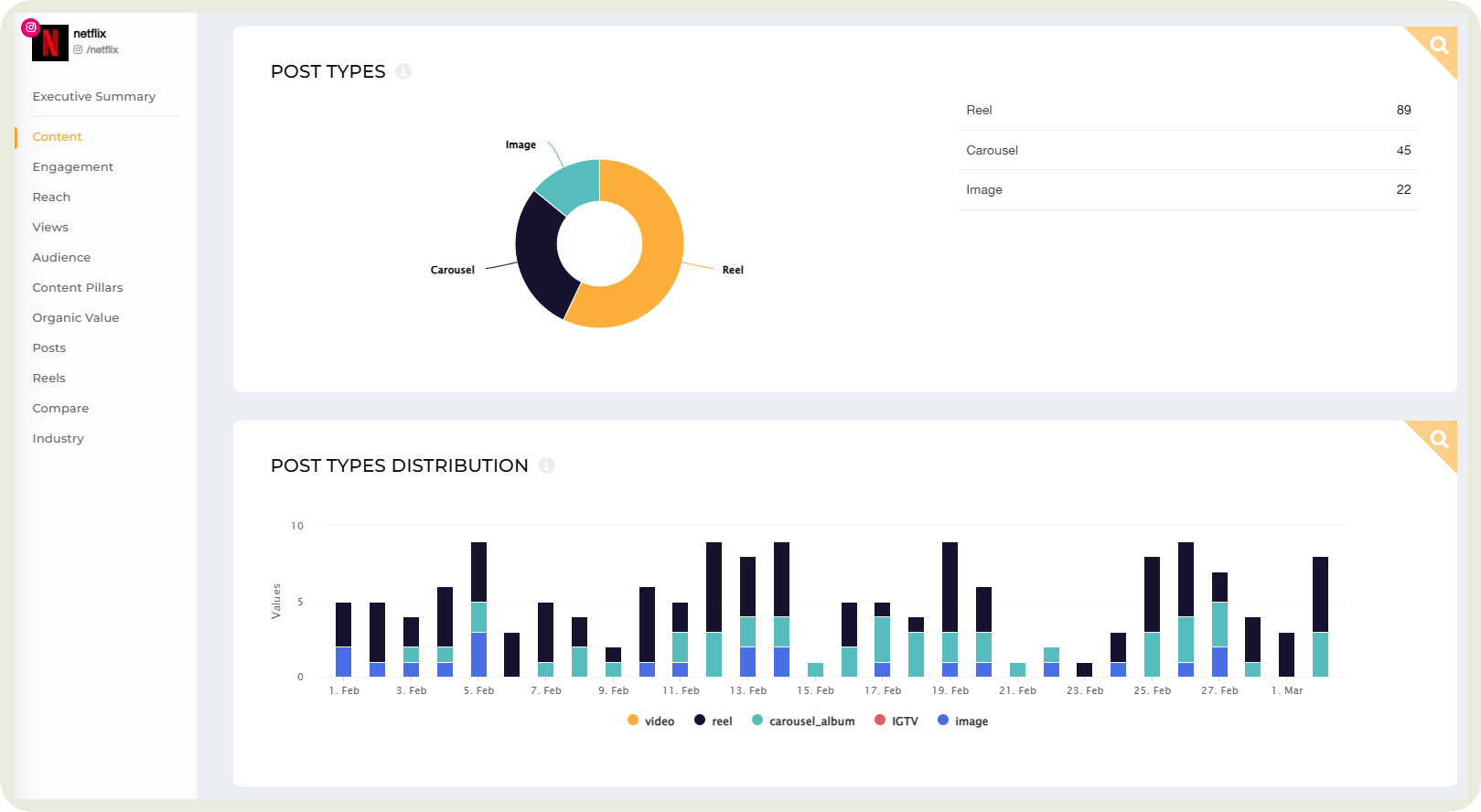
You can even rely on benchmarks that give you an idea of what format is working well on which platform. Here are some statistics from Socialinsider benchmark reports:
- According to Socialinsider'Instagram Benchmarks Report, Carousels remain the most effective format on Instagram, showing the strongest engagement resilience year over year.
- Based on Socialinsider's LinkedIn Benchmarks report, multi-image posts drive more likes across the board on LinkedIn.
Posting frequency and consistency
Your competitor’s engagement, impressions, and views, depend heavily on how often they post on social media.
A higher posting frequency might bring them a lot more likes and views than you.
This is why it’s important to look at factors like:
- How many times do they post per week or day? You might notice that high-performing accounts usually follow a clear cadence instead of random posting.
- Are there any gaps in their posting cadence? Do they post heavily for a period and then go silent? These gaps often explain drops in engagement or missed momentum.
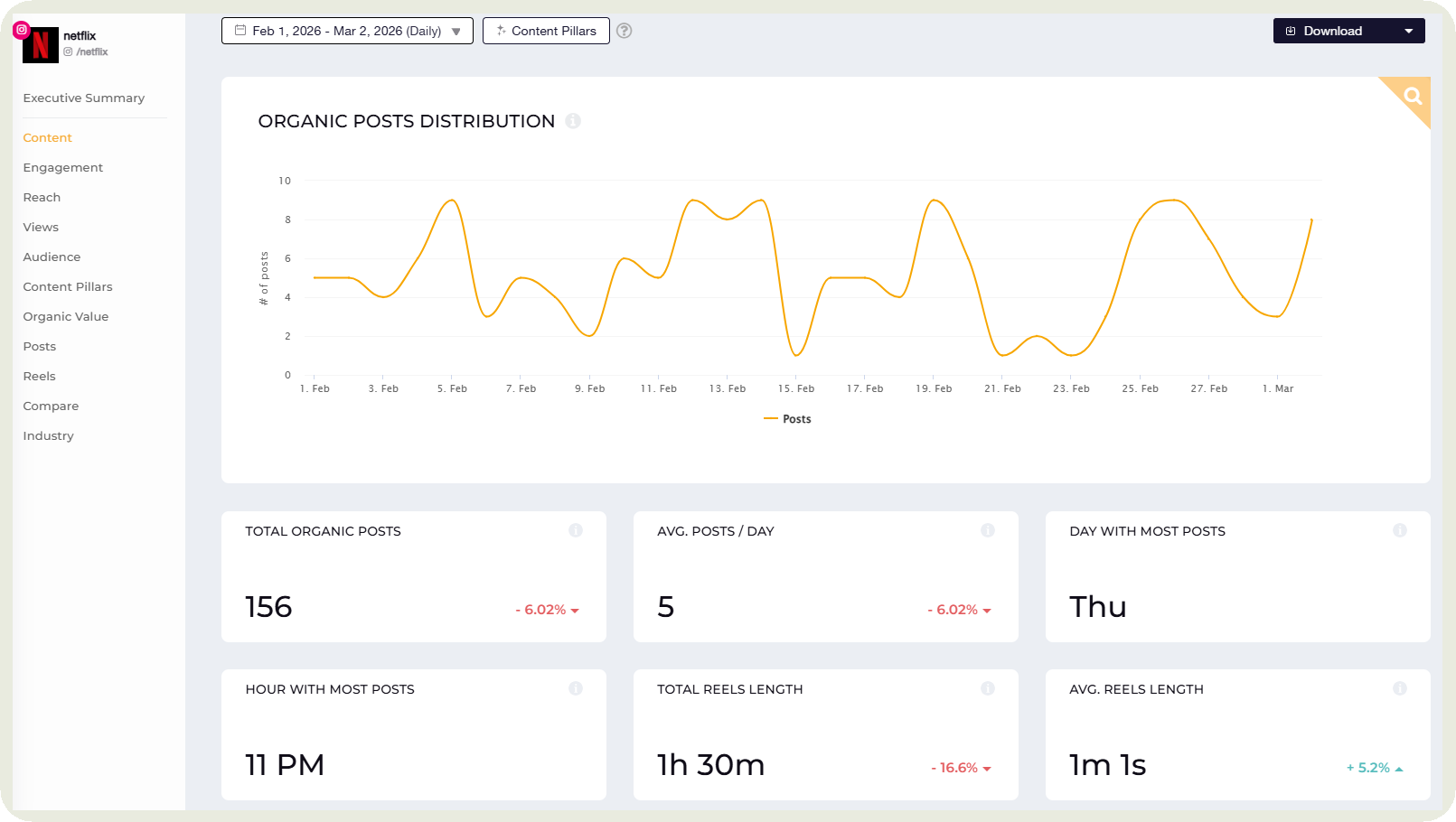
- Do they follow burst posting or a steady cadence? Some competitors post in bursts, 5-6 posts in a few days, then nothing. Others follow a steady rhythm, like one post per day or a few posts every week.
To make tracking this easier, I utilize the trend graph in Socialinsider where I can click on each point and see the number of posts per day and how the graph changes per week or month.
Hook patterns
Hooks decide whether your content gets attention or is ignored. This is where you break down how competitors earn those first few seconds.
I go through their top-performing posts and focus only on the first line or first 2-3 seconds. Here’s how you can categorize the hooks used:
- Questions: Are they opening with questions that pull the audience in? For example, “Why is your engagement dropping?”
- Bold statements: Some competitors lead with strong opinions or contrarian takes. Think “Most brands are doing social media wrong.”
- Relatable pain points: A lot of high-performing content starts with something the audience instantly recognizes. For example, “Posting every day but getting no engagement?”
- Data-driven hooks: Hooks that use numbers or insights signal credibility. For example, “We analyzed 10,000 posts and found this.”
Once you categorize these, patterns become obvious. You’ll see which hook styles dominate your niche and which ones actually drive engagement. That’s what you build on.
Visual identity and branding consistency
Have you ever come across a post and instantly thought, “This is from brand X.” That’s the power of having a consistent visual identity.
Start by looking at how your competitors do it to get inspiration:
- Color schemes: Do they stick to a defined set of colors or change styles every post? Strong brands usually have instantly recognizable palettes that make their content stand out in the feed.
- Templates: Are they using repeatable layouts for carousels, reels covers, or posts? Consistent templates reduce effort and create familiarity. You’ll often notice high-performing accounts reuse the same structure across posts.
- Typography: Look at their font choices. Are they clean and readable on mobile? Do they use bold text for emphasis?
- Face vs faceless content: Are they putting people on screen or relying on graphics and text? Creator-led and face-driven content often builds stronger connection, while faceless content can scale faster. For example, ClickUp often uses more people-driven content.
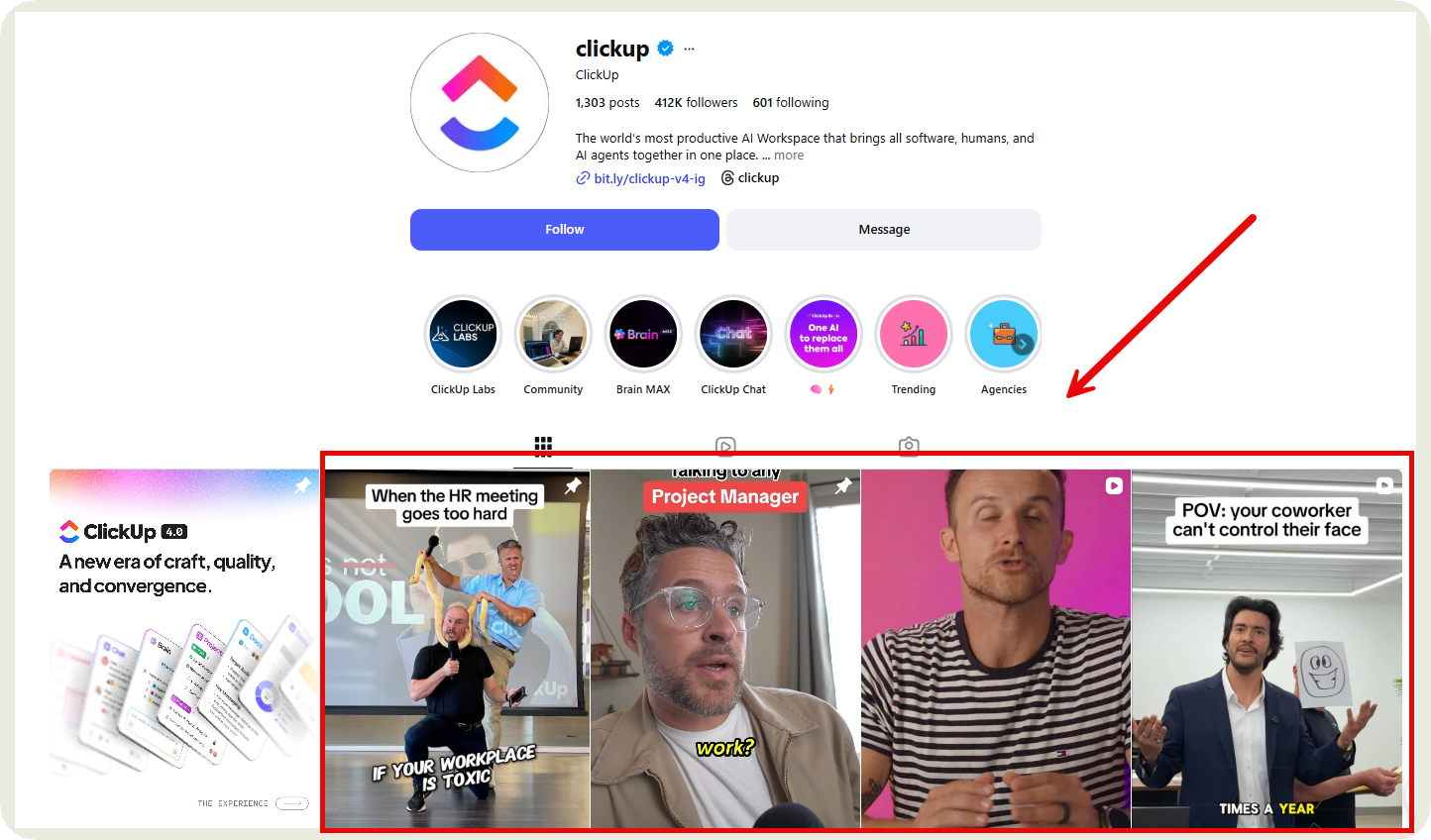
Top-performing content
I look at my competitor’s top posts in Socialinsider to gain insights into what made these posts perform well.
Was it the tone? The hook? Or the storytelling technique they used?
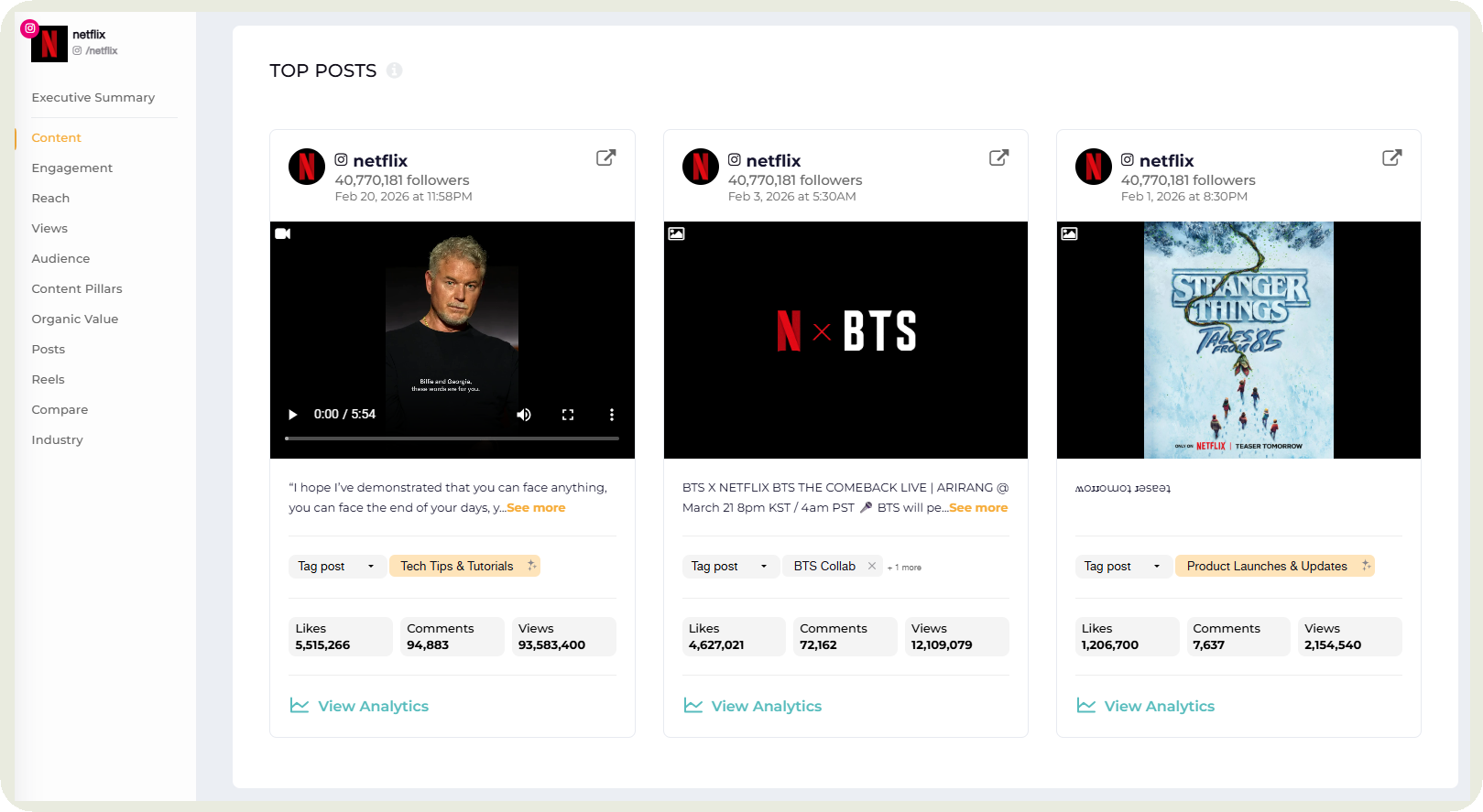
This helps you understand which content elements work best with your audience.
3. Analyze their engagement quality
Not all engagement is equal. A post with 1,000 likes and no real conversation is very different from one with fewer likes but strong audience interaction. This step is about understanding how meaningful their engagement actually is.
Here’s how to do that.
- Check their follower-to-engagement ratio: Look at how engagement compares to their follower count. A large audience with low engagement usually signals weak content or passive followers. Smaller accounts with high engagement often have stronger audience trust and relevance.
- Audience mentions and sentiment: Are people tagging the brand in comments or posts? Are mentions positive, neutral, or critical?
- Comments depth: Don’t just count comments, read them. Are they one-word replies or thoughtful responses? For example, users saying “this is exactly what I needed” is very different from generic comments like “nice post.”
- Response rate and interaction: Check if the brand replies to comments. How quickly do they respond? Do they just react, or actually engage in conversations? Brands that actively interact tend to build stronger communities.
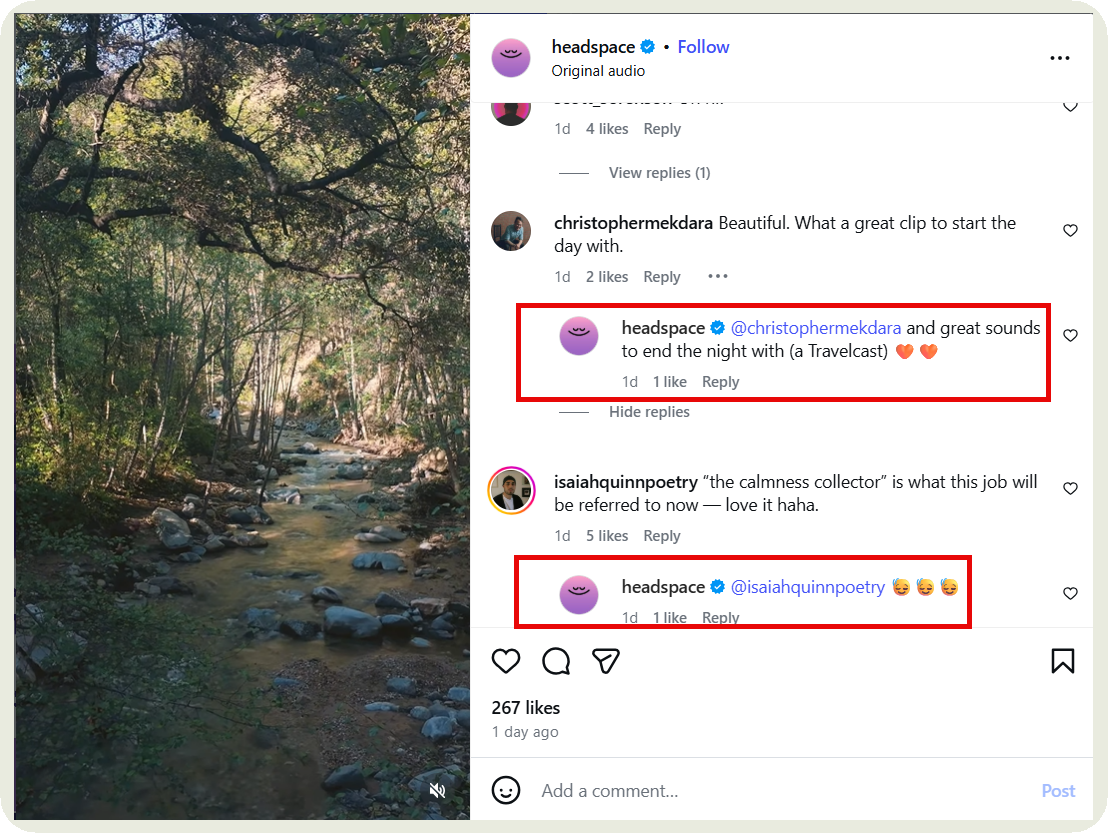
In our discussion, Haley mentioned looking at conversation signals. She said —
Follower count tells you almost nothing about engagement quality. I’ve seen accounts with huge audiences where the actual interaction on posts is minimal.
What I look for instead are conversation signals. Are people leaving thoughtful comments? Are they replying to each other? That kind of interaction shows real interest, not passive scrolling. I also pay close attention to saves and shares relative to views. If a post is being saved or shared frequently, it’s a strong sign the content truly resonated.
4. Benchmark performance against key metrics
Once you’ve analyzed content and engagement, the next step is to quantify where you stand.
Start with the core metrics that actually matter to your brand. This could include engagement rate, reach, follower growth, saves, shares, or video views. The key is to avoid tracking everything and focus only on what ties back to your goals.
Haley mentioned not getting swayed by overrated metrics here. In her words:
The metrics that actually matter are engagement per impression, especially saves and shares. When someone saves a post or shares it, that’s a clear signal the content has real value. For video, retention is another key metric. How long people actually stay and watch tells you if the content is truly holding attention.
These metrics show whether content is resonating and getting pushed by the algorithm. On the other hand, metrics like total follower count or one-off viral posts are often overrated. They look impressive, but they don’t reflect consistency.
Social media competitor analysis tools like Socialinsider make this easier by letting you build a customized dashboard and compare your performance side-by-side with competitors.
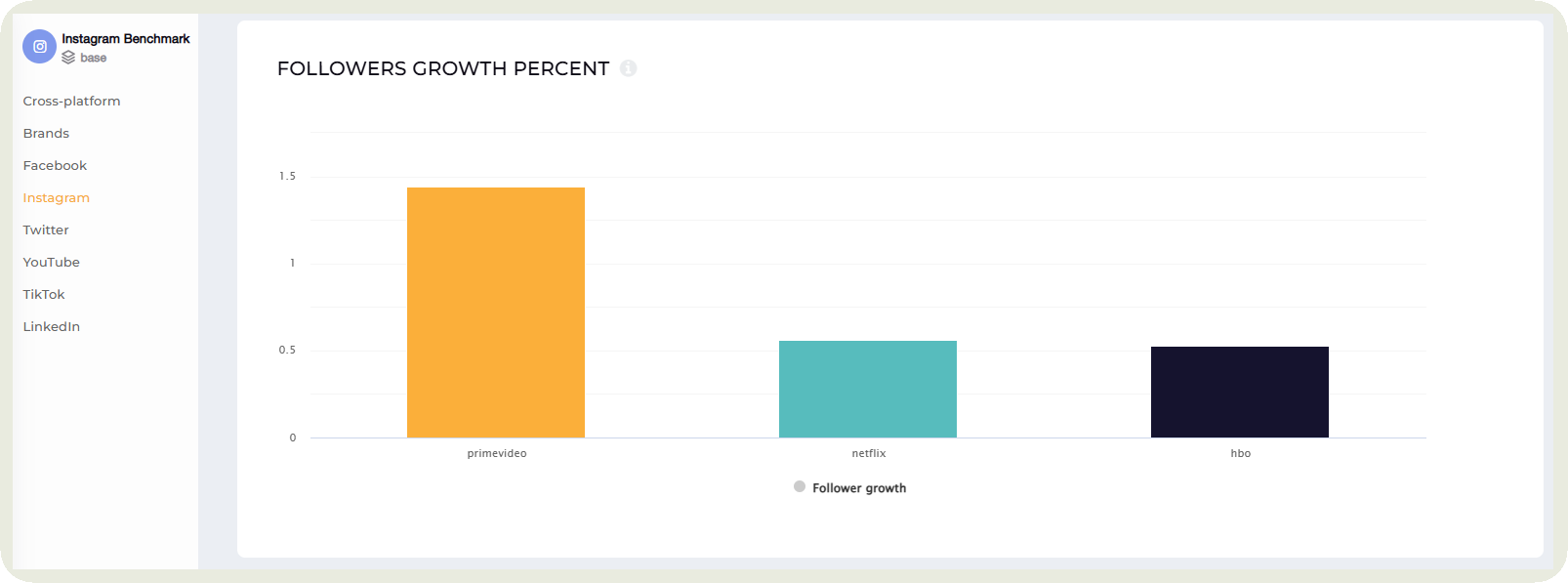
But tracking numbers isn’t enough. The real value comes from connecting these metrics to outcomes.
For example, high engagement might signal strong brand affinity, consistent shares can indicate content that drives awareness, and fast response rates often reflect better customer experience.
When you map competitors social media performance metrics to outcomes like brand equity, lead generation, or customer care, your analysis becomes actionable.
5. Spot gaps and opportunities
This is how you can actually turn competitive analysis into an advantage.
To spot these gaps and opportunities, here’s what Haley suggests doing —
- Analyze topics. Map out what everyone in the industry is talking about and identify where coverage is clustered versus where it’s missing. That gives a clear view of saturated areas and gaps.
- Next, look at format. Are competitors avoiding certain formats like educational series, long-form content, or creator-led posts? Format gaps are often easier to win than topic gaps.
- Finally, go into the comments and mentions. What are people asking that no one is answering? The biggest opportunities usually live there. If the same questions keep coming up and no one is addressing them, that’s a clear signal for content you can own.
The goal here is simple. Find what’s missing and build around it.
6. Use these competitive insights to guide your strategy
Once you’ve gathered all your competitor insights, the goal is to translate them into clear, actionable decisions. I like to think of this as moving from analysis to execution.
Double down on patterns that are consistently working, whether that’s specific content pillars, hook styles, or formats. At the same time, identify where your current social media strategy is falling short and adjust accordingly.
Most importantly, this shouldn’t be a one-time exercise. Keep revisiting your analysis regularly and refining your approach at regular intervals.
How we conduct a competitive analysis with Socialinsider
Nobody wants to spend weeks manually jumping between profiles, tracking numbers in spreadsheets, and still struggling to connect the dots while running a competitor analysis.
What tools like Socialinsider do is remove that friction. Instead of collecting scattered data, you get a structured view of your competitors’ content, performance, and trends, all in one place.
Here’s exactly how I use it to gain insights from a social media competitor analysis.
- Add your competitor profiles. Go to your Projects and click on the ‘Add Social Profiles’ tab. Enter the link or the name of your competitors and add those profiles.
- Once the profiles are added, go to the Benchmarks section in the Tools menu. You can customize this high-level dashboard by selecting the metrics that matter to your analysis.
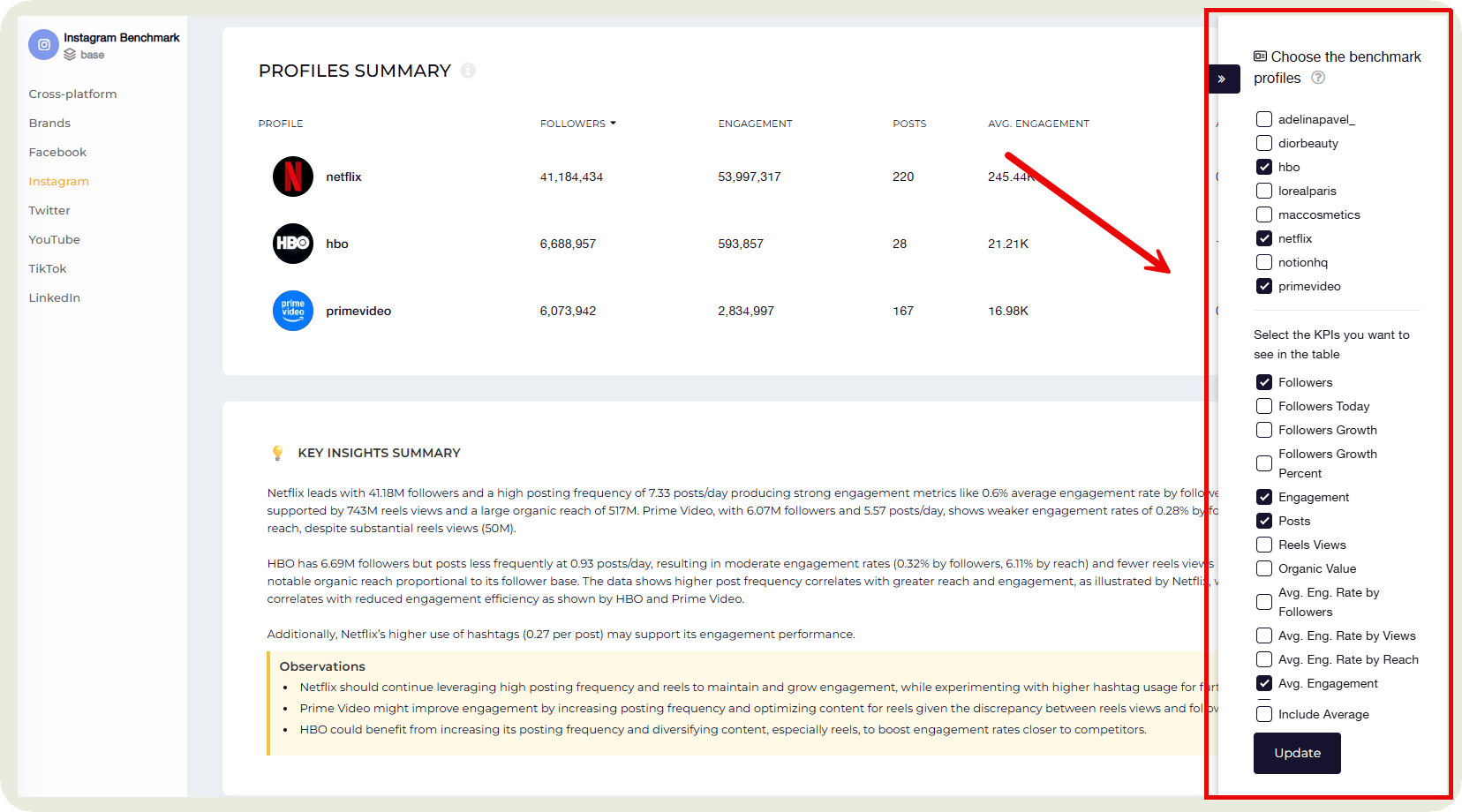
- Next, I click on individual profiles and check their content format distribution, content format by reach, top performing content, and content pillars.
- Lastly, you can use Socialinsider AI Assistant to ask specific questions around the competitive data.
Social media competitive analysis template
To make this process easier to apply, I’ve put together a practical social media competitive analysis template you can use with your team.
Instead of starting from scratch, this template walks you through every step, from identifying competitors and breaking down their content strategy to analyzing engagement quality, benchmarking performance, and turning insights into action.
Common mistakes to avoid
- Copying competitors blindly: It’s easy to see a competitor’s post performing well and try to replicate it exactly. But what works for them may not work for you — their audience, positioning, and brand voice are different. Instead of copying, focus on understanding why something worked (the hook, format, timing, or insight) and adapt that learning to your own strategy.
Haley talked about the same —
The biggest mistake I see is brands copying instead of interpreting. They look at what competitors are doing and try to replicate it directly.
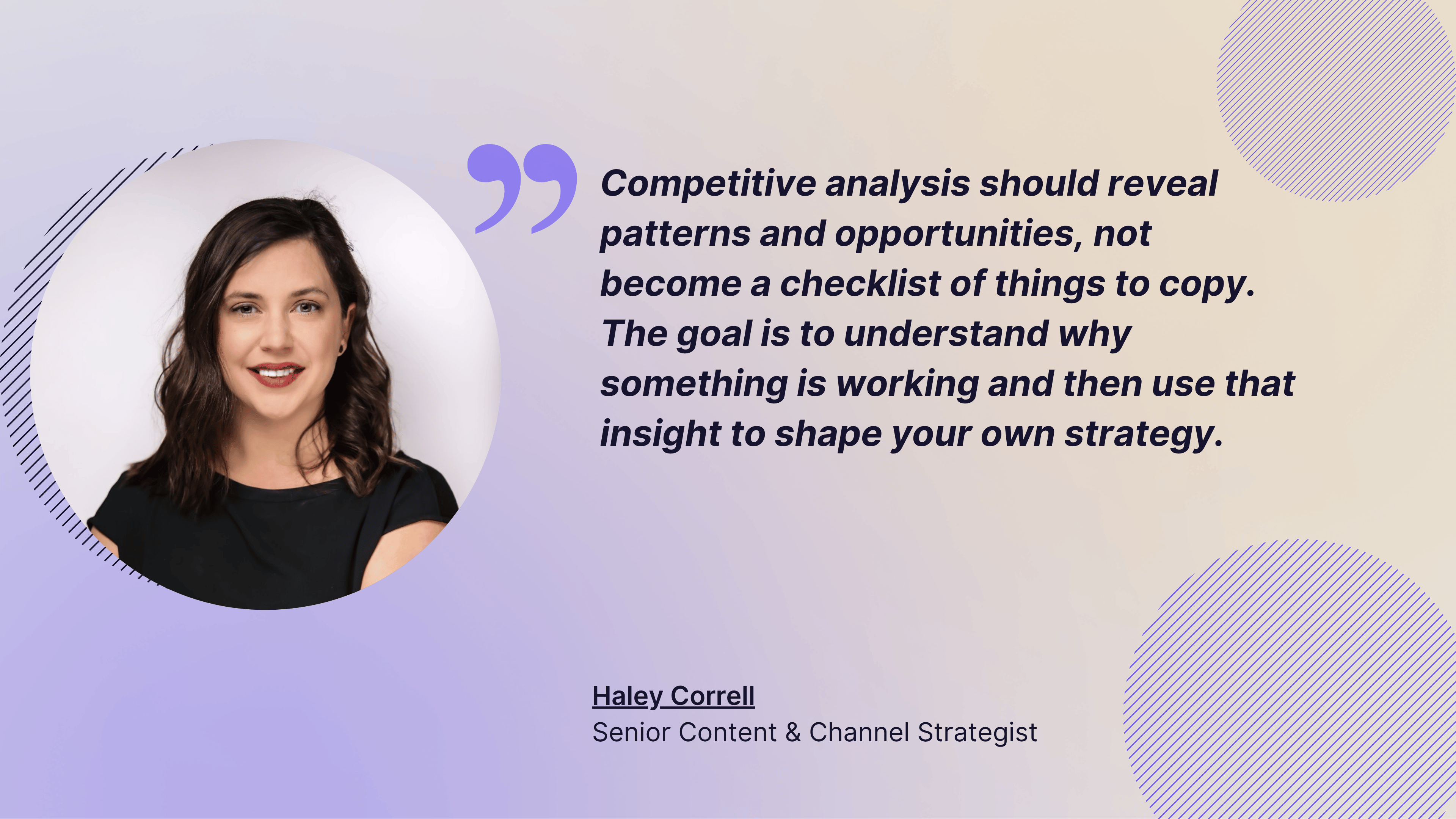
Competitive analysis should reveal patterns and opportunities, not become a checklist of things to copy. When you approach it that way, you’re always a step behind.
The goal is to understand why something is working and then use that insight to shape your own strategy.
- Tracking vanity metrics: Follower counts and likes might look impressive, but they rarely tell the full story. Instead, prioritize metrics that reflect real impact, like comments, shares, saves, and engagement rate, so your analysis leads to meaningful decisions.
- Ignoring smaller competitors: Some of the best insights come from smaller or emerging accounts. They often experiment more, move faster, and discover what works before larger brands catch on. If you only analyze big players, you risk missing early trends and fresh content approaches.
- Not analyzing comments: Some of the most real insights hide in the comments. That’s where you’ll find audience questions, objections, feedback, and sentiment. Ignoring this means missing out on understanding what your audience actually cares about and where you can create better, more relevant content.
Final thoughts
Competitive analysis works when it leads to action. Focus on spotting patterns across content, hooks, formats, and engagement signals, then translate those into clear decisions for your next posts.
Build around what consistently earns attention in your space and refine your positioning based on the gaps you uncover. I like to treat this as an ongoing system rather than a one-time task, where each round of analysis sharpens the next set of content decisions.
To make the entire process easier, subscribe to Socialinsider’s 14-day free trial and try the tool for your brand.
Nidhi Parikh
Nidhi Parikh is SaaS writer that believes scrolling through social media is research for work. When not working, find her binge watching the latest series or reading anything she can get her hands on.

Know what your competitors do — before your manager asks
Get instant social benchmarks & reports without manual work.
You might also like




Improve your social media strategy with Socialinsider!
Use in-depth data to measure your social accounts’ performance, analyze competitors, and gain insights to improve your strategy.