Best AI Tools for B2B Marketing in 2026 (How to Choose)
Discover powerful insights for AI in B2B marketing: real use cases, expert insights, and best practices to help your team move faster.
Okay, real talk: every B2B marketing tool on the market now says it's "AI-powered." It's basically the new "cloud-based." So if you're a head of social or a marketing lead trying to actually decide what to invest in this year, that label has stopped meaning anything useful.
I get why you're tired of this. You don't need another "50 AI tools for marketers" list where forty of them were built for ecommerce and got a B2B sticker slapped on the homepage last minute. What you actually need is a straight answer: what does AI in B2B marketing look like once you strip away the hype, how do you tell a real b2b marketing tool from a relabeled one, and which b2b ai tools are worth your team's time this year. That's what I want to walk you through here, job by job, not feature by feature.
Key takeaways
-
The best AI tools for B2B marketing are chosen by use case rather than ranked head-to-head, covering competitive and social intelligence, content strategy, lead scoring, ad targeting, and budget allocation.
-
Evaluating AI tools for B2B marketing means checking what the model was trained on, requesting real output instead of a feature list, and confirming the platform delivers interpreted insight rather than raw, aggregated data.
-
The most common mistakes when adopting AI tools for B2B marketing are automating every use case at once, treating AI output as final without human review, and choosing a tool based on its AI claim alone instead of its fit for long B2B sales cycles.
What AI in B2B marketing actually looks like in 2026 (beyond the hype)
A couple of years back, "we have AI" was enough of a pitch on its own. Nobody's impressed by that anymore, and honestly, you shouldn't be either. The real question now is whether a tool understands how B2B buyers actually behave, or whether it's a consumer tool that bolted on a chatbot and called it a day.
Here's the thing — the most useful AI in b2b marketing right now isn't loud about it. It's quietly running underneath your competitive tracking, your content calendar, your lead qualification, your forecasting. The teams doing this well don't even talk about "our AI strategy." It's just part of how the work gets done, the same way nobody calls Slack "our messaging strategy."
That's also why people are searching "ai in b2b marketing" differently than they used to. You're not Googling what AI can theoretically do anymore. You want the short list: which tools, for which job, and how do you tell the ones with real substance from the ones surfing the wave.
How to choose AI tools for B2B marketing — what to look for
Before I get into specific tools, let's talk about how to actually judge them — because as a social media leader, you're not buying for a B2C funnel, and a lot of AI tooling was built like you were.
Long sales cycles and multiple stakeholders change what "good" AI tooling looks like
A consumer AI tool gets to optimize for one clean, fast signal: did they click, did they buy. You don't get that luxury. Your deals run for months, five different people from the same account might count as "the lead," and there's rarely one tidy moment you can point an algorithm at and say "that's the conversion."
So when you're evaluating a b2b marketing tool, push on this directly: can it handle messy, multi-touch attribution without falling apart the moment a second stakeholder shows up? Does the insight it gives you actually help the rep who has the real conversation three weeks later, not just you? If a tool's AI was trained on single-session, single-buyer behavior, it's going to misread your funnel — not occasionally, constantly.
Why generic AI marketing tools often miss B2B-specific needs
Most "AI marketing" platforms started out solving for high-volume, fast-cycle problems — ecommerce personalization, social ad bidding, retail recommendations. Their models learned on that kind of behavior. Point that same model at your B2B funnel and the cracks show up fast.
You'll feel it in content recommendations that have no idea where your buyer is in a six-month evaluation, lead scoring that treats an email open the same as a demo request, or competitive intelligence built for tracking consumer brand chatter instead of how a competitor is shifting their positioning account by account. The best AI marketing tools for b2b are the ones built around this reality from day one, not a general-purpose AI tool with "for B2B" added to the landing page.
Best AI tools for B2B marketing, by use case
I'd rather not rank tools against each other in a vacuum — that kind of list rarely survives contact with your actual stack. So here's how I'd think about the best AI tools for b2b marketing instead: one job at a time, starting with the one I know best.
Competitive and social intelligence
If part of your role is staying ahead of what competitors are doing, this is the category where AI saves you real hours, not theoretical ones.

One of the simpler ways to start is a competitor content pillars analysis, which gives you a quick read on the themes and formats actually carrying their engagement, rather than eyeballing dozens of posts yourself.

And none of this is locked to a single network. Socialinsider lets you run the same kind of analysis across Instagram, TikTok, LinkedIn, Facebook, and the rest, side by side — so you're benchmarking your B2B brand against competitors on whichever platforms your buyers actually live on, instead of stitching together a separate view per channel every time. That cross-channel lens is what makes the comparison meaningful in the first place; a single-platform snapshot rarely tells you the full story of where a competitor is actually winning.
How B2B marketers are using AI for competitive intelligence
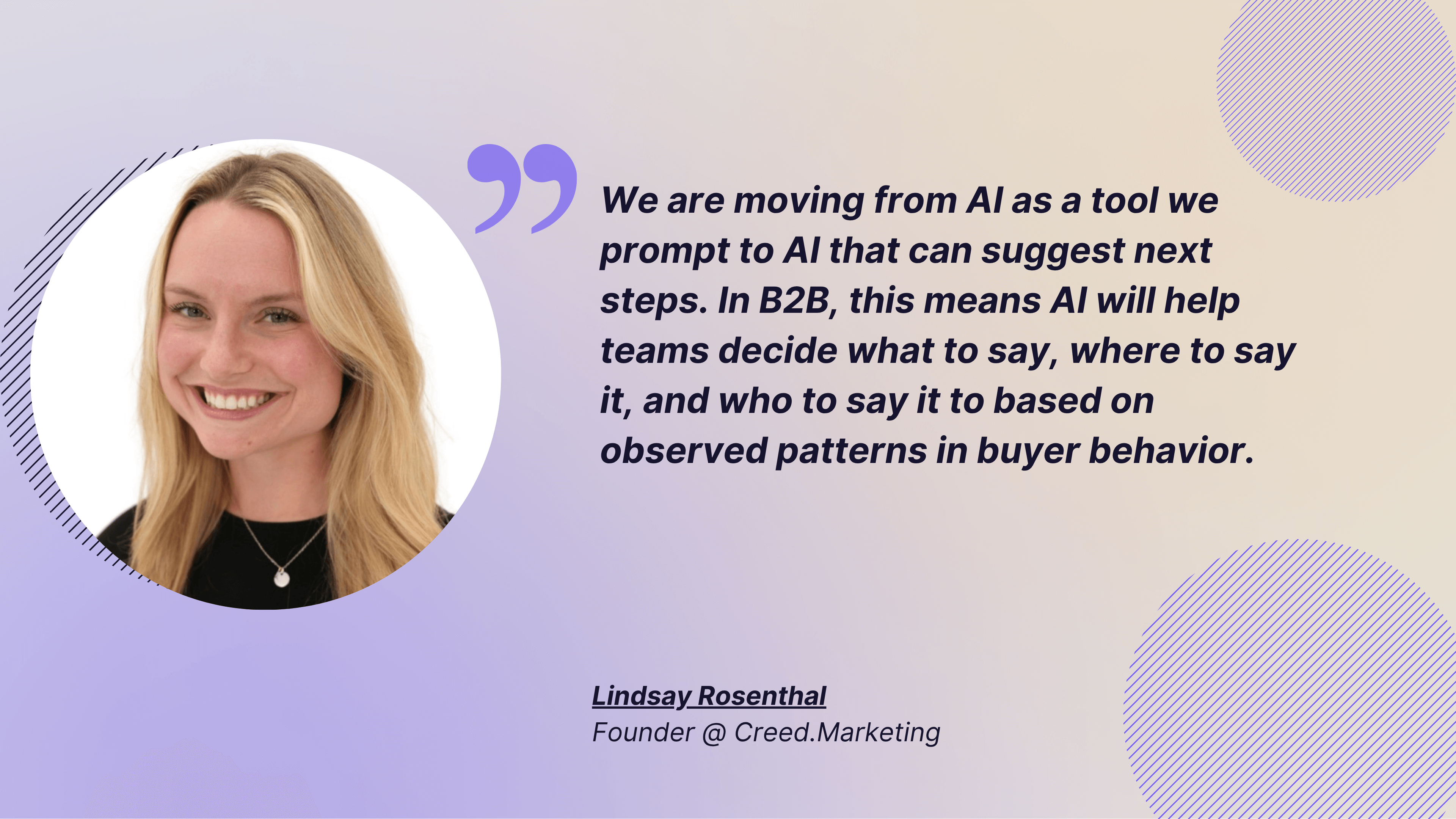
To make sure my theory matches practice, I asked Lindsay Rosenthal — B2B marketing expert and founder of Cred. Marketing — what's actually changing in competitive work right now, beyond faster reporting.
Her take:
AI is moving from something you prompt for an answer into something that proactively suggests the next move — where to focus messaging, who to talk to — based on patterns it's picking up in buyer behavior, with a human still checking the work before anything goes out.
That lines up with what I'm seeing in tools like Socialinsider's own dashboards. The output isn't "here's competitor X's engagement rate" anymore, it's closer to "here's what I'd do about that engagement rate." The habit worth building isn't really about the tool — it's treating AI-surfaced competitive insight as a starting point for a decision, not a report you skim once at 9am and forget by lunch.
Content strategy and ideation
Where AI actually earns its keep in content isn't drafting — it's telling you what to write about in the first place. The better b2b marketing tools here cluster what you've already published into pillars, show you which themes are genuinely pulling interest, and flag the content types where your competitors are winning, and you've gone quiet. That gap — what's working for everyone else and missing from your own calendar — is the part worth paying for.
How B2B marketers are using AI for content strategy
From what I've seen, this is the pattern that actually works: letting AI handle synthesis and scale — pulling research together, structuring outlines, surfacing what's performing across your content library — and keeping a person firmly in charge of tone and the parts of the story that only come from a real customer conversation, not a pattern match.
Here's Lindsay's advice as well:
Keep real customer input as your base, keep a human editor for tone and judgment, and make sure what you publish sounds like how your buyers actually talk, not just what reads well in a doc.
Honestly, from our chat, if I were to sum up what her bet is regarding next practices for AI in B2B marketing, it would be this: the content that resonates in 2026 will be the content that reads the least like it came out of an AI workflow. Which, honestly, is a good filter to run your own process through, too — not just the tools you're buying.
Lead scoring and prioritization
This is one of the easiest ROI cases to make to your CFO. AI reads behavioral signals — downloads, email engagement, site visits, social interaction — and predicts which leads are actually worth a rep's time. Done well, your team stops chasing every whitepaper download with the same urgency and starts focusing on the accounts that behave like your best existing customers. After identifying high-intent prospects, an AI appointment setter can automatically qualify them further and schedule meetings with the sales team, helping reduce manual work and improve conversion rates.
Ad targeting and personalization
AI-driven targeting keeps refining your audience segments off real engagement instead of static demographic guesses, and keeps shifting spend toward what's actually converting. For a B2B team, the win is speed: you catch a shift in what's working before your next quarterly review would have caught it.
Resource and budget allocation
This one's less flashy, and probably the highest-leverage use case on this whole list. AI helping you decide where your limited hours and budget actually move the needle, instead of defaulting to "what we did last year." In practice, that looks like AI cutting the research-to-publish timeline on data-heavy content, or forecasting tools flagging a pipeline problem mid-quarter instead of after the numbers already came in.
How to evaluate AI tool claims before you buy
Every vendor pitch in this space sounds basically the same — more accurate, more predictive, more "intelligent" than whatever you're using now. A few questions cut through that fast.
- Ask what the model was actually trained on — a tool that started as ecommerce personalization and added "B2B" to the homepage isn't the same as one built around B2B buying patterns from the start, no matter how similar the pitch sounds in the demo.
- Ask to see real output, not a feature list — a live demo on your own data (or something close to it) tells you more in ten minutes than an hour of slides ever will; if a vendor hesitates to show unpolished output instead of a cherry-picked screenshot, that's worth noting.
- Check whether you're getting interpreted insight or just aggregated data with a nicer chart — a lot of "AI-powered" dashboards are well-organized raw numbers with an AI sticker on the box; the tools worth your budget tell you what the number means and what to do next.
And, as Lindsay Rosenthal said:
Look past how shiny the tool is and judge it against what actually moves your specific goals — not the goals the demo was clearly built to flatter.
Common mistakes when adopting AI tools for B2B marketing
Here's the mistake I see most often: trying to automate everything at once instead of picking one or two high-ROI, low-complexity use cases first. Competitive benchmarking and content performance tracking are usually the easiest place to start — they prove value fast, without forcing you to rebuild your whole stack before you've seen a single win.
The second: treating whatever the AI hands you as final. A content outline, a lead score, a competitive summary — all of it needs a person checking whether it actually held up, then feeding that back in. Skip that step and you're just handing your budget to a black box and hoping.
The third: buying a tool for the AI claim alone, without checking whether it was actually built for long sales cycles and multiple stakeholders. That's the exact gap I covered above, and it's where most "generic AI marketing tool" purchases quietly fail the second they hit a real B2B funnel.
The teams getting real value out of AI in b2b marketing this year aren't the ones running the most tools. They picked a short list of the best AI tools for b2b marketing, each one tied to a specific job, and they kept a person checking the output every step of the way.
If you want to see what AI-interpreted competitive intelligence actually looks like on your own data, try Socialinsider free for 14 days — no access needed from the competitors you're tracking, and up to four years of history to tell a real trend from noise.
Final thoughts
Remember, none of this is really about chasing more AI. It's about picking the few tools that solve a real problem you have right now — competitive blind spots, a content calendar running on guesswork, leads your team's wasting time on — and trusting them just enough, not completely. The best ai tools for b2b marketing aren't the ones doing the most; they're the ones doing one job well, with a person still in the loop checking the output.
If you only take one thing from this: don't buy the AI claim, buy the fit. A tool built for your sales cycle and your stakeholders will outperform a flashier one built for someone else's funnel, every time.

Elena Cucu
As Content & SEO Manager at Socialinsider, Elena Cucu helps social media leaders make sense of the numbers behind their performance. Featured in TechCrunch, TNW, and ReadWrite.

Know what your competitors do — before your manager asks
Get instant social benchmarks & reports without manual work.