2026 TikTok Benchmarks
From engagement data to posting frequency and follower growth analysis, these TikTok benchmarks will help you better understand TikTok's potential for your brand.

TikTok has never been easy to figure out—but lately, it’s become even harder to predict.
What used to work consistently now delivers mixed results. And if you’ve been managing a brand account for a while, you’ve probably felt it too—that subtle shift where performance becomes less about doing more, and more about doing things right.
I’ve seen this play out across multiple accounts and industries. Content is getting better. Faster. More aligned with trends. And yet, at the same time, visibility feels more uneven, growth less predictable, and results harder to replicate without a clear system behind them.
That’s exactly where Socialinsider’s TikTok benchmarks report, covering the analysis of more than 2M TikTok posts, comes to offer some guidance.
By analyzing the latest trends in engagement, views, posting frequency, follower growth and more, I wanted to understand what’s actually changing beneath the surface. Because here’s the thing. TikTok hasn’t become less effective—it’s just become more demanding. And if you don’t adjust your strategy to match that shift, it’s very easy to fall behind without even realizing it.
Executive summary
- Over the first half of 2026, TikTok engagement rate by views is stands at an average of 3.85%.
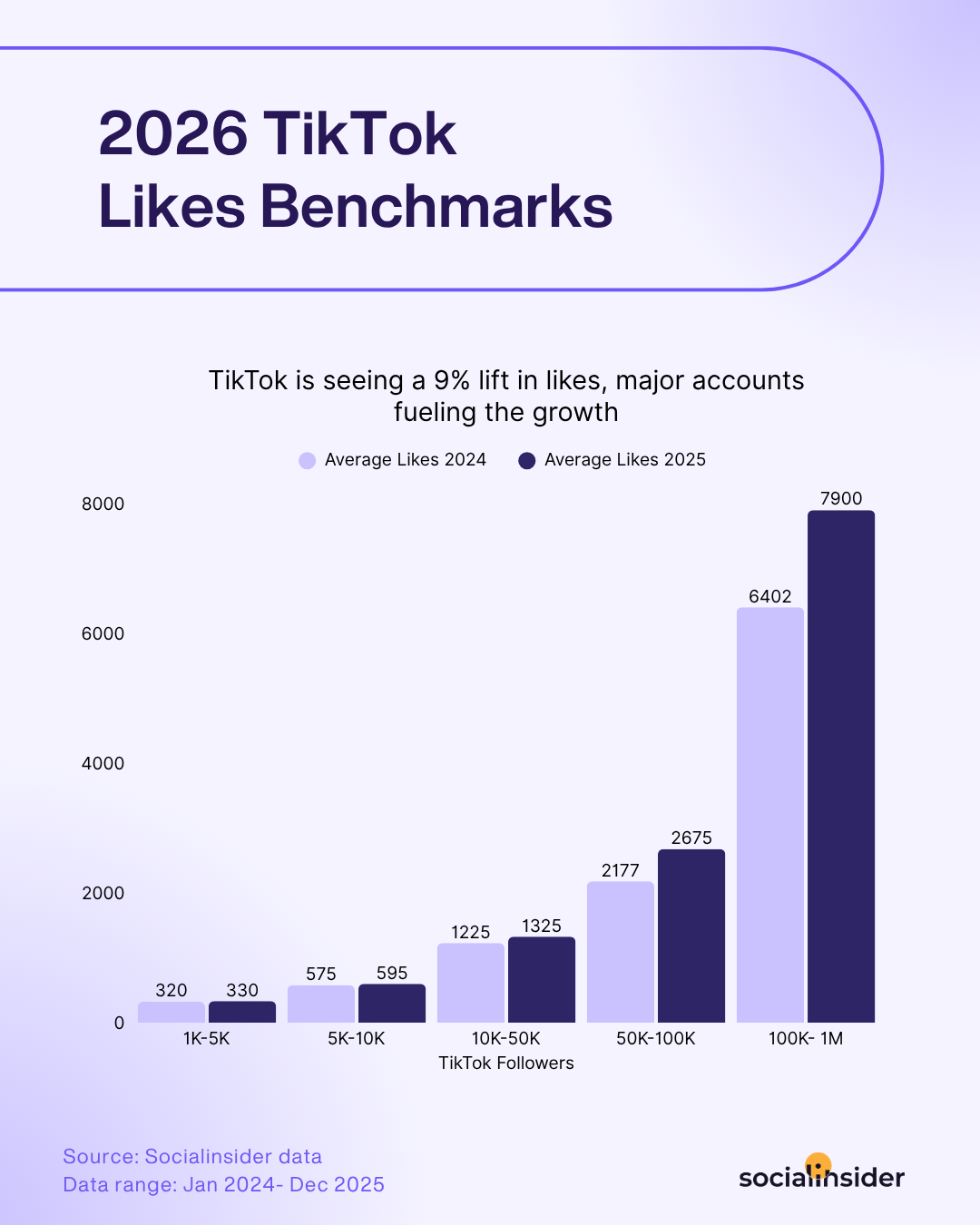
- TikTok is seeing a 9% lift in likes, with major accounts fueling the growth
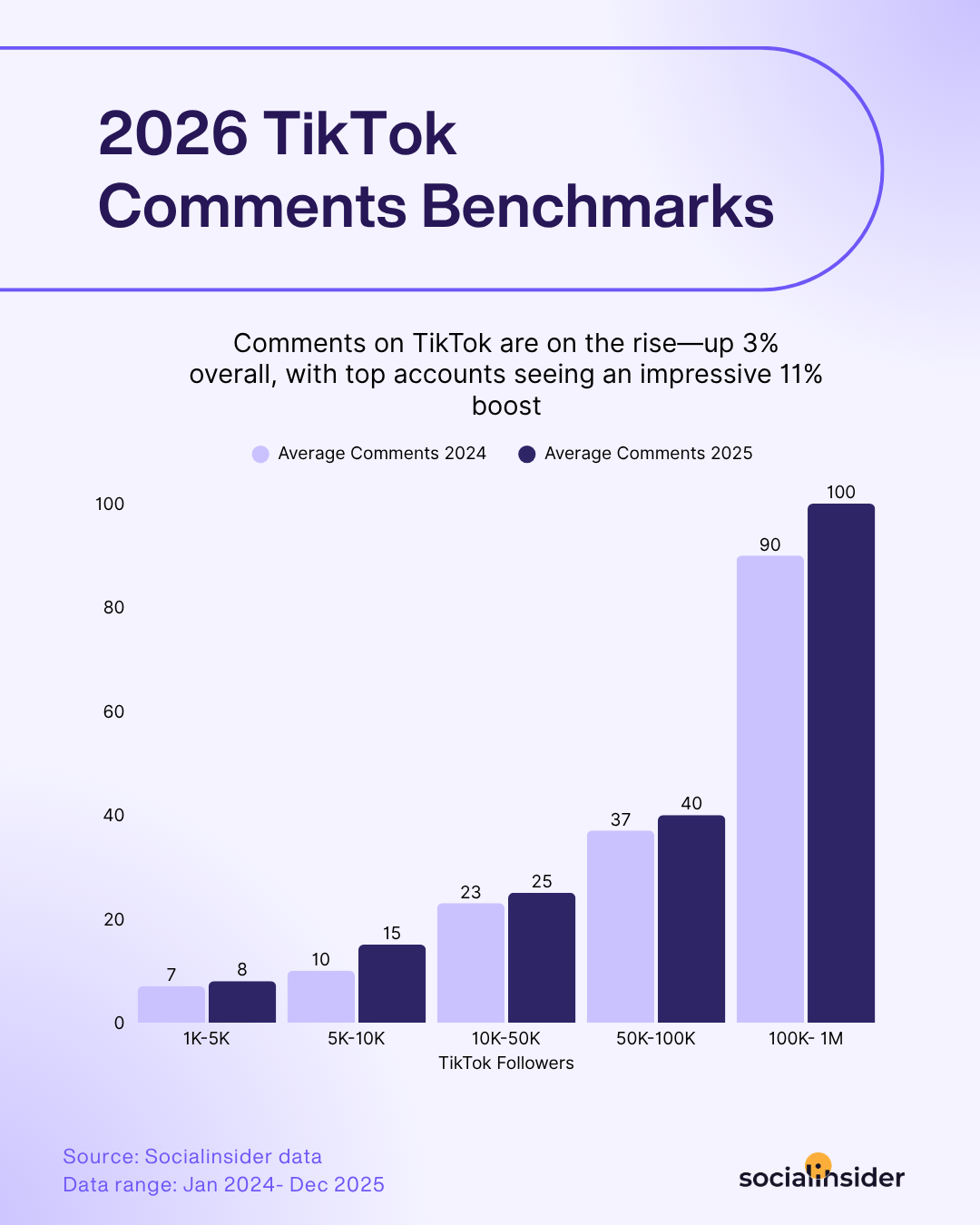
- Comments on TikTok are on the rise—up 3% overall, with top accounts seeing an impressive 11% boost.
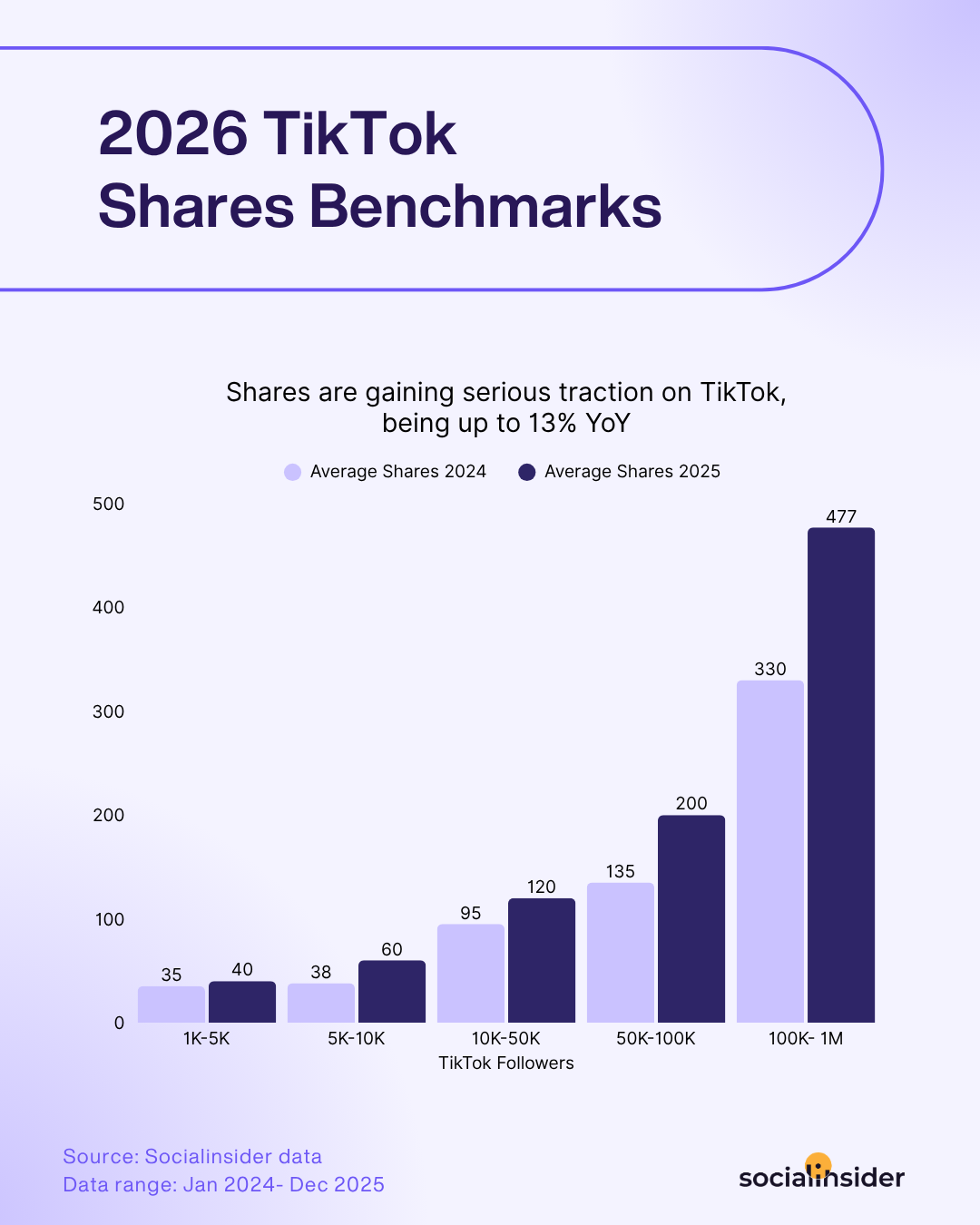
- Shares are gaining serious traction on TikTok, being up to 13% YoY, and a standout 44% growth for the largest accounts.
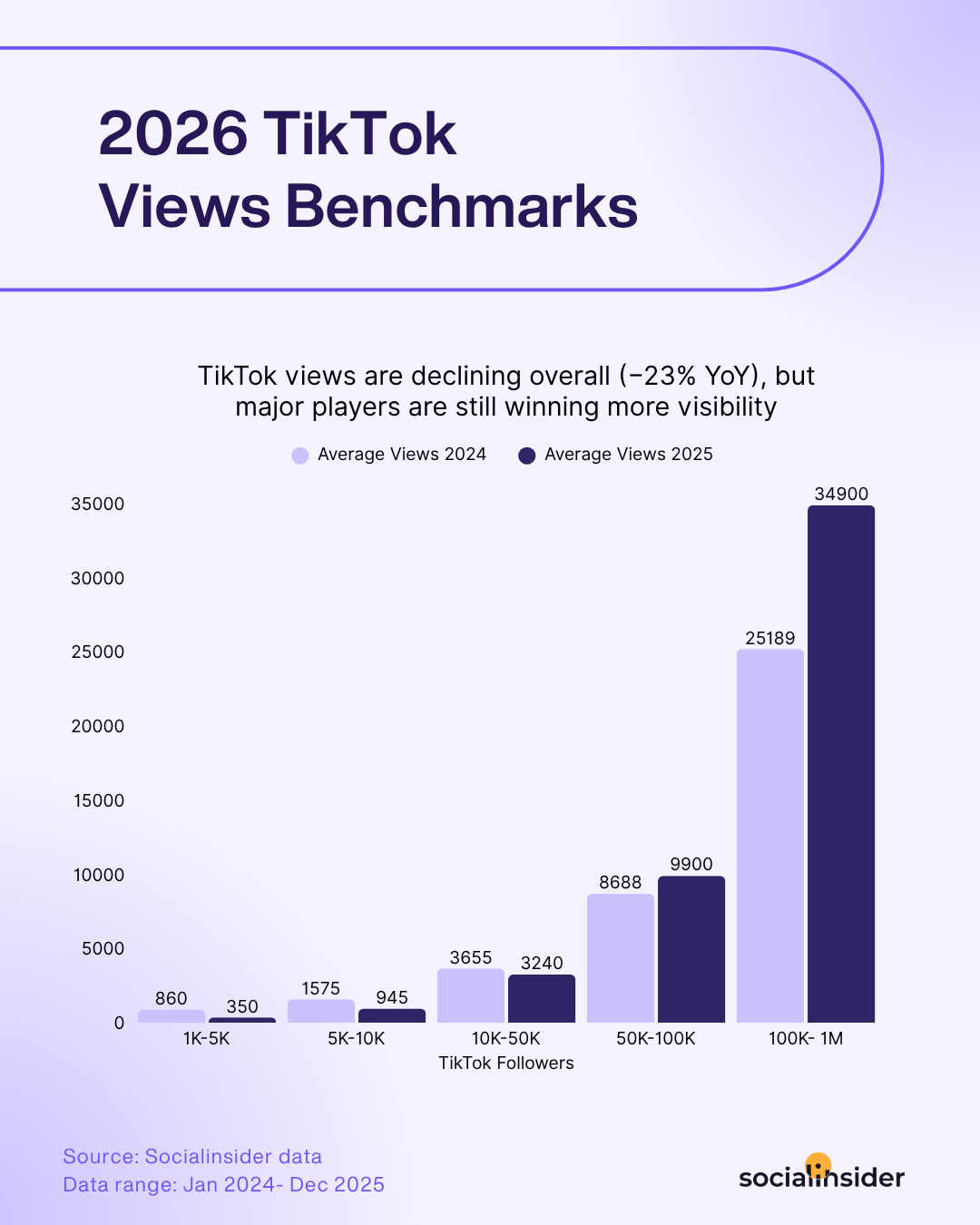
- TikTok views are declining overall (−23% YoY), but major players are still winning more visibility
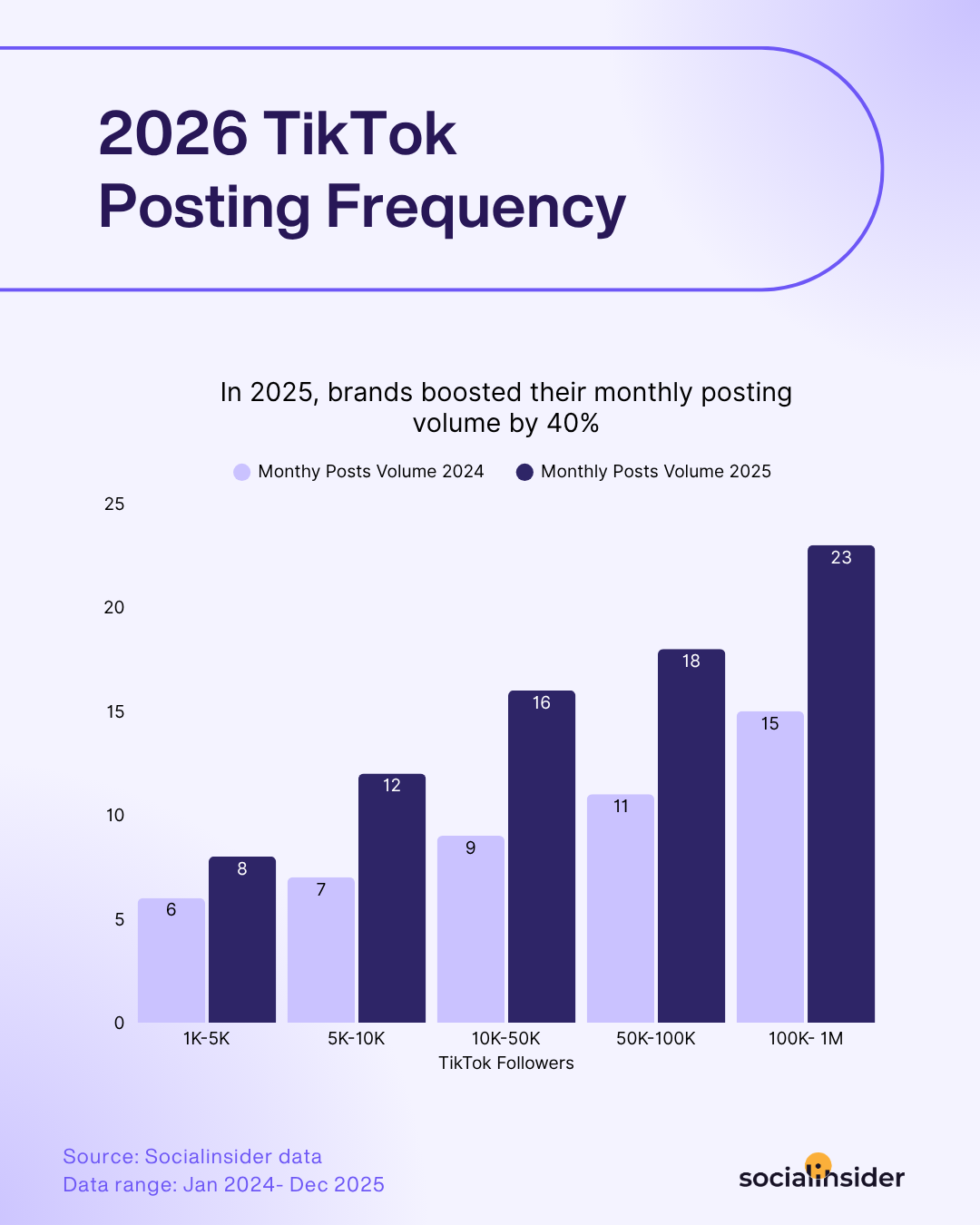
- In 2025, brands have boosted their posting frequency by 40%
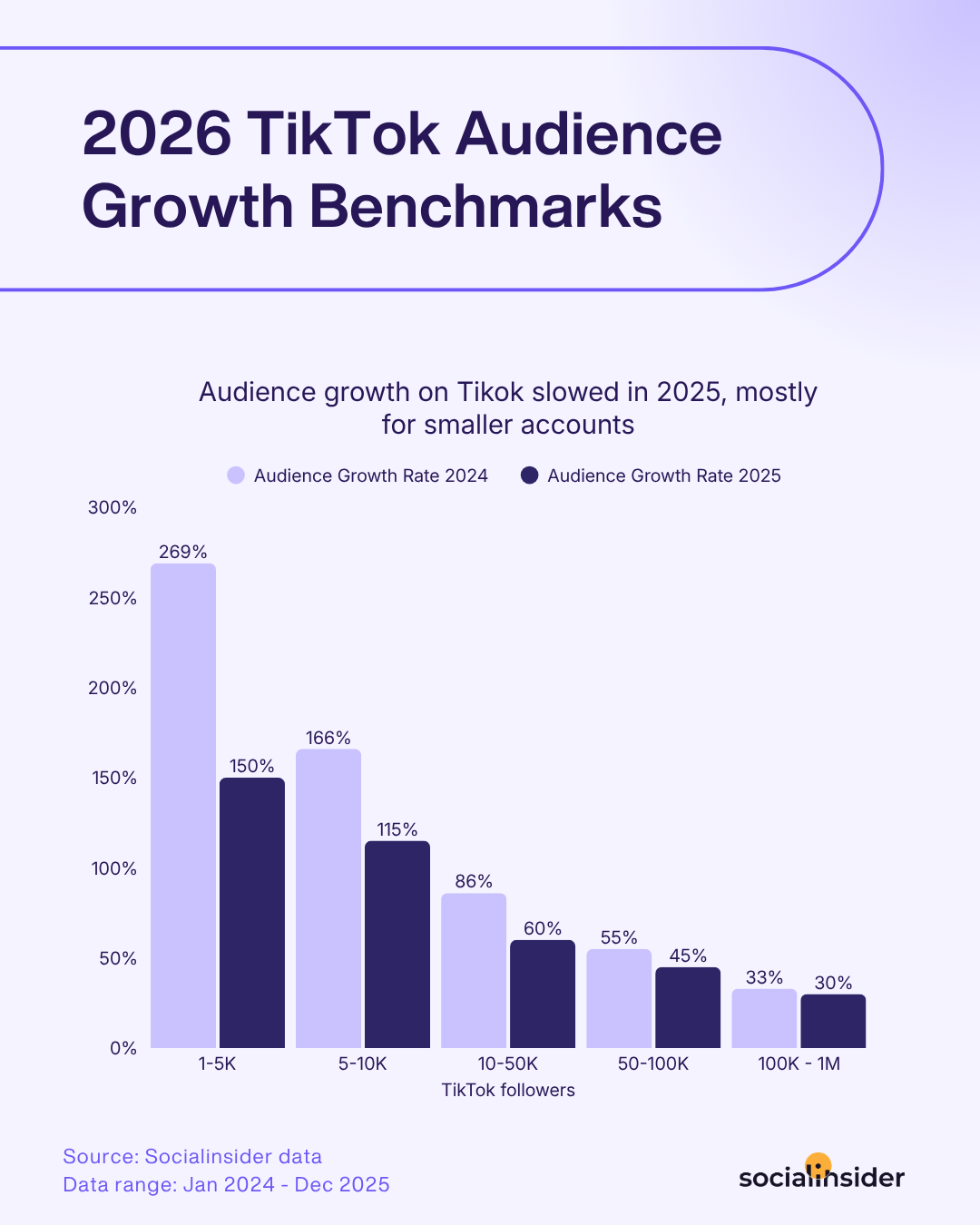
- There’s a 33% decrease in audience growth on TikTok, with the smallest accounts being the most impacted.
TikTok quarterly benchmarks
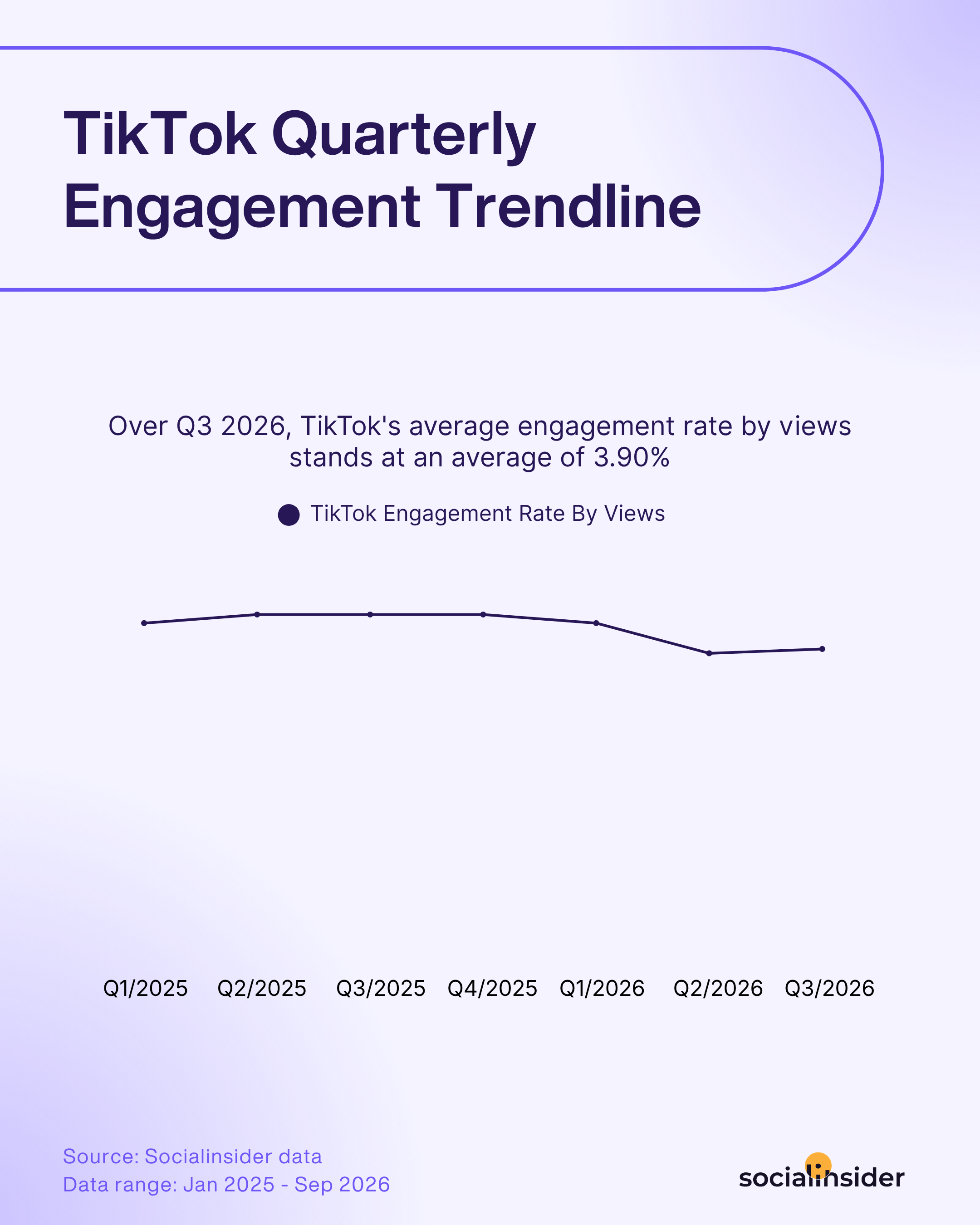
In the first half of 2026, TikTok's engagement by views entered a decreasing phase, after remaining mostly flat throughout 2025. However, during Q3 2026, it went back on an ascending trend, reaching an average of 3.90%.
Would the next quarter be a turning point in TikTok's impact over the new generation of consumers? I guess only time will tell.
TikTok engagement benchmarks by views
If there’s one thing I’ve learned after analyzing tiktok engagement benchmarks year after year, it’s this: engagement on TikTok doesn’t stand still. It shifts quietly—and if you’re not paying attention, you miss the moment when “good” becomes “average.”
That’s exactly what’s happening here.
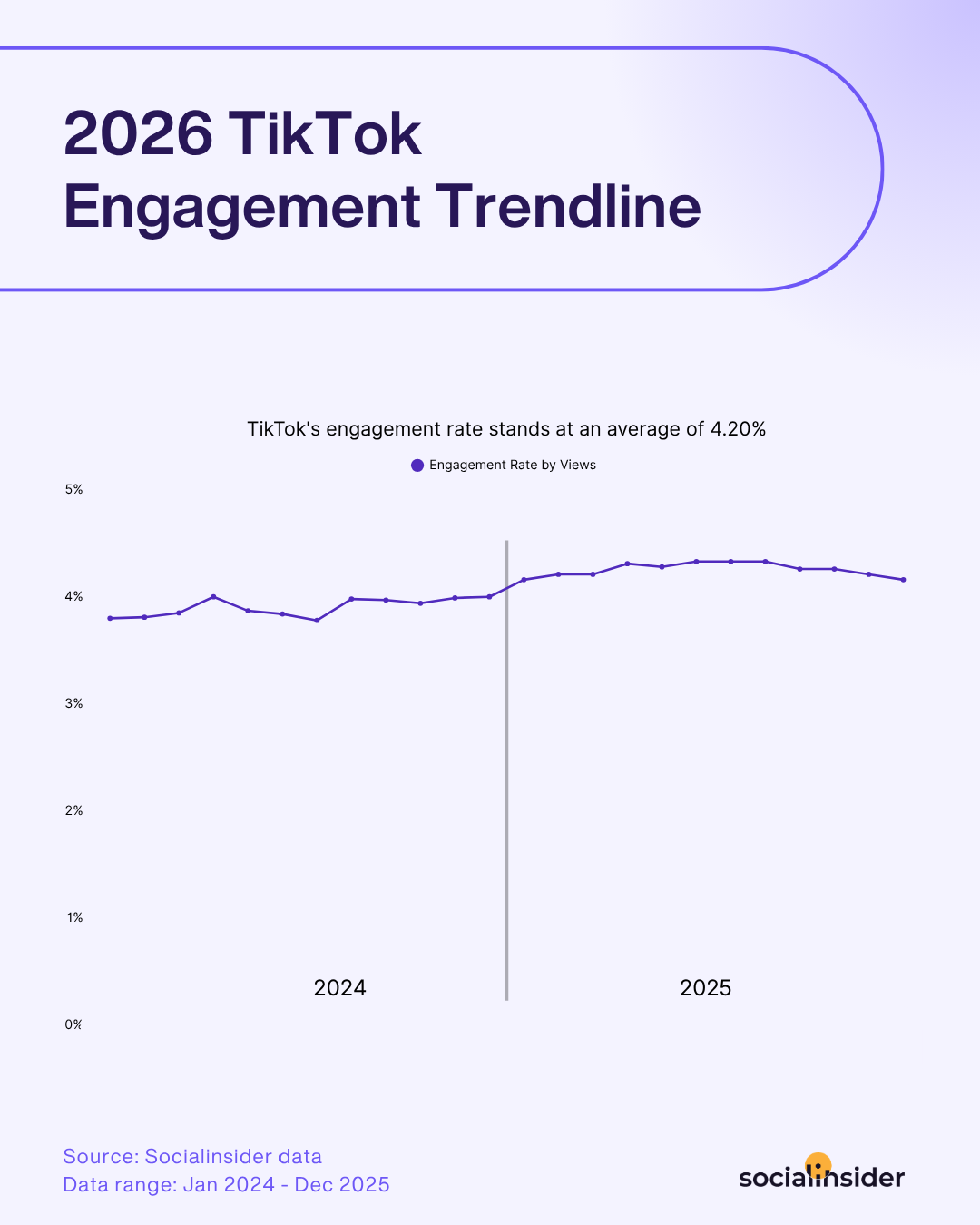
At a platform level, Tiktok's engagement rate by views has increased from 3.85% in 2024 to 4.20% in 2025, scoring a 9% YoY increase. Now, that might look like a small jump, but in reality, it signals a bigger behavioral shift. Audiences are engaging more—but they’re also expecting more. The content that wins today is sharper, faster, and way more intentional.
TikTok's algorithm is just genuinely better at closing the gap between people and content they actually care about.
This means even if there's more content competing for attention, the right content still finds the right people. It doesn't feel like discovery, it feels like the platform already knows you.
There's also something in how people use TikTok versus other platforms. They're not just scrolling for entertainment anymore — they're searching for answers, communities, opinions. - Chris Sheen, Director of Social, Celonis
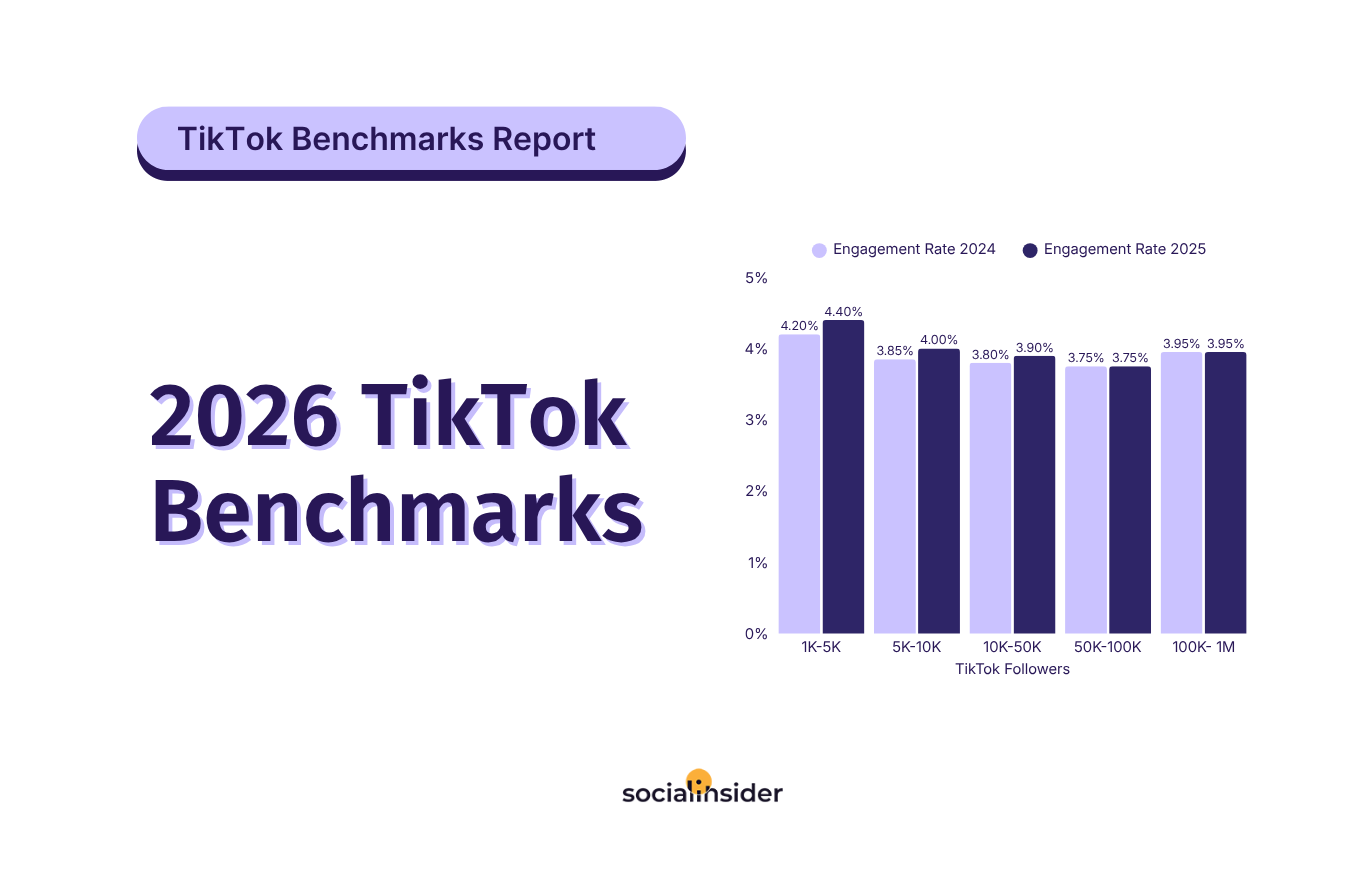
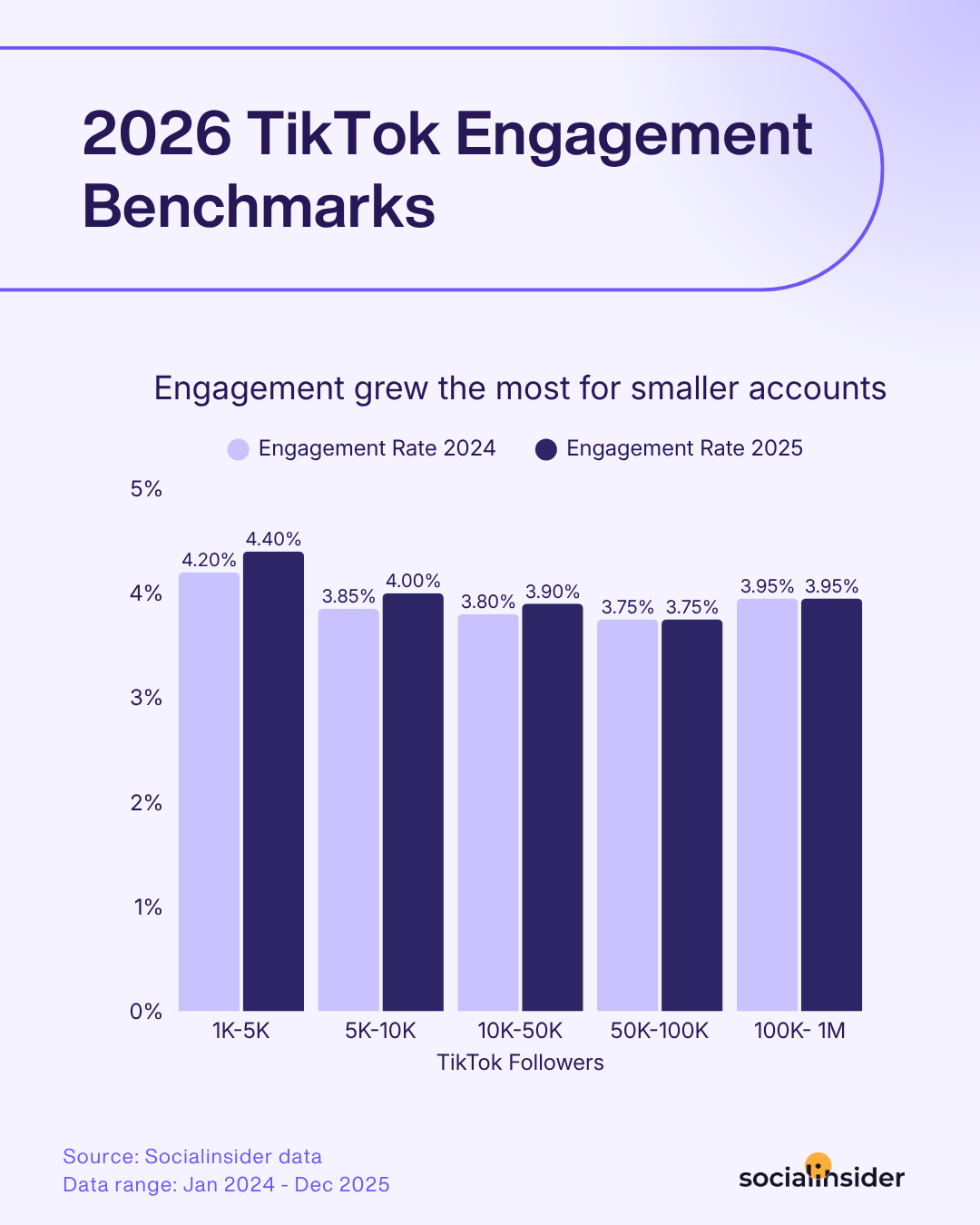
When I dug deeper into the numbers by page size, a familiar pattern showed up— that smaller accounts (1K–5K followers) are leading the pack, climbing from 4.20% to 4.40%. Personally, I’ve seen this play out over and over—and that’s because smaller accounts are closer to their audience, quicker to jump on trends, and less restricted by internal approvals. But once you move beyond that tier, engagement starts to plateau.
And here’s a valuable lesson for brands: engagement isn’t something you “carry” with you as your follower count grows—it’s something you have to constantly re-earn. As you scale, content has to work harder to feel just as relevant, just as native, just as worth interacting with. That’s why bigger audiences don’t automatically translate into higher engagement—relevance does.
Strategic tactics to get a higher TikTok engagement rate
- Design content for interaction, not just consumption: Before posting, ask: “What will make someone react to this?” Add hooks that invite opinions, leave questions unanswered, or create small moments of tension. This is how you lift performance within tiktok engagement rate benchmarks without needing more reach.
- Bring creators or internal faces into the content: As accounts grow, content often becomes more “brand-like” and less human. Introduce faces—creators, team members, founders. It instantly increases relatability and helps maintain engagement as you scale.
- Turn top-performing posts into repeatable series: If a video drives strong engagement, don’t move on—double down. Create variations, follow-ups, or recurring formats. This helps you maintain consistency and avoid drops
TikTok’s average likes per post
After seeing how TikTok’s engagement benchmarks evolved, one thing became clear: while engagement tends to plateau as accounts grow, raw interactions tell a slightly different story.
Likes, in particular, show steady and predictable growth as accounts scale, with that consistency clearly showing up in Socialinsider’s data.
As for insights that drew my attention, I would also mention that every audience segment saw an increase in likes from 2024 to 2025, the overall YoY growth located at an average of 9%. From smaller accounts to larger brands, average likes per post are consistently moving upward, reinforcing the idea that as visibility expands, so does this type of interaction.
However, there’s an important nuance here.
While likes are a strong signal of reach, they don’t always reflect how deeply content resonates. They’re easy, immediate, almost instinctive—which makes them valuable for measuring exposure, but less reliable when it comes to understanding true engagement depth.
Strategic tactics to get a higher number of likes on TikTok
- Front-load emotional or visual payoff: Likes often happen instantly. If the value or emotional trigger comes too late, you lose that interaction. Move your strongest moment into the first 2–3 seconds.
- Use high-like content as a reach lever: Content that generates a lot of likes is often your best bet for expanding visibility. Use it strategically to attract new audiences, then follow up with content designed to convert that attention into engagement.
- Use contrast to trigger reactions: Before/after, right/wrong, myth/reality—contrast-driven content tends to get quick engagement. It gives viewers a clear reason to respond without overthinking.
TikTok’s average comments per post
If likes are easy to earn, comments are where things get real. This is the metric that shows whether your content actually triggered a reaction—not just a quick tap.
According to Socialinsider’s data, the average number of comments on a TikTok video increased across every single page size from 2024 to 2025. No exceptions. And get this, while across the board the increase reflects a change of about 3%, the largest accounts (with more than 100K followers) even hit the 100 comments mark, scoring an 11% climb.
These aren’t just incremental gains—they suggest that brands are getting better at creating content that invites participation, not just passive interaction.
But unlike likes, comments don’t scale as easily. Truthfully, the growth is more uneven and far more dependent on how content is structured. That’s because comments require intent. More thought. More emotional investment.
In other words, comments start to pick up when content truly feels relevant.
What’s driving higher comment activity on TikTok is that comments no longer sit beneath the content, but act as an extension of it. Smart brands treat comments as content, but users do too: they use them to add jokes, context, opinions, and community signals. In a post-Twitter social landscape, where X can feel risky for brands and Threads still lacks some of the publishing tools marketers value, TikTok’s comment section has now filled that gap as a prime space for fast, witty, reactive copy. More than a passive engagement signal, comments are becoming an active part of the content strategy. - Mark Sphungin, Social Media Strategist
The honest answer to sparking meaningful conversations is: stop trying to start conversations and start joining them.
The brands doing this well aren't broadcasting. They're reacting, responding, and showing up in comment sections like actual humans.
Beyond that, open loops work well. Unfinished stories, "what would you do?" setups, genuine asks for input. People don't comment to complete a thought - they comment because they feel something or because they can't help themselves. - Chris Sheen, Director of Social, Celonis
Strategic tactics to get a higher number of comments on TikTok
- Use relatable pain points to trigger responses: People comment when they feel seen. Call out specific struggles, frustrations, or “this is so me” moments—those tend to spark immediate reactions.
- Ask for opinions, not actions: “Drop a comment” doesn’t work. But asking “Do you agree or not?” or “Which one would you pick?” does. Frame your content around decisions, not instructions to drive more comments on TikTok
- Test question placement (start vs. end): I’ve seen big differences just by moving the question. Sometimes asking in the first 3 seconds drives more comments, other times placing it at the end works better. Test both intentionally.
TikTok’s average shares per post
Shares have quietly become one of the most important metrics on TikTok—and not just for reach, but for trust.
When someone shares your content, they’re not just interacting with it—they’re endorsing it. They’re saying, “this is worth someone else’s attention.” And that shift matters. Because in a crowded feed, trust is what drives amplification.
Looking at the Socialinsider data, it quickly becomes evident that shares are climbing across the board from 2024 to 2025 (up to 13%)—but not at the same pace. The growth starts off steady, almost easy to overlook… and then it picks up speed. The larger the account, the sharper the increase, turning what looks like a trend into something much more momentum-driven.
This becomes especially clear in the top tiers.
Accounts between 50K–100K followers jump from 135 to 200 shares per post. And for brands with 100K–1M followers, the increase is even more striking—from 330 to 477 average shares per tiktok video.
Now, when talking about shares, it’s important to understand what actually drives them. Sharing only happens when content delivers transferable value—something worth passing on. And once that kind of value is in place, distribution starts to feed itself. What begins as engagement quickly turns into amplification.
The kind of content that is most likely to be shared on TikTok today is increasingly long-form content as part of an ongoing series. Much like how audiences eagerly wait for the next episode of their favorite TV show to drop, viewers on TikTok are now returning in the same way, waiting for the next installment from the brands they follow. - Melody Doffman, Social Media Manager, Nestlé
Strategic tactics to get more shares on TikTok
- Turn niche insights into shareable assets: Hyper-specific content often gets shared more than broad advice. Why? Because it feels personal. The more niche your angle, the more likely someone is to think of exactly one person to send it to.
- Use curiosity gaps to encourage sharing: Content that feels incomplete or intriguing (“wait, you have to see this”) naturally gets passed along. Tease just enough to make people want a second opinion.
- Pair shareable content with follow-ups: When a post spikes in shares, quickly release a follow-up (Part 2, response, deeper dive). This helps you capture and extend the distribution wave.
TikTok’s average views per post
After seeing steady growth across engagement, likes, comments, and shares, you’d expect the same pattern when looking at the average views per TikTok video, right?. However, that’s not what the Socialinsider data shows.
Looking at the latest TikTok views benchmarks, a clear divide starts to emerge: while smaller accounts are losing ground (scoring an average of 23% decrease in their average TikTok views gained), on the other end of the spectrum, the trend flips.
So what explains this split?
From what I’ve seen, this comes down to how competition and content maturity are evolving on the platform.
There’s simply more content than ever. And as volume increases, breaking through at the lower tiers becomes harder. Smaller accounts are competing in a much more crowded space, often without the consistency, testing cycles, or content systems that larger brands have already built.
At the same time, bigger accounts benefit from momentum.
Not just in terms of followers, but in terms of proven formats, audience signals, and repeated performance patterns. The algorithm has more data to work with—and that increases the chances of content being distributed further, faster.
So while TikTok still rewards relevance, visibility is becoming more uneven.
And that’s the shift: it’s no longer just about creating good content—it’s about competing in a more saturated, performance-driven environment where scale amplifies your chances of being seen.
Smaller brands need to stop trying to compete on volume or production and start competing on relevance.
As reach becomes more selective, every piece of content has to earn attention. That comes down to creating strong hooks in the first few seconds, keeping ideas clear and easy to follow, and speaking to a specific audience rather than trying to appeal to everyone.
The brands that are still growing are the ones treating TikTok less like a content calendar and more like a testing platform. And once something works, they double down on it instead of constantly starting from scratch. - Tola Janus, Freelance Social Media Manager
Strategic tactics to get more views on TikTok
- Build “pattern recognition” for the algorithm: Consistency in formats, topics, and posting style helps TikTok understand your content faster.
- Focus on retention, not just reach: High views come from videos that people watch through. Tight editing, faster pacing, and removing filler can significantly improve your average tiktok views per video.
- Balance consistency with experimentation: Larger accounts win because they’ve found repeatable systems—but they also test constantly. Keep ~70% proven formats, 30% experimental content.
TikTok posting frequency benchmarks
As visibility becomes harder to secure and competition continues to rise, brands are starting to adjust to a new landscape, which is visible in how content strategies are evolving.
Posting is no longer just about consistency or staying active. It’s about increasing your chances of being seen. And that shift is reflected clearly in the data, with posting frequency increasing by 40% on average across every single page size from 2024 to 2025.
But here’s something you should know: they’re not just posting more randomly—they’re building volume with intent. Because here’s the reality: on TikTok, consistency isn’t enough anymore. Frequency is becoming a competitive advantage.
But there’s a catch.
More content doesn’t automatically mean better performance. If anything, it raises the bar. The more you post, the more disciplined you need to be with quality, structure, and iteration.
Which is why the brands increasing their posting frequency—and actually seeing results—are the ones treating content like a system, not a one-off effort.
Increasing frequency is really about finding the balance between visibility and value. There’s no point posting every day if the quality drops - audiences don’t reward volume, they reward relevance. One strong post will always outperform a rushed one. - Malene Hold, Senior Manager Social & Content, MCoBeauty
On a platform like TikTok, where performance can vary massively from one video to another, that volume of testing becomes a real advantage. The more you post, the faster you understand what resonates with your audience.
The problem is when brands increase frequency without changing anything. Posting more of the same content won’t improve results, it will just repeat them. But when posting more is paired with testing different hooks, formats, and angles, it accelerates learning over time.
When done right, it’s one of the fastest ways to figure out what content actually works for your audience. - Tola Janus, Freelance Social Media Manager
Strategic tactics to improve your posting strategy
- Increase volume—but do it with structure: Don’t just post more randomly. Define 3–5 content pillars and scale within them. This keeps your output aligned while increasing your chances within tiktok benchmarks.
- Build a repeatable content system: The brands hitting 15–20+ posts per month aren’t starting from scratch every time. They rely on formats, series, and templates that can be reused and adapted quickly.
- Batch content creation to reduce friction: Instead of creating daily, produce multiple videos in one session. This helps maintain consistency without burning out your team.
TikTok follower growth rate benchmarks
Follower growth is starting to show a different kind of shift—one that goes beyond TikTok. Across most major social platforms, growth rates have been slowing down, and TikTok is no exception.
Socialinsider’s TikTok follower growth benchmarks show that every segment saw a decline from 2024 to 2025. On average, there’s a 33% decrease tendency, but the drop isn’t evenly distributed - smaller accounts are feeling it the most.
Growth on TikTok isn’t what it used to be. These days, TikTok is a lot pickier about which videos it promotes. Instead of simply boosting anything that gets views, the algorithm now focuses on whether people actually stick around to watch—and if they’re truly engaging with the content, like watching until the end.
On top of that, there’s more competition than ever. Even great videos have to fight to stand out. Instead of going viral from one lucky post, creators now grow by consistently connecting with their audience and finding their niche.
This means that content has to be more strategic - thinking about hooks, storytelling and even SEO. And that’s where smaller accounts often struggle, as they’re either exploring these for the first time or still figuring out those fundamentals. - Sophie Hill, Social Media Manager, Burgerism
While small to mid-sized accounts scored a growth rate decrease of around 50%, the data indicated that as accounts grow, the decline becomes less aggressive. And there’s a reason for that.
As platforms mature, growth doesn’t come as easily. People are still engaging with content—but following has become a more deliberate action.
Which changes the game. Because growth on TikTok is no longer just about getting attention—it’s about converting visibility into long-term audience.
I do believe that TikTok has shifted from a distribution-led model where content was widely pushed to discover hits to a filtration model that tests content in small, highly targeted cohorts and only scales what demonstrably outperforms.
This, combined with content saturation and more selective user behaviour, means that “good” content is no longer sufficient; only content that delivers strong early retention, clear niche relevance, and high-intent engagement (such as shares and saves) earns broader reach.
While TikTok still offers greater organic discovery potential than platforms like Instagram or YouTube, success increasingly depends on strategic execution, repeatable formats, and a deep understanding of audience and algorithm dynamics rather than relying on virality alone. - Sophia Cavallari, Freelance Social Media Manager
Strategic tactics to boost your following on TikToK
- Track follows per video, not just total growth: Look at which posts actually drive followers. That’s where your real growth engine is—not just in views or likes.
- Avoid “viral-only” thinking: Chasing views without a clear content direction often leads to low conversion. A smaller, more targeted audience will grow your account faster over time.
- Create “bingeable” content journeys: Think beyond individual posts. Make your content easy to consume in sequence so that new viewers naturally watch multiple videos—this increases follow likelihood.
Methodology
The dataset used to uncover these TikTok benchmarks consisted of 2M TikTok videos coming from 214.507 TikTok profiles that had an active presence on TikTok between January 2024 - December 2025.
TikTok engagement rate by views: it is calculated by adding the total interactions of Tiktok posts (including likes, comments, shares and saves) divided by the number of views gained within the selected timeframe and multiplied by 100.
Average likes per post represents the number of likes a post receives on average.
Average comments per post represents the number of comments a post receives, on average.
Average shares per post stands for the average number of shares a post receives, on average.
The average follower growth rate is calculated as the number of followers you gained divided by the number of followers you started with and multiplied by 100.
NOTE: This study contains 2025 values, presented as 2026, because, at the time of publication, there wasn't enough data for analysis, with the year just starting. That is why we bring quarterly updates, as the year unfolds and more data is available.
Get in-depth TikTok performance metrics
Run an insightful TikTok analysis and get strategic content optimization ideas!
Ready to improve your social media strategy with real-time insights?
Get strategic insights, analyze the social performance across all channels, compare metrics from different periods and download reports in seconds.