How to Turn Social Media Analytics Into Business Insights
Learn to use social media analytics effectively to refine your marketing approach, measure success, and connect with your audience effectively.


One look at your social media dashboard and a jumble of numbers keeps popping up at you. Engagement is up. Reach is climbing. Followers are rolling in. For a second, it feels like you're winning.
Then someone asks, "So what did this actually do for the business?"
That's where things get quiet. I've been there too.
Here's the thing: knowing how to use social media analytics isn't about collecting more numbers — it's about connecting the right ones to outcomes that actually matter to your business. Why sales moved. Why certain product content is winning. Why leads improved. Why a campaign worked.
That translation — from raw data to business insight — is the skill most social media managers are never taught, but the one that changes everything.
Key takeaways
-
What is new in the social media analytics sphere in 2026? Social media analytics measurement has shifted from measuring broad reach to understanding relevance, intent, and early performance signals driven by AI-powered distribution.
-
How to use social media analytics to extract business insights?
Use social media analytics to identify repeatable content strategies, benchmark against competitors, decode audience intent, optimize resource allocation, track brand perception, and connect social efforts to real business outcomes. -
What social media analytics tools to leverage? The most effective analytics approach combines native tools for real-time, platform-specific insights with advanced tools like Socialinsider for cross-platform analysis, benchmarking, and long-term strategic decisions.
What do social media analytics represent?
Social media analytics refers to collecting and analyzing data from your social platforms to understand how your content and campaigns perform.
For example, if a post gets high engagement but low clicks, analytics helps you see that people liked it but didn’t take action. That’s a useful signal, not just a number.
It typically includes tracking and analyzing:
- Engagement metrics like likes, comments, and shares
- Reach and impressions
- Follower growth and audience demographics
- Click-through rates and conversions
- Content performance by format or platform
What is new in the social media analytics sphere in 2026?
Changing algorithms and audience preferences impact what you make of social media analytics. Here are four things to consider.
AI is impacting content distribution and performance
AI has changed how content gets seen. Platforms are no longer pushing posts to the largest possible audience first. They are getting much better at finding the right audience for each piece of content.
That means distribution is now driven by relevance. A post that resonates deeply with a small, well-matched group can travel further than something shown to a broad but indifferent audience.
This indicates that follower count matters less than it used to. In fact TikTok even claimed this when they said — “While a video is likely to receive more views if posted by an account that has more followers, by virtue of that account having built up a larger follower base, neither follower count nor whether the account has had previous high-performing videos are direct factors in the recommendation system.”
What this means
- Smaller, niche accounts can consistently beat bigger creators
- Content performance depends on how well it matches audience intent
- Analytics should prioritize audience quality, saves, shares, and conversions over raw reach
Benchmarks increase in importance
Benchmarks used to be stable. Now they move under your feet. A year ago, a different content format worked. Now, platforms are pushing videos for instance.
Instead of assuming that your performance declined, you now need to be updated on changes on each platform to see if that’s impacting your performance.
For example, we publish Socialinsider benchmarks for each platform every year to showcase what’s working and what’s declining on social media.
What this means:
- Use relative benchmarks like industry standards and competitor data
- Focus on trends over time, not one-off performance spikes
Engagement is shifting from ‘visible’ to ‘silent’ signals
People aren’t engaging less. They’re just engaging differently.
Public actions, such as liking and commenting, are becoming less common, while private or low-effort actions are rising. Based on a recent study, Agile Brand Guide noted that 34% of Gen Z social media users are just ‘lurking’ on social media; rarely engaging or posting.
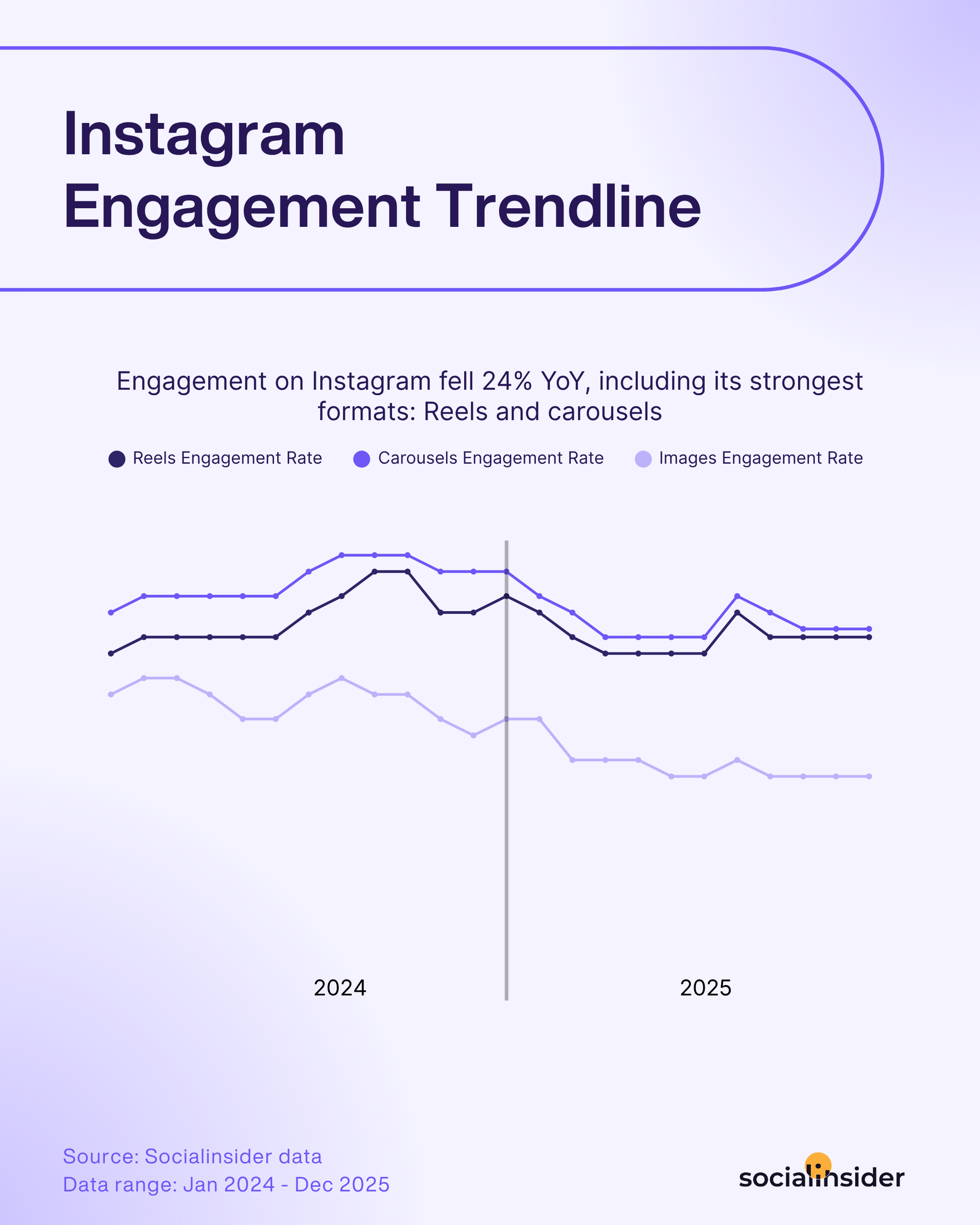
This is also why engagement rates are dropping on platforms like Instagram, which registers a 24% YoY decrease in engagement, as per Socialinisder's Instagram benchmarks report.
What this means
- Low likes don’t automatically mean weak content
- Focus on high saves and shares as they indicate stronger intent and interest
- Analytics should track depth of engagement instead of just volume
Rise of predictive and real-time analytics
Social media marketing analytics used to tell you what worked. Now it tells you what will work, while it’s still happening.
Short-form content has compressed feedback loops. On platforms like TikTok and Instagram, early signals like watch time, completion rate, and initial engagement are used to decide whether a post gets further distribution. Content is tested in small batches first, then scaled if it performs.
That means performance can often be predicted within the first few hours.
What this means:
- Iterate content faster based on early signals
- Double down on formats that show strong initial traction
- Kill underperforming content quickly
How to use social media analytics to extract business insights
Instead of analyzing individual metrics or social media KPIs, here are six ways to look at data holistically and extract insights.
1. Build a content strategy that compounds over time
One thing that I have learned working in content is that no brand making it big works on continuous random bets. They are good at one thing — finding ways to make success repeatable.
To use social media analytics to guide your content strategy, here are four things you can do:
- Identify formats and content pillars that consistently perform. I use Socialinsider to get this data on which pillar gets me the most engagement and organic value.
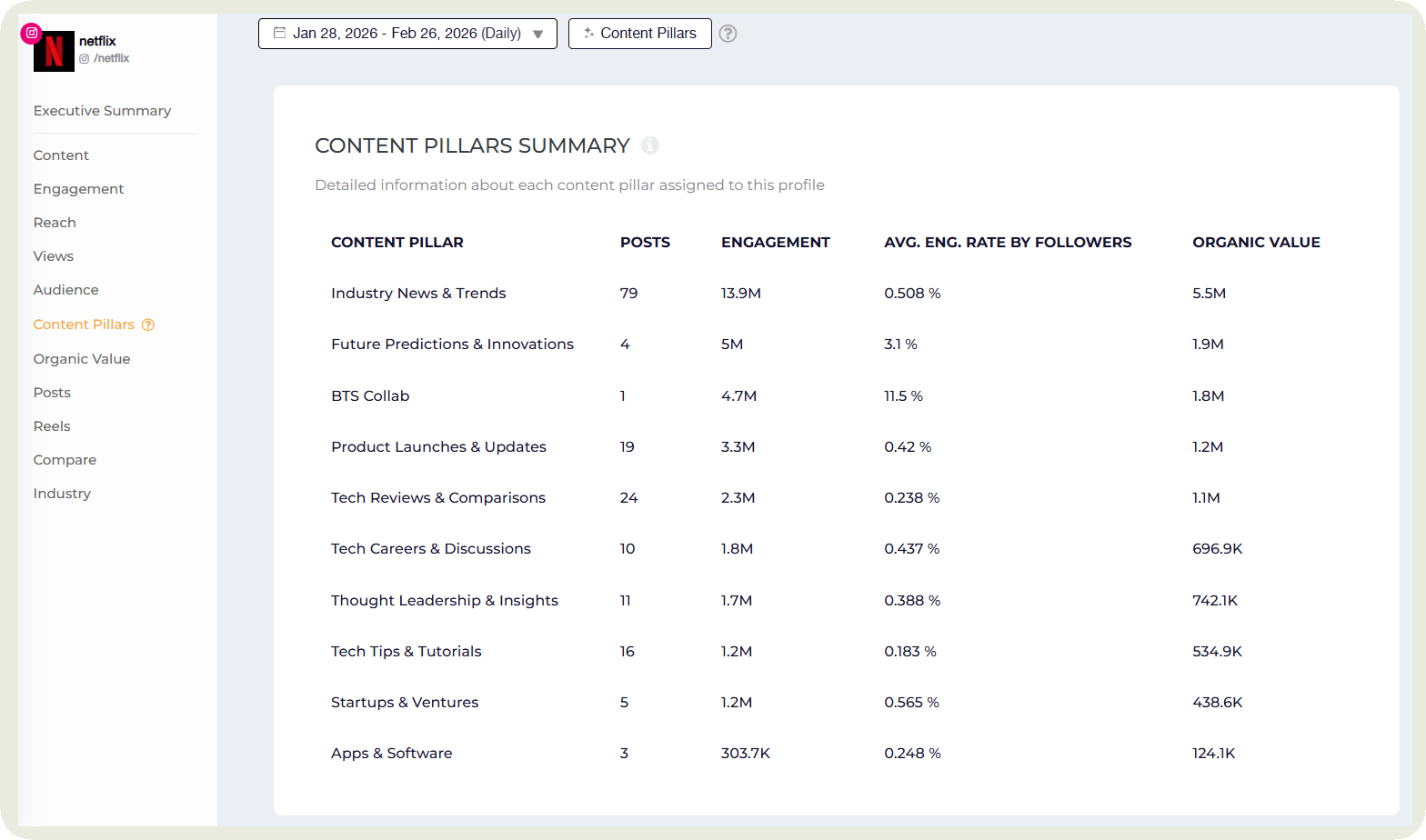
I then use the platform to dig deep into my competitor’s content pillars by adding their profiles. How does this help me? I can find pillars that are working great for them but are underutilized for my brand. And if the same pillar is getting them more engagement, I can look into the elements that make it tick for them.
The same goes for content format.
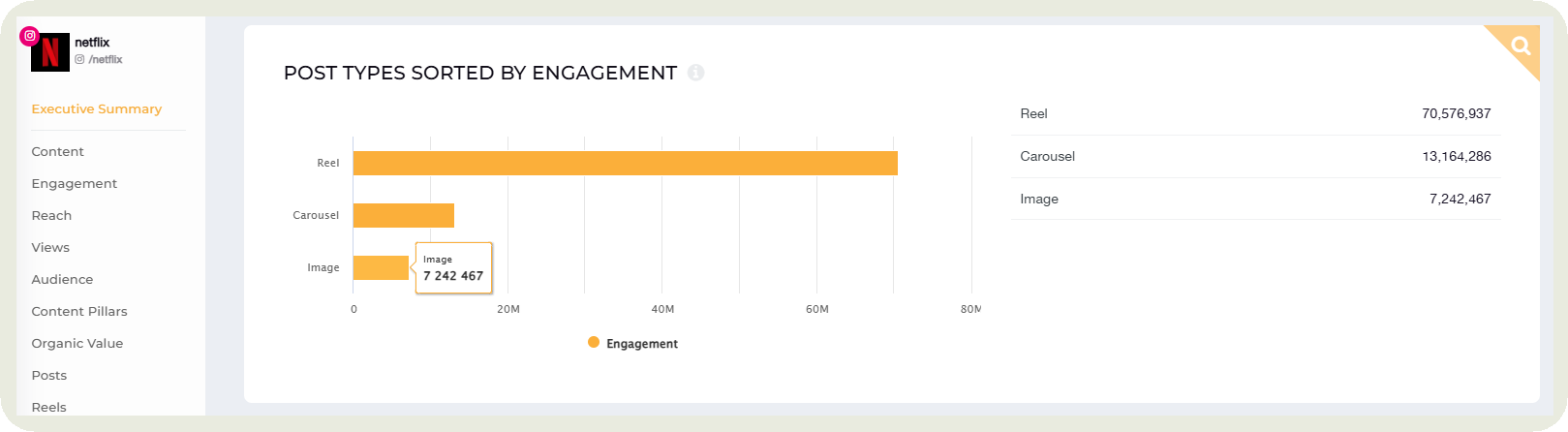
- Is it educational content or funny memes? Is this the content that is helping us achieve our overall social media and business goals? Are our videos getting a higher-than-average watch time?
By looking at what’s working here, you can double down on repeatable patterns and create a successful content strategy.
2. Reverse engineer what’s working for your competitors
Looking at your numbers in isolation tells you how you’re doing. Looking at competitors tells you what’s possible. That’s where insights start to show up.
Here’s how to make social media data analysis useful:
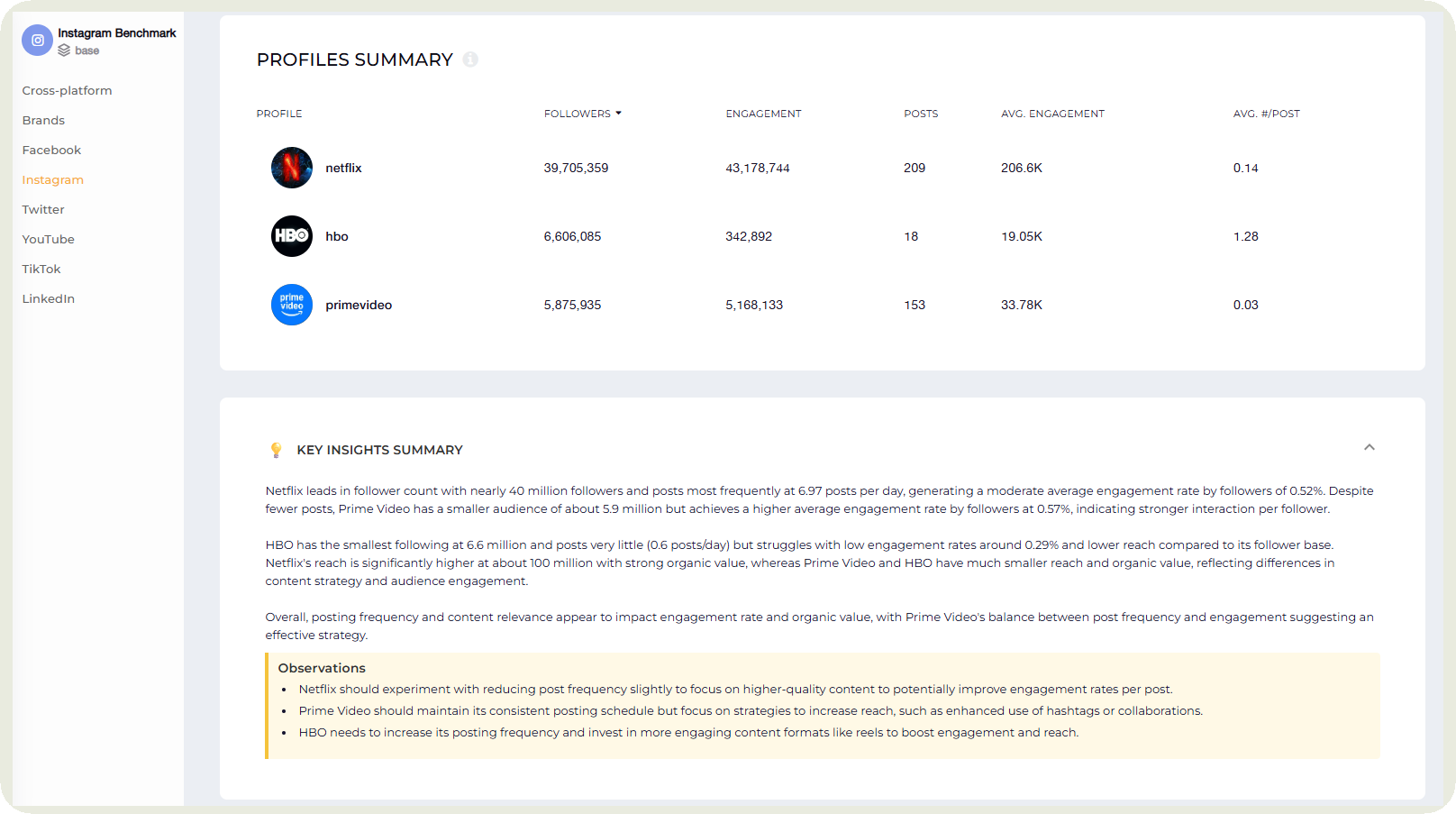
- Benchmark your performance against others in your space. Compare engagement rate, reach, and posting frequency. If similar accounts are getting higher saves or shares, that’s a signal worth digging into.
I use Socialinsider Benchmarks feature to get a side-by-side comparison of my performance with competitors’ performance.
- Analyze their top-performing content themes and formats. Look at their most engaged posts. Are they using carousels, short videos, or educational content? For example, if a competitor’s quick “how-to” reels consistently outperform their other posts, that format is clearly working with your shared audience.
- Spot gaps they are not covering. What are they ignoring? Topics, formats, or audience segments they haven’t tapped into yet. That’s your opportunity to stand out instead of blend in.
3. Decode what your audience actually cares about
Audience preferences keep changing. The only way to actually keep track of them is to look at the signals most marketers miss.
Here’s how I seek them out while conducting social media marketing analysis:
- Track how people interact with different content types. I look at patterns across formats. Do short videos get more reach, but carousels drive more saves? That tells you what grabs attention and what holds it.
Maybe there’s a content type that does well with engagement but another that actually brings conversions. Note them down and use each depending on the goal you’re prioritizing.
- Pay attention to silent signals like saves and shares. Saves signal value. Shares signal relevance. These are strong indicators of intent, even when likes stay low.
- Identify which topics trigger conversation vs passive scrolling. Some topics invite replies and discussion. Others get consumed quietly. Both matter. One builds visibility, the other builds depth.
At the end of the day, you need to use these insights to guide content across the funnel. High-save content can turn into lead magnets or nurture emails. High-comment topics can shape webinars or sales conversations. Example: If “how-to” posts get saved often, turn them into a drip email series for warm leads.
4. Allocate time and budget based on what actually works
Not all content deserves the same level of effort. Some themes quietly drive results. Others just fill the calendar.
Analytics helps you see where your time and budget are actually paying off.
Here’s what to do.
- Compare performance across platforms, formats, and campaigns. Look beyond surface metrics. Which platform drives conversions? Which format brings in qualified leads? For example, if LinkedIn posts generate fewer impressions but more demo requests than Instagram and your goal through social media is to drive conversions, that’s where your effort should lean.
- Evaluate effort vs outcome. Map how much time or budget goes into each type of content against what it returns. If you’re running with a limited budget, you might not want to invest in a high-production video that might underperform. Instead, you might want to see what results simple but effective team-shot videos or carousels bring.
- Identify low-impact activities. Spot what isn’t contributing to business outcomes. Repetitive posts with low engagement. Campaigns that generate reach but no action.
The goal is simple. Spend less time on what looks busy and more on what actually moves the needle.
5. Understand how your brand is perceived over time
You want your brand to be perceived in a certain way. Tracking social media analytics can help you see whether your audience sees your brand the way you want them to.
Below are three ways I do that.
- Track changes in engagement quality and audience interaction. I look beyond volume. Are people asking thoughtful questions or dropping generic comments? Are replies turning into conversations? That shift says a lot about trust and interest.
- Analyze social media for comment sentiment and conversation depth. Read the comments. Notice tone. Positive, curious, skeptical, indifferent. For example, if more people start tagging others or sharing personal experiences under your posts, your content is resonating on a deeper level.
- Observe how people respond to different messaging styles. Test educational, opinion-led, and promotional content. See what gets ignored and what sparks a response. Patterns will emerge quickly.
6. Connect social media efforts to broader business performance
Social media doesn’t work in isolation. The real value shows up when you connect it to what happens next.
- Link social data with website analytics and CRM. Track what happens after the click. Which posts bring in traffic that actually converts? Which campaigns attract high-quality leads?
- Understand how social contributes across the customer journey. Social often starts the relationship. Someone discovers you through a post, visits your site later, and converts days after. That path matters.
- Measure assisted conversions instead of just last-click. Last-click attribution misses the full picture. For example, a user sees your LinkedIn post, signs up for a newsletter a week later, and converts after an email. Social played a role, even if it wasn’t the final step.
When you connect these dots, you can actually show the business impact of social.
How to build a social media analytics system?
Instead of haphazardly tracking your analytics, we recommend following a system that makes extracting insights easy.
Weekly vs Monthly vs Quarterly analysis
I like to follow a set timeline when analyzing my social media efforts. Look at how I go about it.
- Weekly: Stay close to performance. I review post-level metrics and look at what’s getting traction and what’s not. Early signals like saves, shares, and watch time help me spot patterns quickly. Then I use this to tweak captions, formats, and posting times while the feedback is still fresh.
- Monthly: Zoom out and compare. I identify my top-performing content across the month and compare results with previous months to see what’s improving or slipping. Also, evaluate campaigns as a whole. I find which ones drove meaningful engagement or conversions.
- Quarterly: Think in trends and strategy. I look at long-term patterns. Which platforms are actually contributing to business goals? Which formats are consistently working? This is the time to reassess my content mix, double down on what’s effective, and cut what isn’t earning its place.
Create dashboards that drive decisions
You don’t want to manually fetch data each time you run an analysis. The best way to do this is by using a third-party analytics tool.
For example, Socialinsider lets you customize your dashboard to display the metrics that matter to your business.
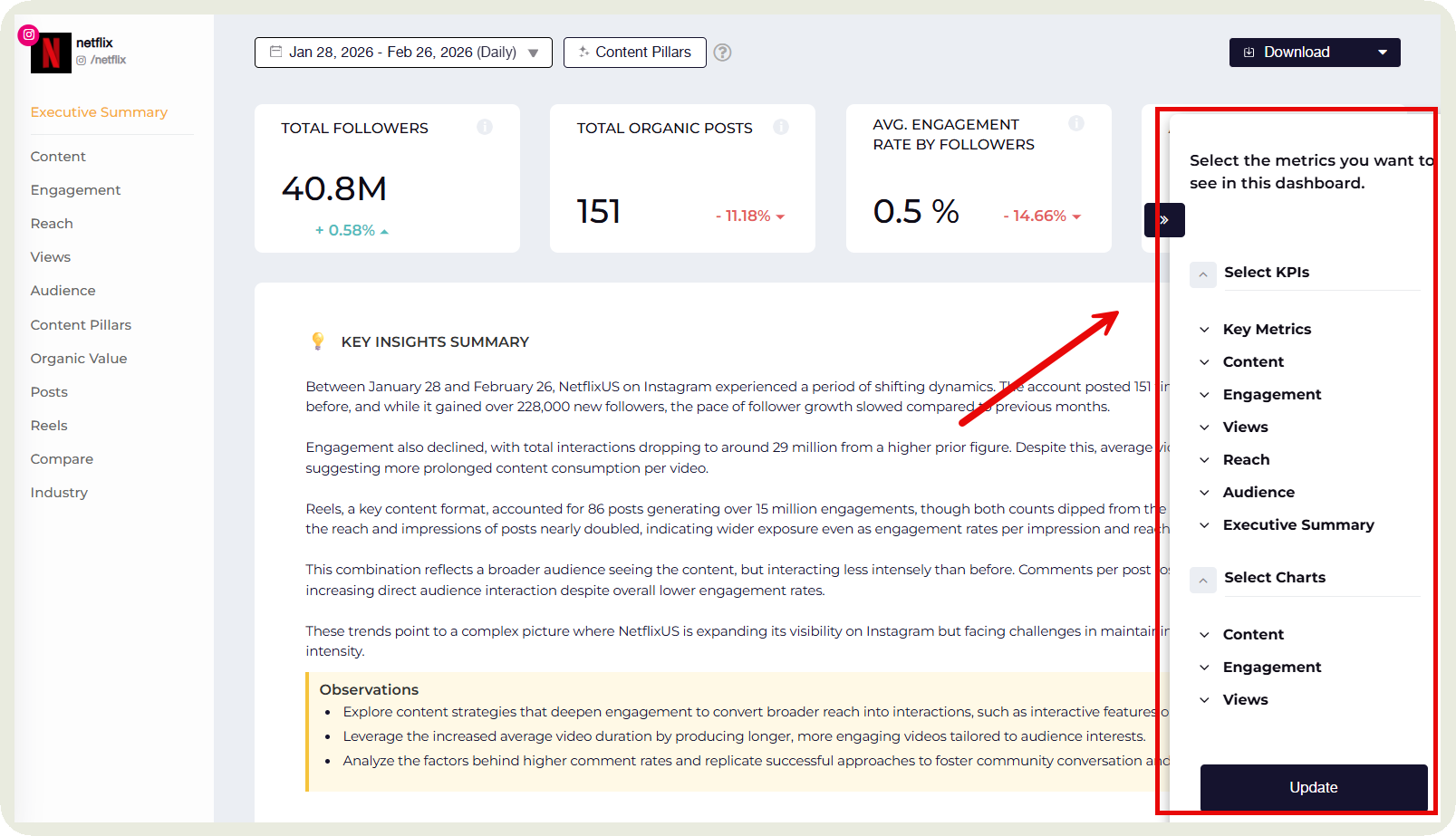
It also shows you a ‘Key Insights Summary’ that provides a snapshot of your performance and the actions you can take next.
You can even download this in the file format of your choice for easy sharing with teammates and executives.
Set team workflows and ownership
If you work with a social media team, you need clear roles to ensure everybody knows what to do. You can divide them in three parts:
- Who analyzes? Assign someone to pull and interpret the data. Their job is to highlight patterns, not just report numbers.
- Who decides? Someone needs to translate insights into direction. What to scale, what to stop, what to test next.
- Who executes? The team that turns decisions into content, campaigns, and experiments.
To make this work:
- Set a regular review cadence. Weekly for performance check-ins. Monthly for deeper analysis and planning.
- Document insights and decisions in one place. Keep a running log of what you learned and what you changed. This builds context over time.
- Create feedback loops between teams. Share what’s working across content, paid, and sales. This helps your team understand performance and how they can use social to help efforts across domains.
Automate your social media tracking
With so much automation and AI catching up in each field, there are ways to utilize them in social media analytics too.
- Centralize data across platforms. Use analytics tools like Socialinsider to bring everything into one place. No switching tabs and piecing together reports. You get a consistent view of performance across channels.
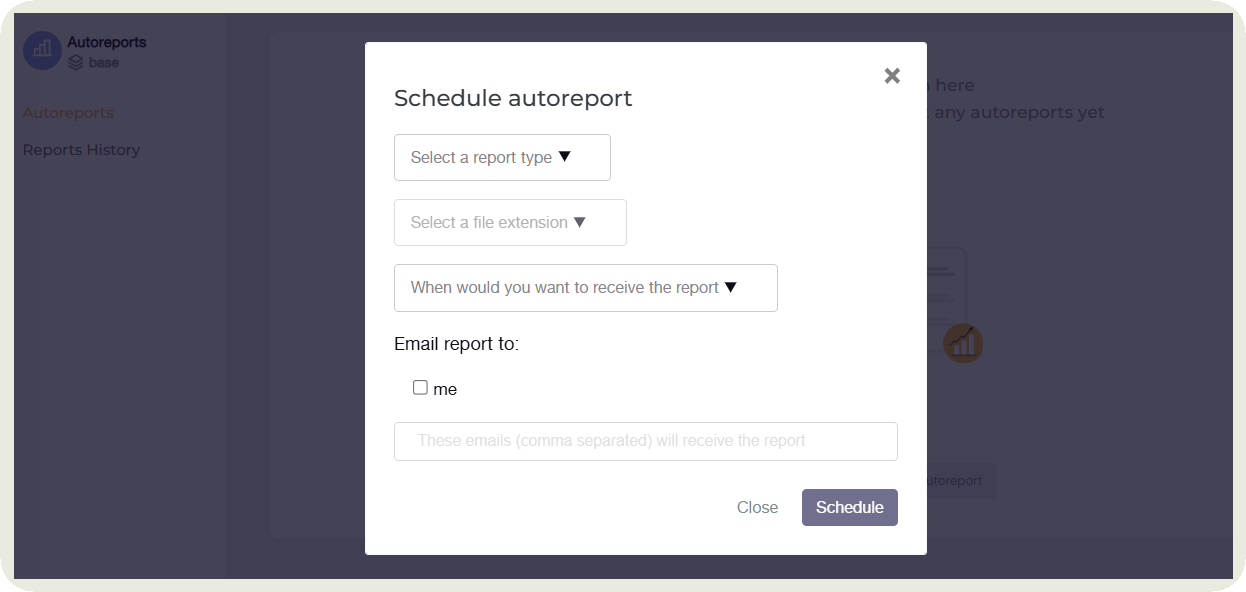
- Automate weekly and monthly reports. Set up recurring reports so your team always has the latest insights. It keeps everyone aligned without extra effort. You can do that in Socialinsider through the Autoreporting feature.
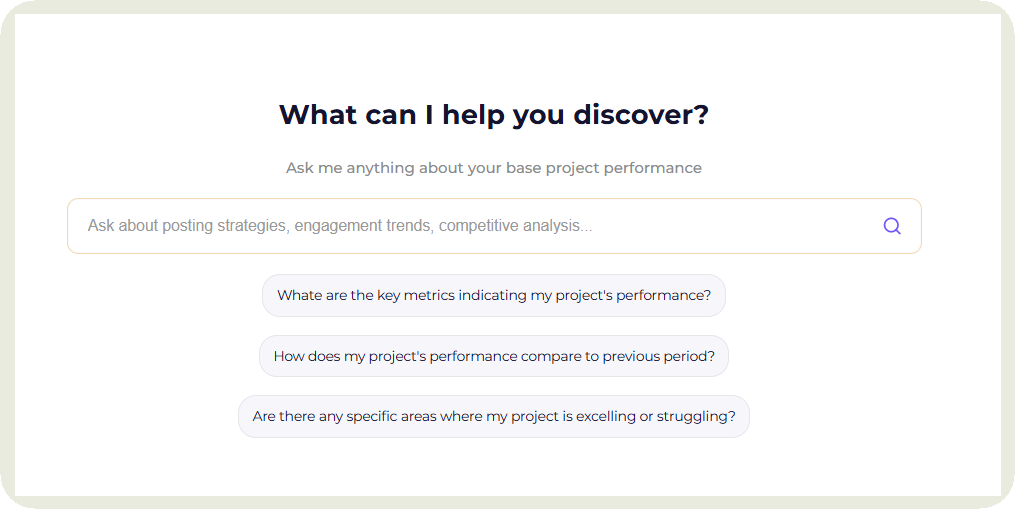
- Use AI to get answers faster. Ask questions directly from your data. What worked this month? Which content drove conversions? Where engagement is dropping? Socialinsider AI Assistant helps you do just that.
Why most brands fail at social media analytics?
- Over-reliance on vanity metrics. I’ve seen reports packed with likes, impressions, and follower growth. They look great but they rarely explain impact. It’s easy to confuse visibility with progress.
- Reporting without context. A spike in engagement shows up. Everyone celebrates. No one asks why it happened or if it mattered. How do you even replicate this win next then?
- No connection to business goals. Social often runs in its own lane. If it’s not tied to leads, revenue, or retention, it becomes hard to learn from or improve.
- Data overload without interpretation. More dashboards. More metrics. Still no clear direction. I’ve seen teams track everything and understand very little.
- Lack of consistency in tracking. Metrics change. Reports shift. Tools don’t align. Over time, it becomes impossible to spot real patterns.
Best social media analytics tools to use
Gone are the days when you wasted time gathering data and bringing it together in one place. Here’s how you can save time by using these social media analytics tools.
Native analytics
Every platform gives you built-in social media insights. Instagram shows reach, saves, and profile activity. TikTok highlights watch time and retention. These are real-time and closest to the source.
What makes them useful:
- Post-level performance and audience insights
- Real-time data without delays
- Platform-specific metrics like retention and interactions
I use native analytics to quickly spot what’s working right now. It’s not built for deep analysis, but it’s great for fast decisions and daily optimization.
Socialinsider
When I need context, I switch to tools like Socialinsider. It pulls everything into one place and actually helps make sense of it.
Instead of jumping between platforms, you get a unified dashboard with performance, trends, and competitor data. It tracks engagement, reach, follower growth, and content performance across channels while also letting you benchmark against competitors.
What stands out:
- Cross-platform analytics in one dashboard
- Competitor benchmarking and content analysis
- Historical data to track trends over time
- Automated reports and performance comparisons
I use it when I want to understand why something worked and how to repeat it.
Final thoughts
You already have the data. The advantage comes from how you use it. Increasingly, I have seen that the brands that are winning are the ones that stay curious, test often, and pay attention to what the numbers are really saying.
Instead of analyzing everything under the sun, pick a few metrics that actually matter to your goals. Review them regularly and turn those analytics into action, even if it’s a small tweak. Over time, those small decisions compound and your strategy gets sharper. Results follow.
If you’re still spending time manually getting data, try out Socialinsider for free for 14 days.
Nidhi Parikh
Nidhi Parikh is SaaS writer that believes scrolling through social media is research for work. When not working, find her binge watching the latest series or reading anything she can get her hands on.

Know what your competitors do — before your manager asks
Get instant social benchmarks & reports without manual work.
You might also like




Improve your social media strategy with Socialinsider!
Use in-depth data to measure your social accounts’ performance, analyze competitors, and gain insights to improve your strategy.