15 Influencer Marketing KPIs to Evaluate Brand Collaborations
Navigate the world of influencer marketing KPIs. Gain insights into crucial metrics that help you assess performance and achieve your goals.

You’ve mastered the art of building campaigns that inspire—and you know that the real magic lies in the details you measure.
As your strategies evolve, so does your need for metrics that capture more than just surface-level wins. Think back to your most ambitious collaborations: what really set them apart was your ability to translate creative energy into measurable business growth.
In this article, I’ll spotlight the influencer marketing KPIs that speak your language—helping you track true influence, refine your approach, and conduct every campaign with the confidence of experience.
Key takeaways
What are some key influencer KPIs you should track? To measure influencer marketing effectively, track reach and awareness KPIs to evaluate visibility, engagement KPIs to assess resonance, traffic KPIs to measure intent, conversion KPIs to determine business impact, and brand perception KPIs to understand how campaigns shape audience sentiment.
How to select the right KPIs that align with your goals? Choose influencer KPIs based on your primary campaign objective, audience behavior, creator type, and platform strengths, balancing quantitative performance data with qualitative insights for a complete picture of success.
How to track and analyze influencer marketing KPIs? Track and analyze influencer KPIs by using a centralized analytics tool, setting up proper attribution with UTMs and discount codes, and continuously reviewing performance data to optimize campaigns in real time.
What are influencer marketing KPIs?
Influencer marketing KPIs are the signals that tell you whether your collaborations are actually working. They help you understand how an influencer’s content is contributing to your goals.
When I think about KPIs in this space, I’m looking at how audiences respond, how far the message travels, and whether that attention turns into meaningful action.
These metrics can include engagement rates, reach, clicks, conversions, and even sentiment around your brand. Each one gives you a different lens to evaluate performance. Together, they paint a clearer picture of what’s driving results and what needs to be refined.
Why should you track influencer marketing KPIs?
As a brand, you invest quite a lot of money on your influencer collaborations. If you don’t track its metrics, you may miss out on the most from your investment. Here are four key reasons why you should track influencer marketing KPIs.
- Identify the right influencers to partner with: KPIs reveal who actually drives meaningful engagement and conversions, not just vanity metrics. For example, a creator with lower reach but higher saves and clicks may outperform a larger influencer on actual business outcomes.
- Prove ROI and justify your budget: Tracking KPIs connects influencer activity to tangible results like revenue, leads, or cost per acquisition. This makes it easier to show stakeholders how each campaign contributes to growth and why continued investment makes sense.
- Optimize campaigns while they’re still running: Real-time KPI tracking helps you spot what’s working early and adjust quickly. If a certain format or creator is driving higher engagement, you can double down instead of waiting until the campaign ends.
- Compare performance across platforms and campaigns: KPIs help normalize performance across different platforms by focusing on rates and outcomes. This allows you to see whether Instagram Reels, TikTok videos, or YouTube integrations are delivering better results for your influencer marketing goals.
15 influencer marketing KPIs to track
Here are the most important social media KPIs that we have seen brands track for their influencer collaborations.
Reach and awareness KPIs
When I track reach and awareness KPIs, I’m looking at how far the content actually travels and how many new people it brings into the brand’s orbit.
I also track these influencer marketing metrics for each creator to help me understand which creators and formats expand awareness most effectively.
1. Reach
What it means: Reach is the number of unique users who see your influencer content. It tells you how many distinct individuals your campaign is able to expose your brand to.
Why track it: I track reach to understand how effectively a campaign is expanding awareness. It helps identify which influencers are attracting new audiences rather than repeatedly reaching the same group.
How to analyze it: Look at this KPI for influencer marketing alongside audience demographics and overlap. If multiple influencers show similar reach but target the same audience, you are not truly expanding visibility. Prioritize creators who bring incremental reach.
2. Impressions
What it means: Impressions represent the total number of times content is displayed, including multiple views from the same user. It reflects overall content exposure.
Why track it: I use impressions to understand content visibility and frequency. Repeated exposure often strengthens brand recall, especially in awareness-focused campaigns.
How to analyze it: Compare impressions to reach. A high impressions-to-reach ratio indicates repeated views, which is useful for recall. If both are low, the content likely isn’t being distributed effectively.
3. Audience growth
What it means: Audience growth measures the increase in your brand’s followers or subscribers during a campaign. It reflects how many people choose to stay connected after exposure.
Why track it: I track this to see if awareness is turning into long-term interest. It signals whether influencer content is compelling enough to convert viewers into followers.
How to analyze it: Map follower spikes to specific campaigns or creators. If certain influencers consistently drive growth, they are not just creating visibility but building your brand’s owned audience.
4. Share of Voice
What it means: Share of voice measures how often your brand is mentioned or discussed relative to competitors in a specific market or campaign.
Why track it: I track share of voice to understand how visible the brand is in the broader conversation. It shows whether your campaigns are helping you stand out.
How to analyze it: Benchmark against competitors during the same time period. If your share of voice increases during campaigns, your visibility is improving. If not, your messaging or creator mix may need adjustment.
Engagement KPIs
Engagement KPIs show how people actually interact with influencer content through likes, comments, saves, and shares.
These signals tell me if the content is resonating. I use these social media influencer metrics to quickly identify what’s clicking with the audience and refine campaigns in real time.
5. Engagement rate
What it means: Engagement rate measures the percentage of people who interact with content relative to reach or followers. It standardizes performance, making it easier to compare creators of different sizes.
Why track it: I rely on engagement rate to understand content quality. It shows whether the audience is genuinely interested.
How to analyze it: Compare engagement rates across influencers and formats. A smaller creator with a higher rate often delivers stronger audience connection. Track consistency over time to spot reliable performers.
6. Total engagement
What it means: Total engagement is the absolute number of interactions on a post, including likes, comments, shares, and saves. It reflects the overall volume of audience activity.
Why track it: I use this to gauge the scale of interaction a campaign generates. It helps understand which collaborations are driving the most activity at a broader level.
How to analyze it: Look at total engagement alongside reach. High engagement with low reach signals strong resonance. High reach with low engagement suggests the content isn’t connecting well.
7. Saves and shares
What it means: Saves and shares indicate how often users bookmark content or pass it along to others. These actions reflect deeper interest and perceived value.
Why track it: I prioritize these because they signal intent. People save content they want to revisit and share content they find useful or relevant.
How to analyze it: Track saves and shares as a percentage of reach. Content with high saves often has educational or inspirational value, while high shares suggest strong relatability or virality.
8. Video views and watch time
What it means: Video views count how many times a video is played, while watch time measures how long viewers stay engaged. Together, they reflect content consumption.
Why track it: I track these to understand how well video content holds attention. Strong watch time indicates that the content is engaging beyond the first few seconds.
How to analyze it: Focus on retention patterns. If views are high but watch time drops early, the hook may be weak. Consistent watch time suggests the content is holding audience interest throughout.
Traffic KPIs
When I track traffic KPIs, I focus on how influencer content drives people to take action, such as clicking links, visiting landing pages, or exploring products.
These metrics for influencer marketing show real intent beyond engagement. I use them to identify which creators and content actually move audiences closer to conversion and optimize accordingly.
9. Website traffic
What it means: Website traffic measures the number of users who visit your site through influencer-driven links, swipe-ups, or bio links. It reflects how effectively influencer content pushes the audience to take action.
Why to track it: It shows whether people are interested enough to move from content to your website.
How to analyze it: Break traffic down by influencer, platform, and campaign. Use UTM parameters to track sources accurately. If one creator drives significantly more sessions, double down on similar profiles or content formats.
10. Click-through rate (CTR)
What it means: CTR measures the percentage of people who click on a link compared to how many saw it. It indicates how compelling the call-to-action and content are.
Why to track it: Use CTR to evaluate how effectively influencer content drives action. It highlights whether the messaging and placement of links are working.
How to analyze it: Compare CTR across influencers and formats. A low CTR with high reach suggests weak CTAs or misaligned messaging. Test different hooks, placements, and formats to improve performance.
Conversion KPIs
When I track conversion KPIs, I focus on what actually drives business outcomes like purchases, sign-ups, or leads. These influencer metrics show whether influencer efforts are translating into real results.
11. Conversion rate
What it means: Conversion rate measures the percentage of users who complete a desired action after interacting with influencer content, such as making a purchase or signing up.
Why to track it: Track this to understand how effectively traffic turns into results. It shows whether the audience and messaging are aligned with the final goal.
How to analyze it: Compare conversion rates across influencers and landing pages. If traffic is high but conversions are low, the issue may lie in the offer, audience fit, or user experience.
12. Sales generated
What it means: Sales generated refers to the total revenue directly attributed to influencer campaigns through tracked links, promo codes, or affiliate setups.
Why to track it: Use this to tie influencer efforts directly to revenue. It helps identify which creators are actually driving purchases.
How to analyze it: Break down sales by influencer and campaign. Look for patterns in content style or audience type that consistently lead to higher revenue and scale those partnerships.
13. Cost per acquisition (CPA)
What it means: CPA measures how much it costs to acquire a customer through influencer marketing. It is calculated by dividing total campaign spend by the number of conversions.
Why to track it: I track CPA to understand efficiency. It shows whether the investment in influencers is delivering customers at a sustainable cost.
How to analyze it: Compare CPA across influencers and channels. A lower CPA indicates better efficiency. If CPA is high, reassess creator selection, targeting, or conversion flow.
14. Return on Influencer Spend (ROIS)
What it means: ROIS measures the revenue generated for every dollar spent on influencer campaigns. It reflects the overall profitability of your efforts.
Why to track it: I rely on ROIS to evaluate the true business impact of influencer marketing. It helps justify budgets and guide future investments.
How to analyze it: Calculate ROIS per campaign and influencer. Identify which partnerships deliver the highest returns and prioritize them. Consistently low ROIS signals a need to refine strategy or reallocate budget.
Brand perception KPIs
When I track brand perception KPIs, I focus on how people feel about the brand through sentiment, mentions, and overall conversation quality.
These metrics show whether influencer content is building trust and credibility.
15. Sentiment & brand mentions
What it means: Sentiment and brand mentions measure how often your brand is talked about and the tone of those conversations across influencer content and audience responses. It captures both visibility and perception.
Why to track it: I track this to understand how influencer campaigns shape brand perception. It shows whether conversations are positive, neutral, or negative, and if the messaging is landing as intended.
How to analyze it: Look beyond volume and focus on sentiment trends over time. A spike in mentions is only valuable if sentiment is positive. Review comments and conversations to identify recurring themes and adjust messaging or creator selection accordingly.
How to select the right KPIs that align with your goals
We went through all the different KPIs that businesses consider for their influencer campaigns. But which ones should you prioritize for influencer marketing measurement? Here’s a step-by-step process that will help you.
Step 1: Zero in on your campaign objective
The first step is to get clear on what you actually want from the campaign. I always pause here because everything else flows from this decision.
Ask:
- Are we trying to increase awareness?
- Drive traffic?
- Generate sales or leads?
- Improve brand perception?
Your answers shape everything that follows. If the goal is awareness, it makes more sense to focus on reach and impressions than conversions and revenue.
For example, during a product launch, I care more about clicks and purchases than likes. Once the goal is clear, picking the right category of KPIs becomes simple and every number you track starts to have a purpose.
Step 2: Consider your audience preferences
How does your audience engage with your content? I always look at past performance to see what actions come most easily to them.
Do they comment more, like more, or share more?
This directly shapes which KPIs matter most. If your audience actively shares content, I prioritize shares and reach expansion. If they tend to comment, I focus more on engagement quality and conversations.
For example, an educational brand might see higher saves, while an entertainment brand might get more shares. When your KPIs match real audience behavior, your analysis becomes far more accurate and actionable.
Step 3: Consider influencer type and platform
Not all creators perform the same way, and each platform has its own strengths.
A nano or micro influencer might drive stronger engagement and trust, so I focus more on engagement rate and saves. A macro or celebrity influencer is better suited for reach and awareness metrics.
Platforms matter just as much. TikTok and Instagram often excel at discovery and engagement, while YouTube is stronger for watch time and deeper consideration.
When I match KPIs to both the creator type and platform behavior, I get a much clearer picture of what success actually looks like for each campaign.
Step 4: Balance qualitative and quantitative metrics
This step of the process is about looking beyond just numbers and bringing in context. I never rely on influencer marketing metrics alone because they only show part of the picture.
Quantitative metrics tell you what is happening. These include reach, engagement rate, clicks, conversions, and revenue. They help you measure scale and performance in a clear, trackable way.
Qualitative metrics tell you why it is happening. These include comment sentiment, the nature of conversations, audience feedback, and how people describe your brand. For example, a campaign might drive strong social media engagement, but if comments show confusion about the product, there is a messaging gap.
Step 5: Keep reviewing and updating your metrics
The last step is about staying flexible and continuously refining what you track. I never treat KPIs as fixed because performance evolves as campaigns run and audiences respond.
I regularly review which metrics are actually giving useful insights and which ones are just noise. If a campaign shifts from awareness to conversion, I adjust my focus accordingly. For example, I might start by tracking reach, then move toward clicks and conversions as the campaign progresses.
This habit keeps reporting relevant and actionable. It also helps me spot trends early, double down on what’s working, and adapt quickly when something isn’t delivering the expected results.
How to track and analyze influencer marketing KPIs
You don’t want to spend weeks getting the data for your campaigns. Here’s a simple process you can use.
Select the right influencer analytics tool
This is where everything comes together. I always make sure I’m using a tool that brings all my influencer data into one place so I can actually make sense of it.
Social media analytics tools like Socialinsider help track performance across creators, campaigns, and platforms without jumping between dashboards.
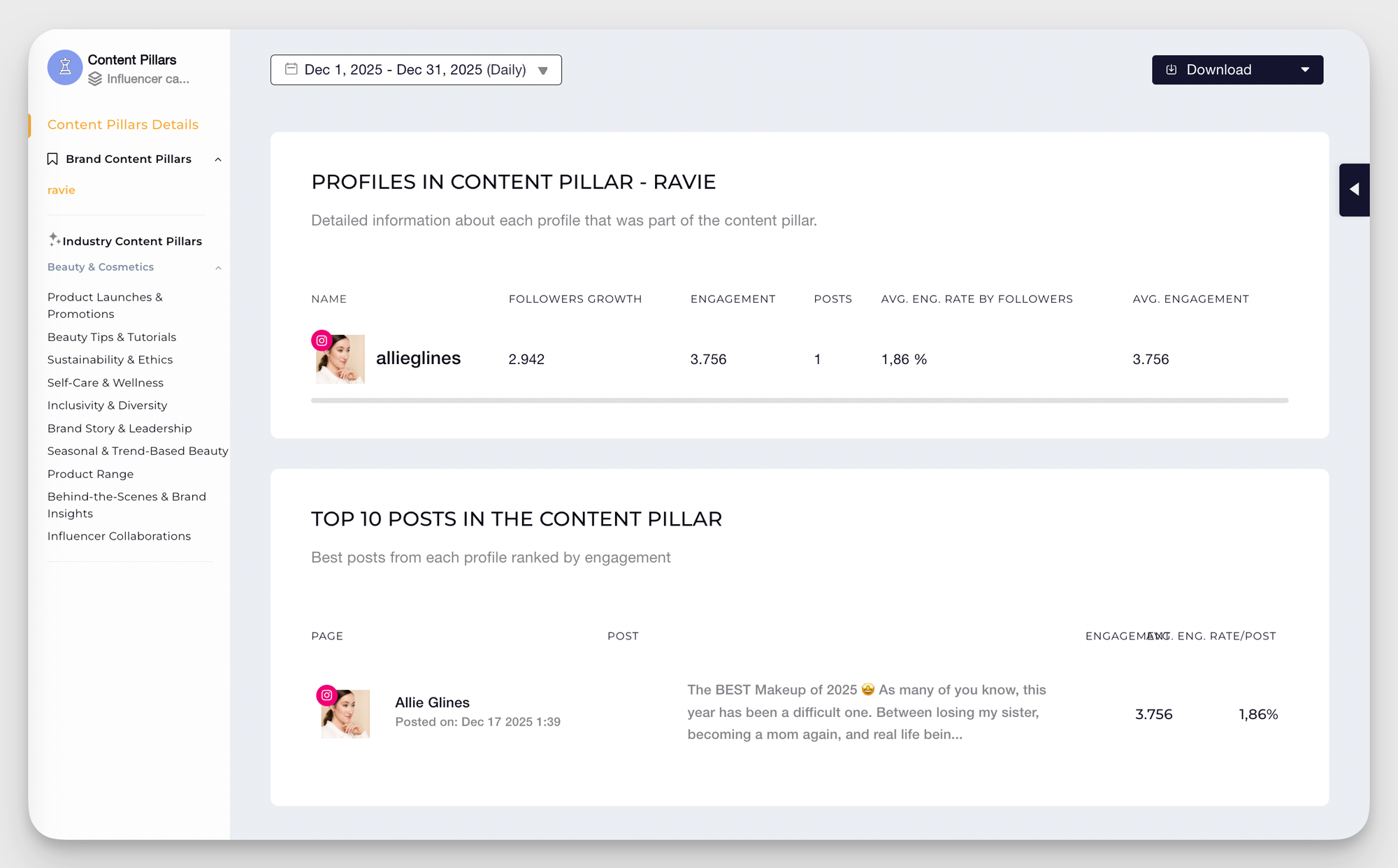
Here’s how I analyzed the collaboration between Ravie Beauty and Allie Glines
- Add the influencer profiles into Socialinsider, then
- Head over to the Query Builder feature to create a campaign-based content pillar
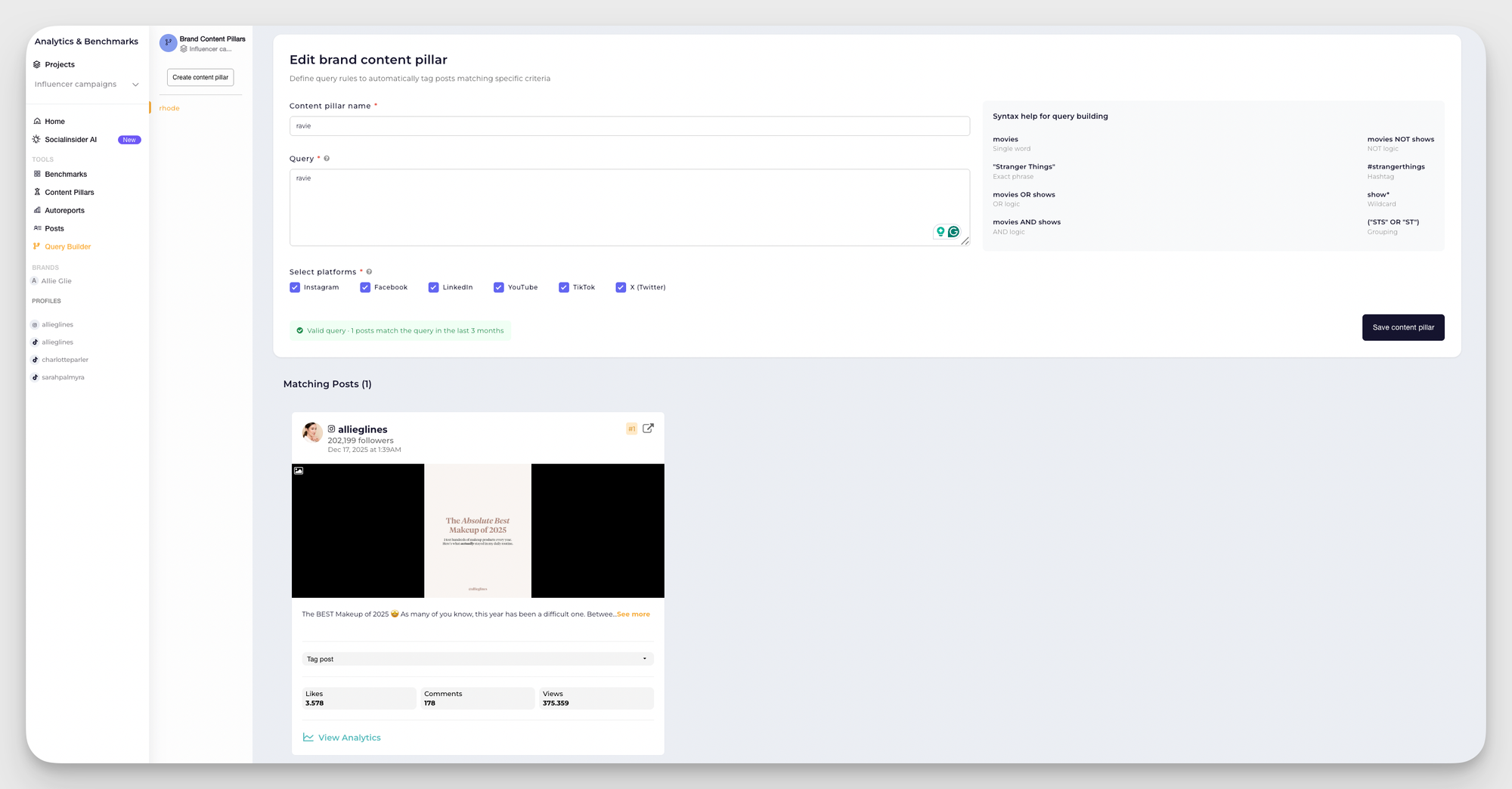
- Then navigate to the Content Pillar section from the left menu, and click on your custom content pillar to get detailed data
Set up tracking parameters
How do you ensure your influencer collaborations are leading to real business results? This step helps you understand that.
I start with UTM parameters by adding unique tags to every influencer link. This helps me track exactly where traffic is coming from, how users behave on the site, and whether they convert. It also makes reporting in tools like Google Analytics much more reliable.
I also assign custom discount codes to each influencer. This gives a clear view of who is driving actual sales and how much revenue each collaboration generates. When both are set up correctly, attribution becomes clearer and decisions become more data-backed.
Analyze this data to optimize your campaigns
Keep a close eye on the KPIs you’ve set and look for patterns as the campaign unfolds. It is not just about tracking expected outcomes, but also spotting anything unexpected that stands out.
If a certain creator is driving higher engagement or better conversions, lean into that quickly. If something is underperforming, look at the content, audience fit, or timing and adjust. For example, shifting budget, tweaking messaging, or testing a different format can make a noticeable difference.
Regularly reviewing performance helps you stay proactive, refine the campaign in real time, and make every iteration more effective than the last.
Final thoughts
Influencer marketing only starts making sense when you stop looking at it as a campaign and start treating it like an ongoing conversation.
You launch something, you watch how people respond, and you learn as you go. One creator brings in the right kind of audience, another gets people talking, and slowly patterns start to show up. That’s where your KPIs come in. They help you notice what’s actually happening beneath the surface.
Once you know the KPIs to track, you can keep adjusting, testing, and refining them with every campaign. And to make this tracking easier, you can use tools like Socialinsider that gets you the data quickly. Subscribe to a free 14-day trial here.

Nidhi Parikh
Having worked with several brands in the social media space, Nidhi writes about all things social. With 13K followers on LinkedIn, she's always up for a chat about books or her next travel plan

Know what your competitors do — before your manager asks
Get instant social benchmarks & reports without manual work.