Instagram Engagement Report: The Hidden Engagement Drivers
Go beyond likes. This Instagram engagement report uncovers the hidden engagement drivers that truly matter - for comments, shares, and saves.

Engagement rate has been the go-to metric for measuring Instagram performance for as long as most of us can remember. And for a long time, that made sense. It was simple, it was comparable, and it gave you a number you could point to.
But something has shifted. Overall engagement on social media has become increasingly passive — more scrolling, more watching, less reacting. And when that happens, a single engagement rate score starts to lose its ability to tell you what's actually going on.
Are people saving your content?
Are they sharing it?
Are they leaving comments, or just tapping through?
Those are very different behaviors, and they point to very different things about how your content is landing.
That's exactly why I put this Instagram engagement report together.
Because I think the conversation needs to move beyond overall engagement rate and into the individual indicators that sit beneath it — comment rate, share rate, save rate.
Each one tells a different part of the story, and together they give you a much clearer picture of what your audience is actually doing when they encounter your content.
The findings in this Socialinsider report are based on the analysis of 15 million Instagram posts, broken down by content format — Reels, carousels, and images. My goal wasn't to produce another set of Instagram benchmarks to stack yourself against. It was to give you something more useful: a way of reading your own Instagram engagement that goes deeper than a single number. Let’s dive in!
Executive summary
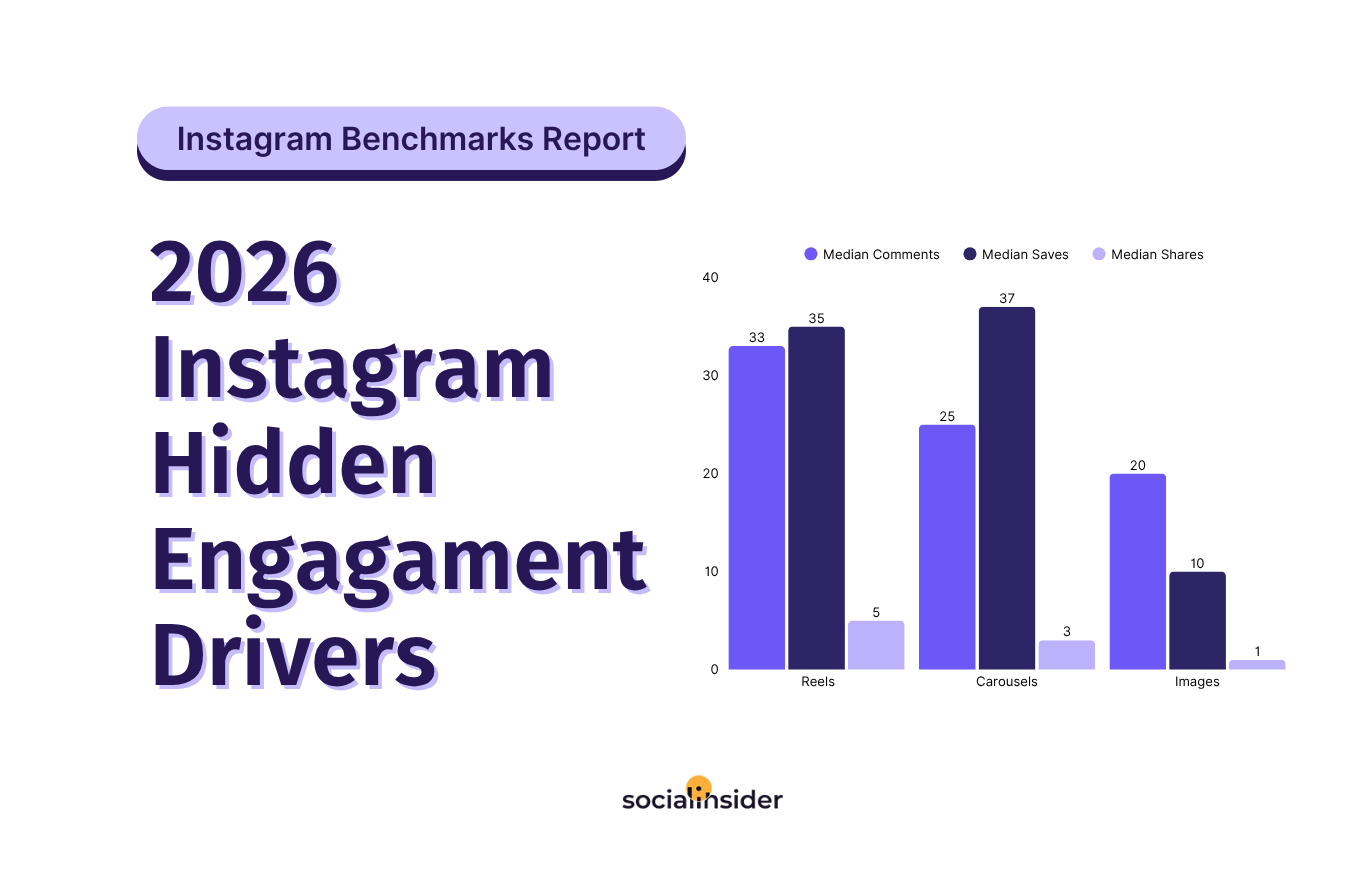
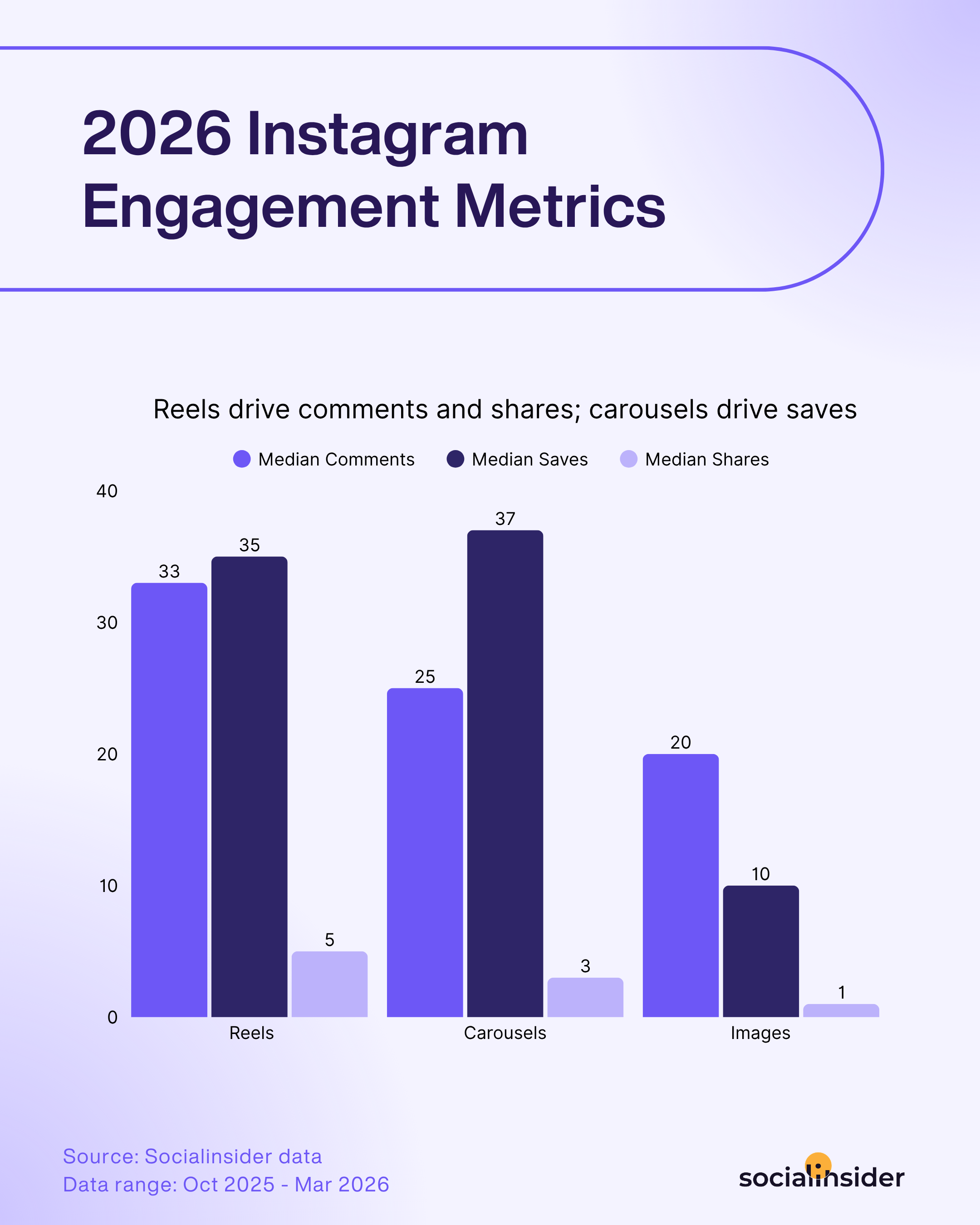
- Reels drive comments and shares. Carousels drive saves
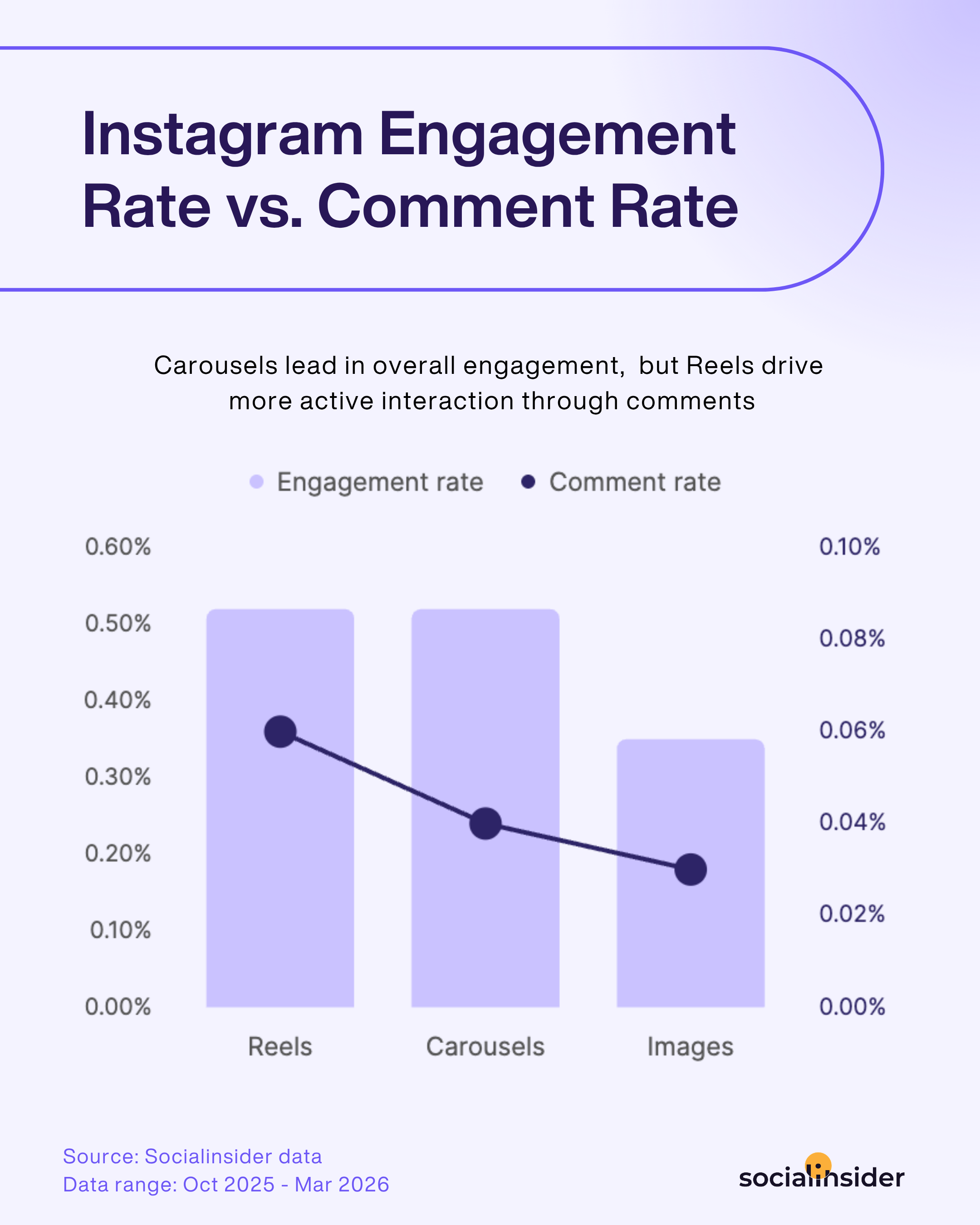
- Carousels lead in overall engagement, but Reels drive more active interaction through comments
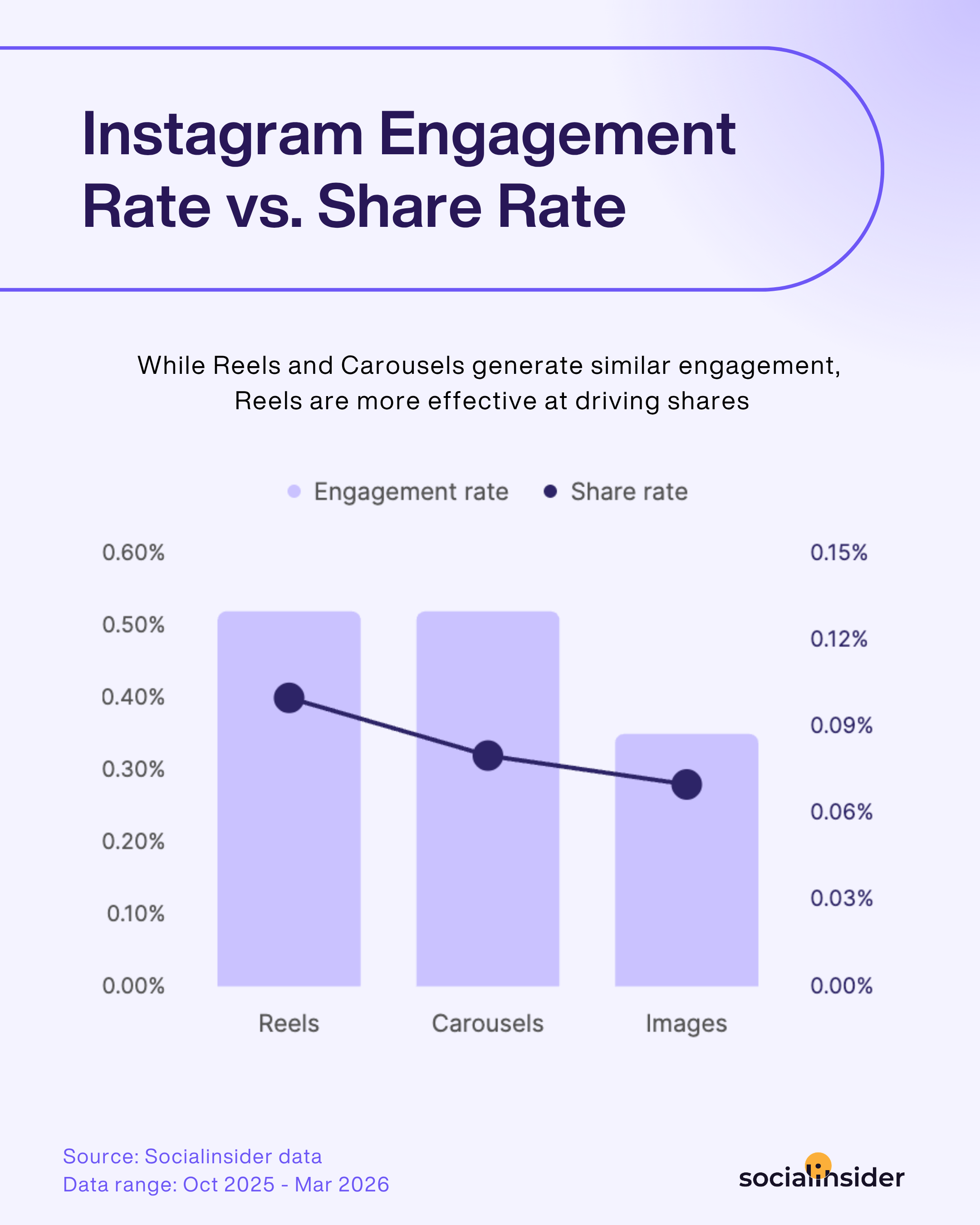
- While Reels and Carousels generate similar engagement, Reels are more effective at driving shares
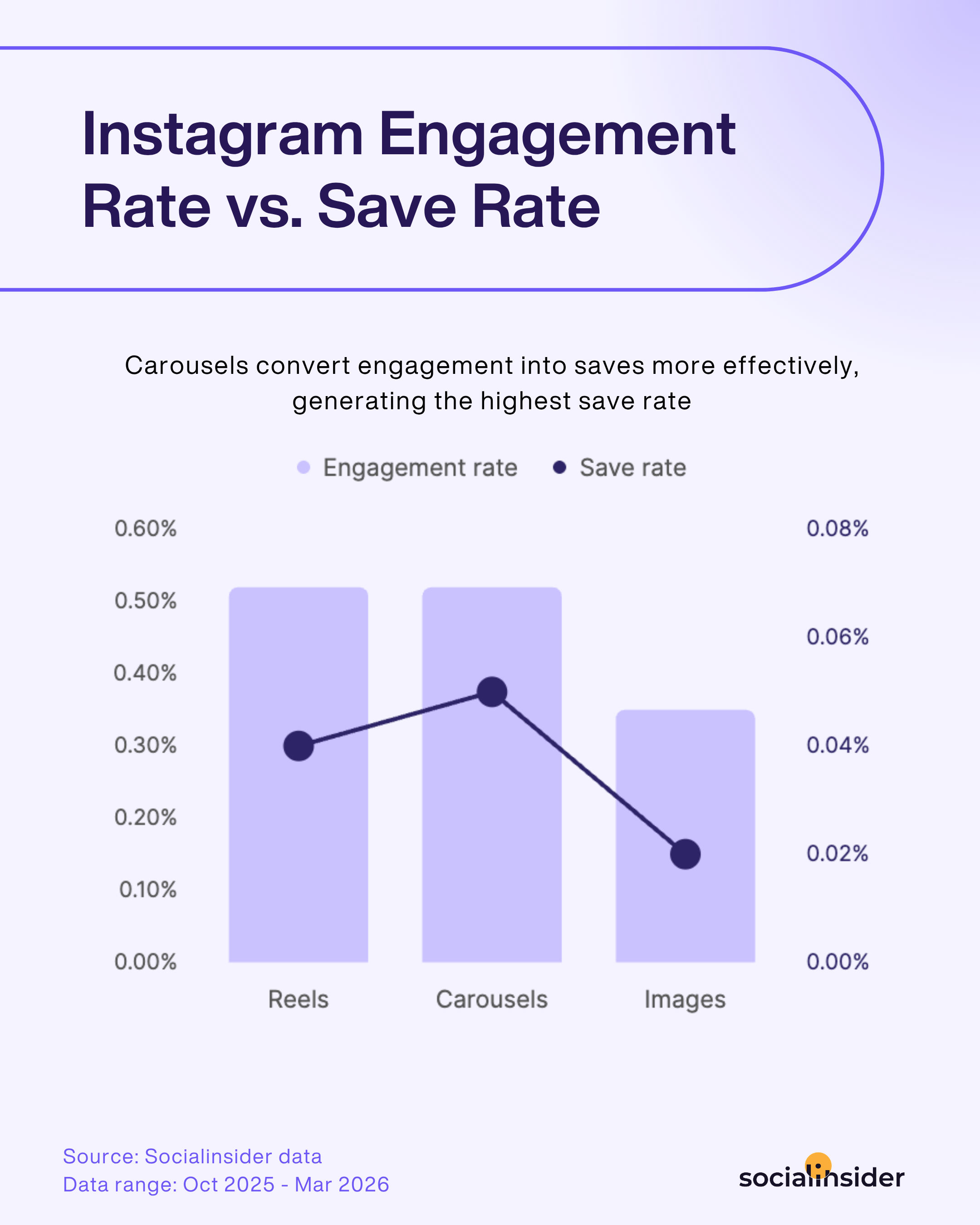
- Carousels convert engagement into saves more effectively, generating the highest save rate.
Instagram engagement metrics comparison by content type
Before I go all nitty gritty with the data, there's something I feel I must point out: Reels, Carousels, and images aren't really competing with each other — they just don't do the same thing.
A Reel is how you show up as a human being on this platform. A Carousel is how you show up as someone worth learning from. And an image is, well, a moment. For me, once I started seeing them that way, the Instagram engagement patterns started making a lot of sense.
When you stop looking at engagement as a single score and start pulling it apart — comment rate, save rate, share rate — what you get isn't a single winner.
What you get is three very different pictures of how people interact with content, and each format paints a different one.
Let's start with Reels.
In my view, this is the format you turn to when you want people to actually react — whether that's jumping into the comments to share an opinion or forwarding the video to someone they think would get it. That second one matters more than it might seem. Every share is your content landing in front of someone who maybe wasn't following you, and that kind of reach is hard to come by otherwise.
Carousels, on the other hand, tell a different story.
They don't spark as many comments as Reels, but they lead on saves. And that makes complete sense when you think about the kind of content that naturally fits this format.
Carousels are where people share frameworks, break down complex topics, lay out step-by-step processes.
Content that's genuinely useful in a way that makes someone think "I'll need this later." That's the behavior driving those saves — an audience that's actively looking for something worth keeping.
There’s a lot more to digest on your own time when taking in a carousel. It’s like a magazine, it's at your own pace. One can feel compelled to stop at a slide and share their thoughts if it’s landing truthfully or one can flip through the slides quickly and get to the end and want more so they end up commenting whatever word the creator is sharing- the conversion is there. – Melani De Guzman, Social media manager & Integrated Content, FreshDirect
Images sit at the bottom across all three metrics, but I wouldn't advise you to remove them completely from your calendar. Just to balance it more.
Strategic tactics to make format decisions that actually move the needle:
- Match format to objective, not habit. If you find yourself defaulting to one format out of convenience, audit your last 30 posts and map each one to a business goal. You'll quickly see where the mismatches are — and where your engagement gaps come from.
- Use Reels to open the door, Carousels to deepen the relationship. Reels bring people in through shares and comments; Carousels keep them engaged over time through saves. A content mix that uses both creates a compounding effect — new audiences discovered through Reels, loyalty built through Carousels.
- Don't abandon images, but be intentional. Single images still work for timely content, announcements, or visual brand moments. The mistake is using them as a substitute for formats that drive deeper engagement. Treat them as punctuation in your content calendar, not the main story.
Instagram engagement rate vs comment rate
Here's a tension worth paying attention to in this engagement report: Carousels tend to lead when you look at overall Instagram engagement, but the moment you zoom into comment rate specifically, Reels take over. And when you think about why, it makes sense. Reels create a feeling of direct contact — someone speaking to you, sharing a take, inviting a response.
Strategic tactics to optimize your Reels for more comments
- Use your caption to do the heavy lifting on Reels. A strong hook in the caption — a controversial opinion, a direct question, a relatable frustration — can be the difference between a Reel that gets watched and one that gets commented on.
- Don't bury the ask. If you want comments, say so — but make it specific. "What do you think?" gets ignored. "Which of these would you try first?" gets answered.
- Track which Reels get the most comments and reverse-engineer them. Topic, tone, caption style, length — something in that combination worked. Do it again before you reinvent the wheel.
A well done captivating reel that is easy to follow, educational, brings value to the audience, or just strikes something relatable is what makes someone stop and comment. The user either values the brand or creator enough to want to share what is resonating. And it could also be the other way around, the user felt moved strongly enough to share their POV. Either way, it means the content hit.- Melani De Guzman, Social media manager & Integrated Content, FreshDirect
Instagram engagement rate vs share rate
Shares are the one engagement action that moves your content beyond your existing audience without you having to do anything else. No ad spend, no collaboration, no hashtag strategy — just someone deciding your content was worth sending to another person. That's a powerful thing, and it's worth understanding which formats earn it most in this Instagram report.
Instagram’s priority is keeping its audience engaged and on the app for longer. Shares demonstrate that not only does the person viewing enjoy the content themselves, but they like it enough to share it with friends, because it lends them social credit, entertains, reminds them of someone or provides value in another way. Sharing also triggers notifications which encourage the recipient to return to the app and spend time there. It makes sense that Instagram would want to encourage this behaviour over other weaker signals with a lower barrier to entry, like a simple tap to like. — Chloe Sharp, Director of Social Media, Carousel
For this particular metric, Reels once again take the lead. And if you ask me, I'd say it makes total sense when you think about what actually makes someone hit share.
People share Reels on instinct — a video that was funny, unexpectedly moving, or said exactly what they'd been thinking but couldn't put into words. That's the kind of emotional immediacy that other formats rarely replicate.
It depends on the case, but I have seen generally video allows you to convey information quickly and impactfully in a way that can be tricky with stills. People-led reels especially trigger an emotive connection that isn’t captured in stills - through tone of voice, gestures and words beyond just physical appearance. Video gives you the freedom and space to convey humour, action-packed dynamic shots, or helpful information in a way that is hard to pack into a few frames of a carousel, and the viewer doesn’t have to have the patience to digest lots of text to get the point. For these reasons, it’s no surprise that reels are more shareable. — Chloe Sharp, Director of Social Media, Carousel
Strategic tactics to get more shares on your Reels
- Pay attention to which of your Reels get shared and ask yourself why. Topic, tone, length, the way it opens — something in that combination resonated enough to make someone forward it. That's your brief for the next one.
- Create content that feels personally relevant, not just broadly interesting. The more specific your content is — a niche frustration, a very particular insight, a relatable scenario — the more likely it is to make someone think of a specific person to send it to.
- End your Reels on something memorable. The last few seconds are what people carry with them after the video ends. A strong closing line, an unexpected turn, or a clear takeaway makes the difference between a video someone forgets and one they send to three people.
Instagram engagement rate vs save rate
If comment rate tells you people are talking about your content and share rate tells you people are spreading it, save rate tells you something quieter but equally important — that someone thought your content was worth coming back to.
And when it comes to saves, Carousels win.
Personally, I also see them as the format that most naturally earns that type of behavior. Carousels are where people go to learn something, work through a framework, or find a resource they know they'll need later.
Carousel posts get more saves because they're built with the purpose of being content people want to revisit, such as step-by-step guides, lists, tips etc. That ‘I'll need this later’ instinct is what drives saves. In comparison, Reels entertain in the moment due to their short form nature, and then you just scroll on. Static images land instantly or get ignored. But carousels often hold more information than you can absorb in one sitting, so bookmarking it feels more natural. — Lydia Baldwin, Freelance social media manager
Strategic tactics to increase your saves through Carousels
- Keep your Carousels visually clean and easy to scan. People save content they can quickly re-read later. If your slides are cluttered or hard to follow, even useful content won't get saved because it feels like too much effort to revisit.
- Test different content formats within Carousels. Step-by-step guides, before and after comparisons, myth vs. reality breakdowns — some structures naturally drive more saves than others. Pay attention to which ones your audience responds to and double down.
- Create content around recurring problems in your niche. The questions your audience asks repeatedly are your best brief for high-save content. If someone is asking it once, a hundred others are thinking it.
The carousels that consistently get saved are the ones that feel useful beyond viewing, content people know they'll want to reference again. Tutorials are a big one. Anything that walks someone through a process step-by-step is save-worthy because nobody wants to Google it again later. Lists and roundups do well too e.g. ‘10 tools for X’ or ‘5 mistakes to avoid’. Templates and frameworks are goldmines. If you're handing someone a repeatable structure they can apply to their own work, they're keeping it. Niche insider tips also perform well. When something feels like information not everyone knows, saving it feels like having an advantage. — Lydia Baldwin, Freelance social media manager
Methodology
The findings of this study were based on the analysis of 15M Instagram posts, collected from 417,130 pages with an active presence between October 2025 - March 2026.
Comment rate — the percentage of your audience that left a comment on a given post, calculated by dividing the number of comments by your total number of followers and multiplying by 100.
Share rate — the percentage of your audience that shared a given post, calculated by dividing the number of shares by your total number of followers and multiplying by 100.
Save rate — the percentage of your audience that saved a given post, calculated by dividing the number of saves by your total number of followers and multiplying by 100.
Know what your competitors do — before your manager asks
Get instant social benchmarks & reports without manual work.
Ready to improve your social media strategy with real-time insights?
Get strategic insights, analyze the social performance across all channels, compare metrics from different periods and download reports in seconds.