Benchmarks LinkedIn 2026
Découvre les derniers benchmarks LinkedIn et obtiens des insights pour optimiser ta stratégie et renforcer ta présence sur LinkedIn.

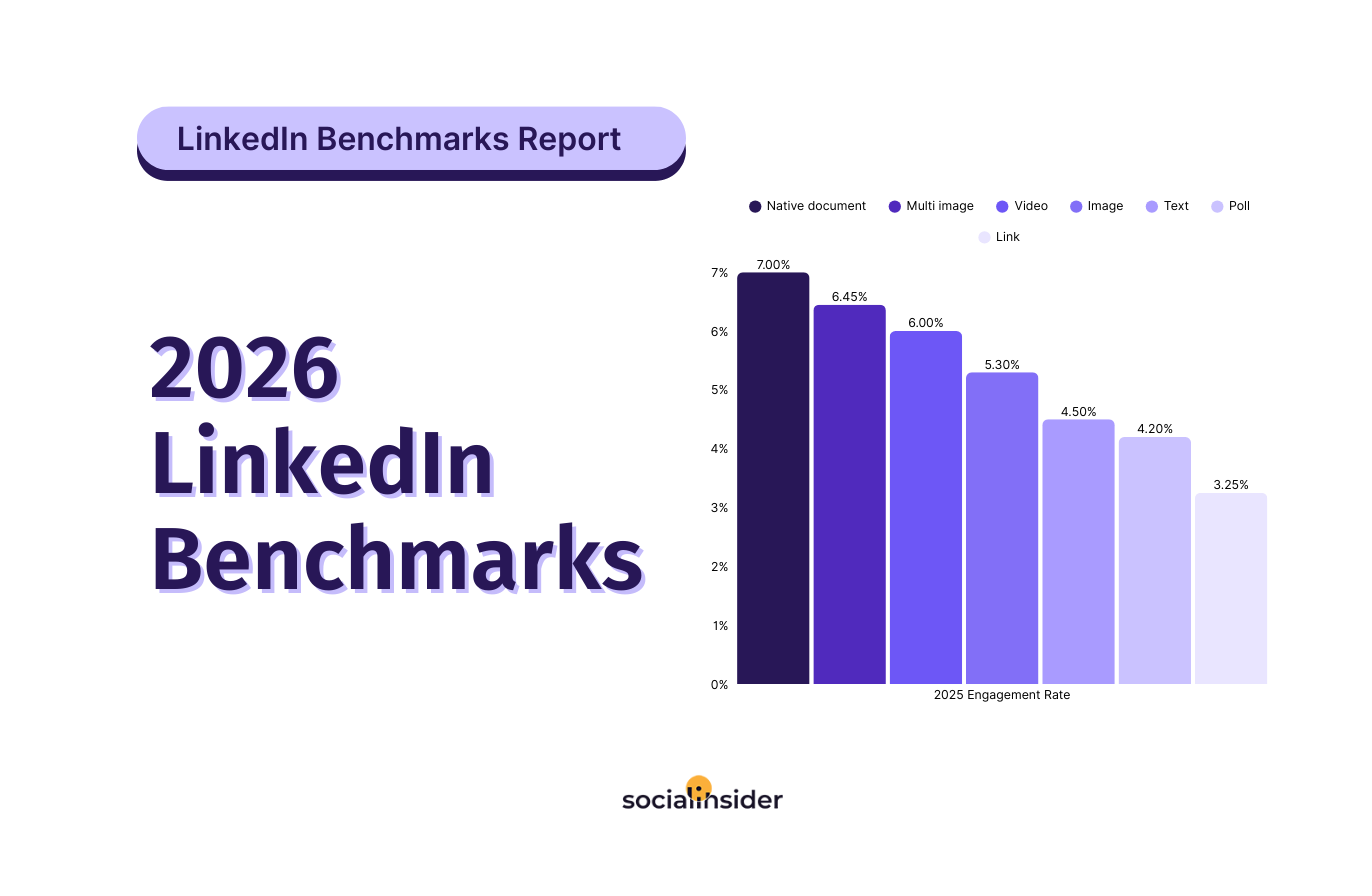
S’il y a bien une chose que j’ai apprise en travaillant avec des données social media au fil du temps, c’est que rester pertinent exige des ajustements constants. La façon dont les gens interagissent avec le contenu évolue sans cesse. Même de petits changements de comportement peuvent modifier les performances d’une année à l’autre.
C’est pourquoi, aujourd’hui, réussir sur LinkedIn est plus difficile — et plus stratégique — que jamais. Pour t’aider à comprendre où se trouvent les nouvelles opportunités, ce rapport de benchmarks LinkedIn te donne des insights clairs sur ce qui fonctionne actuellement en matière d’engagement, d’Impressions, d’habitudes de publication et de croissance de l’audience.
Fondés sur l’analyse de 1.3M de publications LinkedIn d’entreprises, ces benchmarks LinkedIn t’apportent la clarté et le contexte nécessaires pour définir des objectifs éclairés, affiner ta content strategy et maximiser ton impact sur LinkedIn dans un environnement de plus en plus concurrentiel.
Résumé exécutif
- Les publications à plusieurs images génèrent davantage de Likes dans tous les cas.
- Les sondages obtiennent de meilleurs résultats en termes d’Impressions sur les pages comptant plus de 50 k abonnés.
- Même si les plus grandes pages LinkedIn génèrent le plus de Video Views, le nombre de Views a diminué de 36 % en glissement annuel sur l’ensemble des pages LinkedIn.
- En 2025, les marques ont augmenté leur fréquence de publication pour les formats de contenu axés sur le visuel.
- La croissance de l’audience LinkedIn a ralenti en 2025, en particulier pour les grands comptes.
Benchmarks trimestriels de LinkedIn
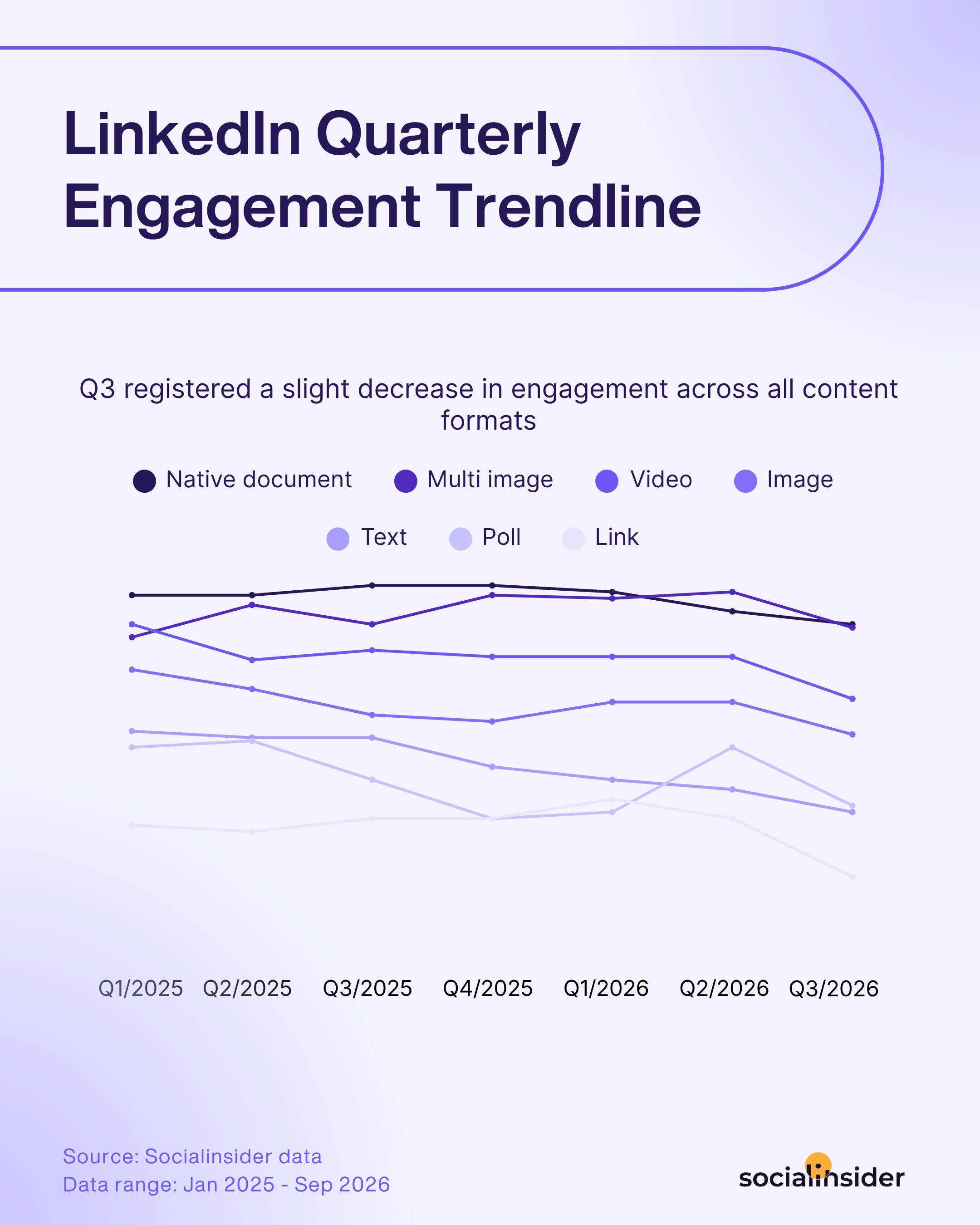
Globalement, au cours du premier semestre 2026, l'engagement sur LinkedIn est resté relativement stable.
D'après les données du T2 2026, l'engagement sur LinkedIn est resté globalement assez stable, la plupart des formats de contenu n'ayant connu que de légères fluctuations par rapport aux trimestres précédents.
Depuis un certain temps déjà, les documents natifs et les publications multi-images surpassent systématiquement tous les autres formats de contenu sur LinkedIn. Cela montre que les utilisateurs de LinkedIn interagissent surtout avec les contenus qui racontent une histoire ou apportent de la valeur de manière plus simple et interactive.
Qu’il s’agisse de carrousels éducatifs, de méthodes étape par étape, d’insights sectoriels ou d’expériences personnelles présentées sur plusieurs slides, les utilisateurs semblent bien plus enclins à interagir avec des contenus qui les invitent à prendre leur temps, à faire défiler les slides et à réellement s’attarder sur une publication.
Voici ce que les données révèlent sur les performances de chaque type de contenu :
- Publications multi-images : Ce format de contenu a enregistré une légère baisse de l’engagement au T3 2026, passant de 6.60% au T2 à 6.40%.
- Documents natifs : Le format le plus engageant de la plateforme a affiché un taux d’engagement moyen de 6.40% au T3 2026.
- Publications vidéo : Après une baisse importante du taux d’engagement, le contenu vidéo affiche désormais une moyenne de 5.25%.
- Publications avec image : L’un des formats de contenu ayant enregistré la plus forte baisse d’engagement au T3 2026, les images affichent désormais une moyenne de 4,70 %.
- Publications textuelles : Suivant la même tendance à la baisse, l’engagement des publications textuelles a chuté pour atteindre une moyenne de 3,50 % au T3 2026.
- Publications avec sondage : Sur LinkedIn, la baisse globale de l’engagement a été la plus marquée pour les sondages, dont le taux est passé de 4,50 % au T2 2026 à 3,60 % au T3.
- Publications avec lien : Ce format reste le moins performant sur LinkedIn, avec un taux d’engagement moyen de 2,50 %, en baisse par rapport aux 3,40 % du T2.
Benchmarks de l'Engagement Rate LinkedIn par impressions
S’il y a une chose que j’ai remarquée en travaillant dans le monde du marketing, c’est que rien ne reste longtemps immobile. Les plateformes social media que nous utilisons, et même la façon dont les gens interagissent avec le contenu, évoluent constamment.
De temps en temps, les plateformes social media nous surprennent avec de nouvelles tendances et de nouvelles bonnes pratiques. Elles redéfinissent souvent notre vision de ce qui fonctionne pour l’engagement.
À la lumière des benchmarks d’engagement LinkedIn de cette année, une tendance se démarque clairement : les audiences recherchent plus que jamais du fond et de la profondeur. Mais examinons une tendance à la fois.
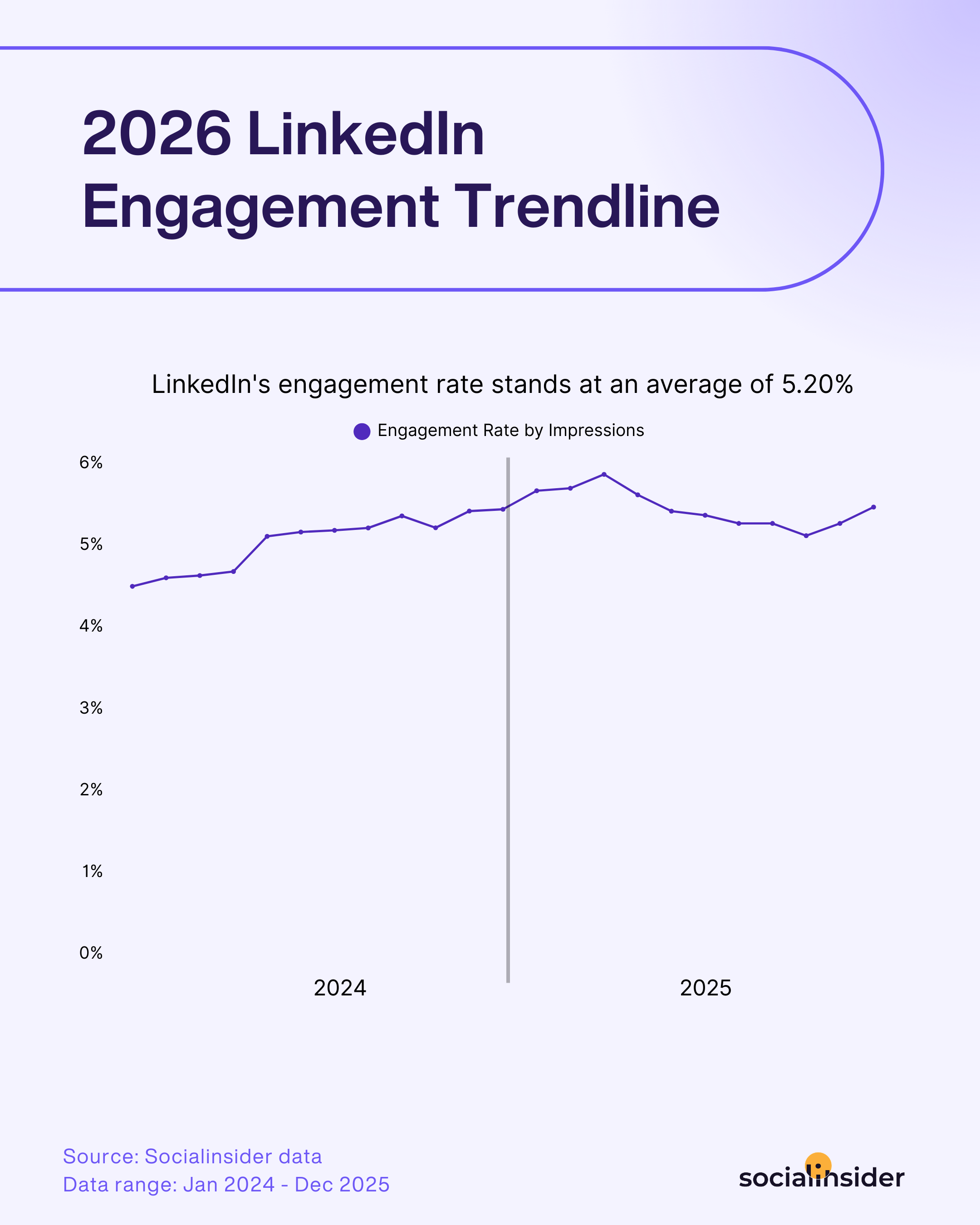
Pour poser le contexte, le taux d’engagement global de LinkedIn s’élève actuellement à 5.20%, ce qui nous donne un point de référence utile pour identifier les formats et les stratégies qui surpassent la moyenne.
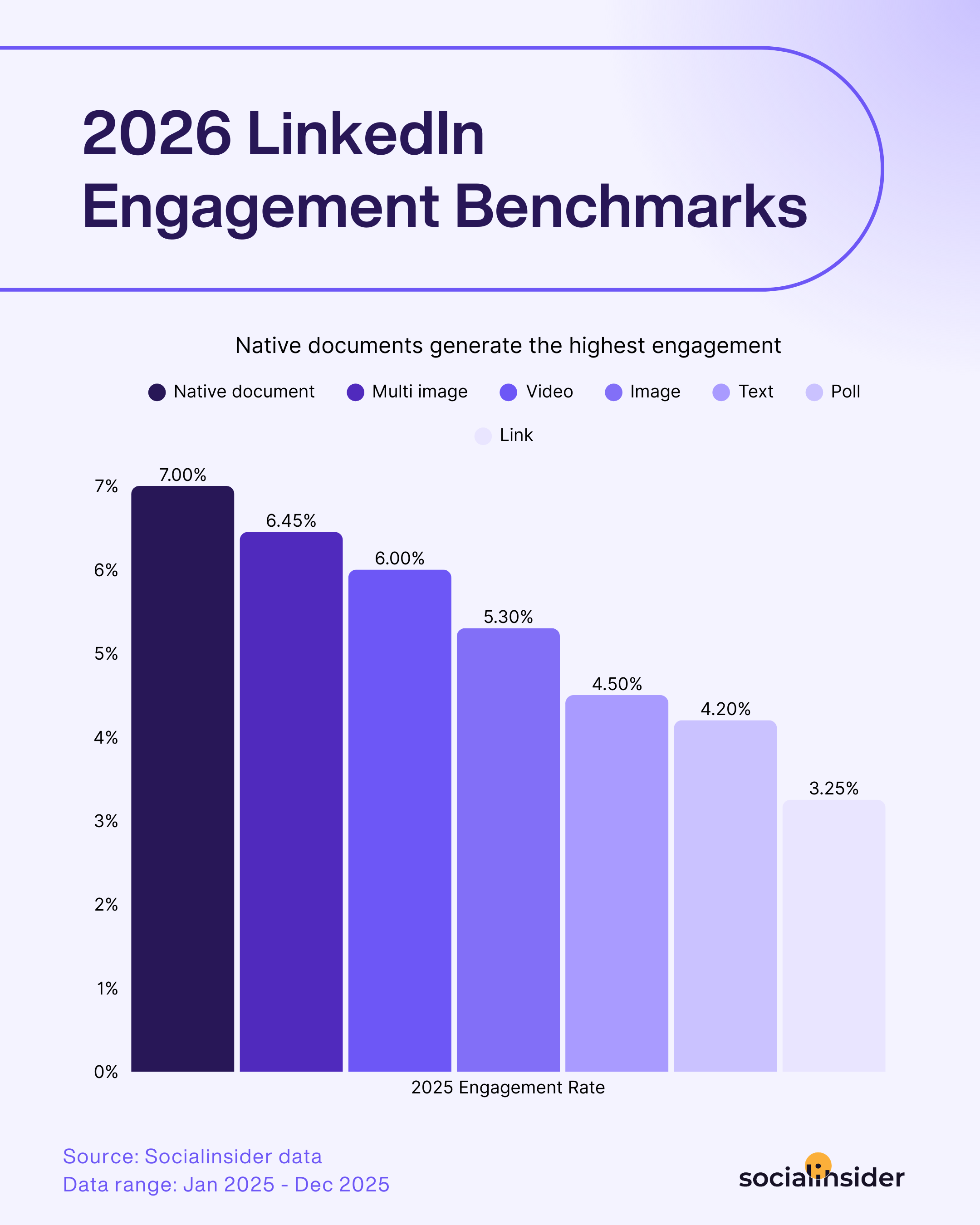
Si l'on examine le format de contenu le plus performant sur LinkedIn, les documents natifs ont pris la tête et occupent désormais la première place, avec un taux d'engagement moyen de LinkedIn de 7,00 % et une hausse de 14 % de leurs performances sur un an.
Les publications au format document fonctionnent bien, car elles offrent une « valeur gratuite » sur une plateforme où les utilisateurs veulent vraiment apprendre. LinkedIn est l'une des rares plateformes sociales où les audiences recherchent activement des conseils concrets (rapports, frameworks, modèles, etc.) Les documents fonctionnent très bien, car ils sont téléchargeables. Les utilisateurs peuvent les enregistrer et réellement les utiliser plus tard (modèles, checklists, frameworks). Ils sont aussi très faciles à utiliser. Le format carrousel facilite la lecture rapide. — Julia Holmqvist, Social Media Manager, Semrush
Alors, quel est l'enseignement clé à retenir ? Les utilisateurs récompensent les marques et les professionnels qui prennent le temps de partager des ressources originales, des études et des guides.
De plus, ce qui m'intéresse particulièrement, c'est de voir que le taux d'engagement moyen sur LinkedIn augmente également pour les autres formats de contenu : les vidéos, les images et même les simples publications texte suscitent davantage de réactions, avec des hausses respectives de 7 %, 9 % et 12 %.
Cette hausse de l'engagement sur LinkedIn s'explique par l'évolution constante de la plateforme, qui est passée d'un espace de networking purement professionnel à un écosystème de contenu plus vaste où les utilisateurs apprennent, débattent et développent activement leur marque personnelle. Parallèlement, de plus en plus de créateurs et de marques considèrent LinkedIn comme un canal de publication principal. Ils investissent dans le storytelling natif, la vidéo et les newsletters, ce qui maintient les utilisateurs sur la plateforme et encourage des interactions plus fréquentes – Dylan Patel, Head of Social Media Management, Born Social
Tactiques stratégiques pour augmenter l'engagement sur LinkedIn
- Oriente davantage ta stratégie vers les documents natifs : partage des actualités pertinentes, des commentaires sur les nouvelles du secteur ou les bonnes pratiques émergentes pour susciter le débat et renforcer ton leadership d'opinion, ce qui incitera davantage d'utilisateurs à interagir avec ton contenu.
- Mets en avant des résultats concrets ou des success stories : Partage des témoignages, des études de cas ou les résultats de projets pour démontrer leur impact, instaurer la confiance et inviter les autres à commenter ou à partager leurs propres expériences.
- Exploite les analytics pour réussir sur le long terme : Surveille les formats qui gagnent en engagement auprès de ton audience et adapte ton calendrier éditorial en conséquence pour capter l’intérêt au meilleur moment, avant que les tendances n’évoluent à nouveau.
Un contenu précis que j’ai vu contribuer à un engagement plus élevé sur LinkedIn, ce sont des publications brutes et non retouchées, avec une ambiance de coulisses. Nous publions généralement des clips horizontaux de 3 à 6 minutes qui présentent une réflexion ou un cadre expliquant notre approche du travail. Je pense que les gens manquent cruellement d’informations simples & utiles. Les fournir clairement dans des publications qui ne cherchent pas à jouer les leaders d’opinion génère un excellent engagement. — Ian Evans, Social Media Manager, tl;dv
Nombre moyen de Likes par publication sur LinkedIn
Une tendance ressort clairement des données LinkedIn de Socialinsider cette année : il n’existe pas d’approche universelle pour susciter un engagement significatif. Au contraire, la diversité des formats de contenu reste essentielle pour maximiser tes performances sur différents types d’interactions.
Les marques ne doivent pas hésiter à réutiliser régulièrement leur contenu dans plusieurs formats. En clair, tu peux reprendre tes vidéos populaires, tes articles de blog et toutes tes autres idées pour les réseaux sociaux, puis les partager au format document carrousel. Bien sûr, tu ne dois pas mettre tous tes œufs dans le même panier. Continue donc à intégrer des vidéos, des publications composées uniquement de texte et d’autres formats créatifs à ton mix de contenu. Tu devrais également investir dans la création de modèles pour le format document/carrousel afin de fluidifier le processus de création. — Casey Smith, Senior Social Media Manager, Slack
Et si on regardait de plus près ? Voici ce que les chiffres ont révélé.
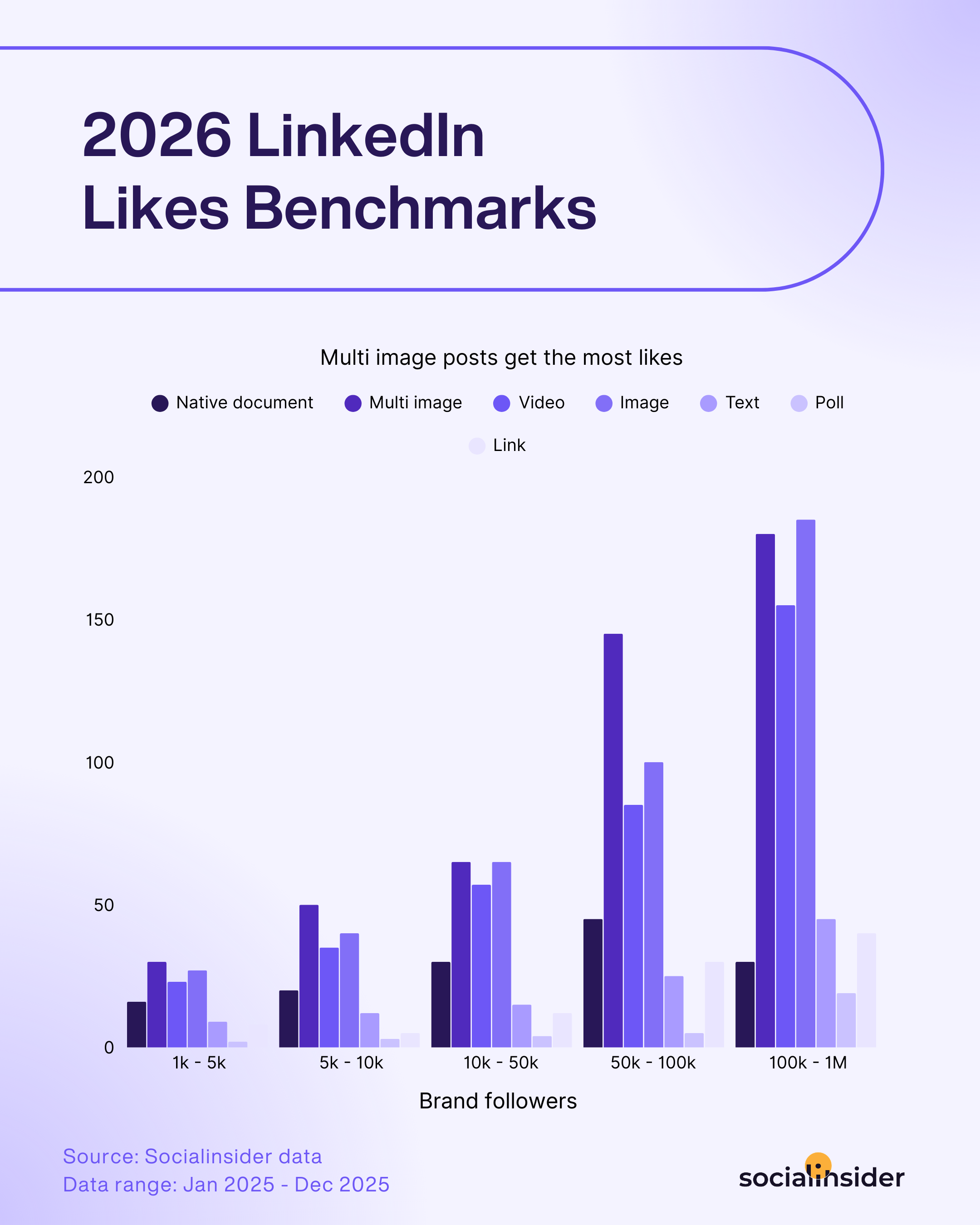
Des pages de marque en pleine croissance aux communautés établies de longue date, une chose est claire : si ton objectif est d'augmenter tes Likes, les publications à plusieurs images sont ton meilleur choix. À mesure que ton nombre de Followers sur LinkedIn augmente, l'efficacité de ce format ne fait que se multiplier, ce qui en fait un choix de premier plan pour maximiser les interactions.
Je pense qu'à une époque dominée par des vidéos au rythme effréné, les publications à plusieurs images, ou carrousels, semblent séduire les audiences parce qu'elles stimulent une partie du cerveau toujours en quête de PLUS. Les gens veulent un récit, du contexte et des niveaux d'information supplémentaires, pas seulement une image ou un insight. Les carrousels permettent de présenter le contenu de manière interactive et gratifiante. Les utilisateurs peuvent les faire défiler, découvrir de nouveaux détails, visuels ou messages à leur propre rythme. Ce sentiment de découverte les maintient engagés plus longtemps qu'une seule publication et encourage davantage d'interactions grâce aux Likes, aux enregistrements et aux Comments. — Ivy Mullins, Social Media Manager, Born Social
Tactiques stratégiques pour augmenter tes Likes sur LinkedIn
- Utilise des visuels d’ouverture et des accroches fortes : Commence tes publications par des images audacieuses ou des titres percutants pour capter l’attention et inciter les utilisateurs à arrêter de faire défiler leur fil et à manifester leur intérêt pour ton contenu avec un Like.
- Personnalise tes messages : Utilise un langage adapté ou des histoires qui parlent directement aux défis et aux centres d’intérêt de ton audience cible. Tes publications seront plus proches de ses attentes et susciteront davantage d’interactions.
- Réutilise du contenu populaire : Identifie les publications les plus performantes du passé, actualise-les ou remixe-les pour les rendre pertinentes, puis repartage-les dans de nouveaux formats pour générer un nouvel engagement sans repartir de zéro.
Des mèmes ! Qui a dit qu’ils étaient réservés à Instagram ? Je vois de plus en plus de personnes, mais aussi de marques, partager sur leur LinkedIn des mèmes très spécifiques à leur secteur. Les gens aiment se sentir « compris » dans leur domaine, et les mèmes sont un excellent moyen de créer du lien. — Eileen Mary O’Connell, Senior Social Media Manager, Paramount
Impressions moyennes par publication sur LinkedIn
Nous avons parlé de l'engagement, une métrique clé pour évaluer les performances sur LinkedIn. Passons maintenant à l'autre moitié importante de l'histoire : impressions.
Des métriques comme les Impressions moyennes sur LinkedIn révèlent l'efficacité avec laquelle le contenu se démarque et atteint les utilisateurs. Elles servent de baromètre fiable de la visibilité de la marque et de la croissance de l'audience.
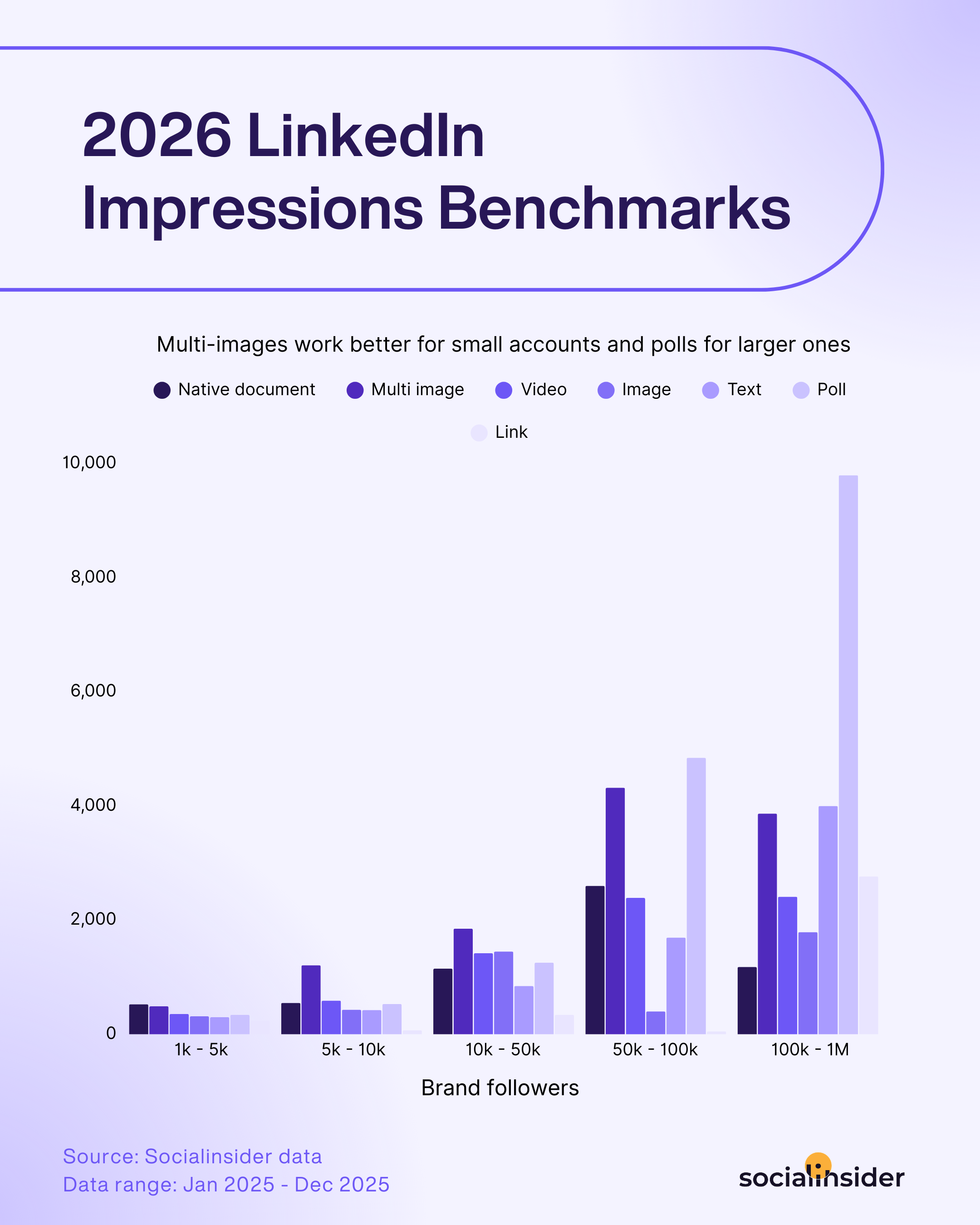
Les benchmarks de cette année montrent clairement que le format du contenu et la taille de la page vont de pair. Pour les pages comptant jusqu'à 50K Followers, les publications multi-images génèrent systématiquement le plus grand nombre d'Impressions LinkedIn par publication, ce qui en fait un type de publication particulièrement efficace pour élargir ton reach dès le début de la croissance de ton entreprise.
Les publications multi-images fonctionnent bien, car elles donnent plus de profondeur à l’histoire et éveillent naturellement la curiosité. Comme lorsqu’on tourne les pages d’un magazine, d’un journal ou d’un livre, chaque diapositive invite l’utilisateur à découvrir la suite. Sur LinkedIn, cela correspond bien à la façon dont les utilisateurs parcourent la plateforme, souvent entre deux tâches ou pendant de courtes pauses. — Denisa Vlăduță, Senior Social Media Manager
Fait intéressant, lorsqu’une page dépasse les 50K Followers, un changement notable s’opère : les sondages deviennent le format le plus performant pour générer des Impressions à grande échelle. Ce changement souligne l’importance de revoir tes stratégies de formats à mesure que ton audience grandit.
D’après mon expérience, les sondages fonctionnent le mieux lorsqu’ils portent sur une question à laquelle la majorité de ton audience peut répondre. Autrement dit, évite d’interroger les utilisateurs sur un sujet de niche ou un produit qui n’est pas encore largement adopté. Crée plutôt des sondages inspirés des conversations organiques que tu as déjà vues à propos de ta marque, aussi modestes soient-elles. Pense aussi à les utiliser pour recueillir les retours de ton audience, en lui demandant ce qu’elle aimerait voir de ta part. Utilise ces enseignements pour façonner ton contenu à venir. — Casey Smith, Senior Social Media Manager, Slack
Tactiques stratégiques pour augmenter les Impressions sur LinkedIn
- Diversifie les formats de contenu pour augmenter le reach : Alterne entre carrousels, sondages et vidéos. Les données montrent que certains formats sont plus performants selon la taille de l’audience. Utiliser le bon format aide à amplifier les Impressions.
- Identifie les personnes et entreprises pertinentes : Mentionne les partenaires du secteur, les employés et les collaborateurs concernés dans tes publications pour améliorer leur visibilité et encourager les partages auprès de réseaux plus vastes.
- Encourage l’engagement de tes employés : Mobilise tes équipes pour interagir avec tes publications et les amplifier. Les réactions et partages de tes employés peuvent considérablement étendre le reach d’une publication au-delà de tes abonnés directs.
L’essor du branding porté par les fondateurs encourage les marques à tirer parti des réseaux personnels de leurs employés, qui contribuent ainsi à leur écosystème de contenu. Alors que les dirigeants partagent plus ouvertement les réalités de la construction d’une carrière et d’une entreprise, la plateforme est naturellement devenue un espace où les professionnels de tous secteurs se sentent à l’aise pour revenir en détail sur leurs étapes clés et leurs expériences. Je m’attends à ce que de plus en plus de voix continuent de se tourner vers LinkedIn pour partager des points de vue qui trouvent un écho auprès d’un public désireux de s’investir dans sa croissance et son développement professionnels. — Eunice Cancino, stratège social media et contenu
Vues moyennes par vidéo sur LinkedIn
Après avoir examiné l'engagement et les impressions, intéressons-nous à un format depuis longtemps considéré comme une valeur sûre sur les réseaux sociaux : le contenu vidéo. Il est vrai que les plus grandes pages LinkedIn continuent d'attirer le plus grand nombre de vues de vidéos. Mais le principal enseignement des données de cette année est un changement notable : les vues ont diminué quelle que soit la taille de la page, avec une baisse moyenne de 36 % en glissement annuel.
LinkedIn n’est tout simplement pas une plateforme axée sur la vidéo. Les utilisateurs n’ouvrent pas LinkedIn pour faire défiler du contenu sans fin comme sur TikTok ou Instagram. Il n’y a pas vraiment de moteur de découverte ni de FYP qui diffuse les vidéos bien au-delà de ton réseau. Les mécanismes de viralité sont donc très différents. LinkedIn a été conçu autour du partage de connaissances professionnelles : publications textuelles, insights, documents et cadres méthodologiques. On voit bien que la plateforme essaie d’ajouter davantage de vidéos, mais le produit et les comportements des utilisateurs ne sont toujours pas vraiment conçus pour ça. — Julia Holmqvist, Social Media Manager, Semrush
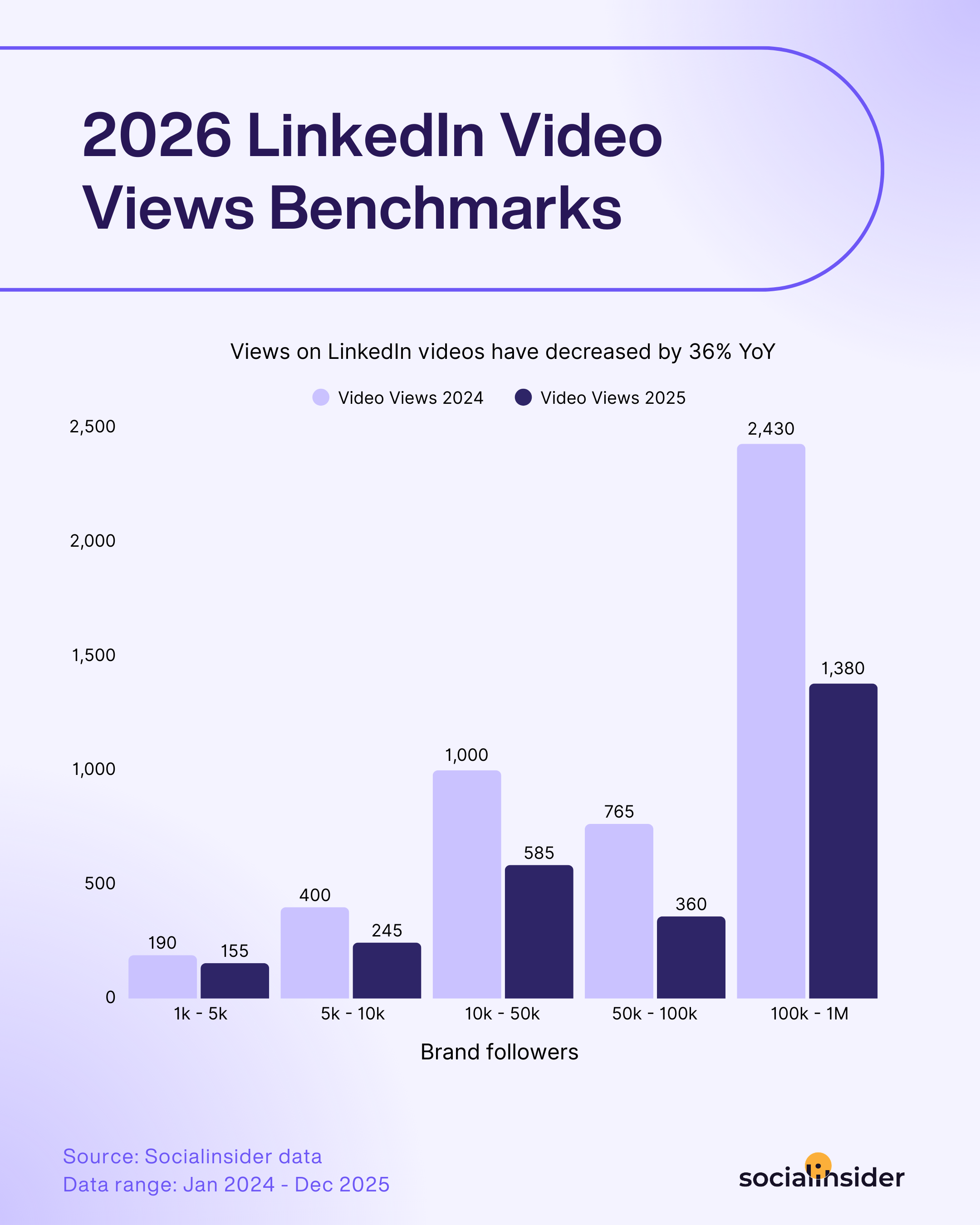
Qu’est-ce qui explique cette tendance ? La concurrence croissante et l’évolution des habitudes des utilisateurs ont probablement un fort impact sur les performances du contenu vidéo, quelle que soit la taille de ton audience.
Dans le contexte actuel, expérimenter en continu et adopter de nouvelles approches créatives sont plus importants que jamais. Diversifier tes content pillars et suivre de près l’évolution des centres d’intérêt de ton audience peuvent aider à renforcer la résilience de ta stratégie.
Tactiques stratégiques pour augmenter tes Video Views sur LinkedIn
- Associe ta vidéo à un résumé de publication descriptif et incitant à l'action. Un texte d'accompagnement percutant peut éveiller la curiosité et encourager les utilisateurs à cliquer sur Lecture.
- Intègre des sous-titres et du texte à l'écran : De nombreux utilisateurs regardent les vidéos sans le son. Ajouter des sous-titres et des messages clés rend ton contenu accessible et engageant. Tu augmentes ainsi les taux de complétion.
- Utilise la vidéo pour répondre aux questions tendance ou récurrentes : Aborde les défis courants de ton secteur ou les sujets d’actualité au format vidéo. Positionne ainsi ta marque comme réactive et experte.
Je pense qu’une baisse peut s’expliquer par le fait que de nombreux créateurs reprennent exactement les mêmes formats vidéo que sur d’autres plateformes. Même si la vidéo fonctionne bien dans l’ensemble, l’audience de LinkedIn s’attend probablement à autre chose.
Une grande partie du contenu suit la même structure : accroche, insight/valeur et appel à l’action. Cette formule peut fonctionner, mais elle devient très saturée. Comme les utilisateurs viennent souvent sur LinkedIn en quête de contenu plus professionnel ou distinct, retrouver les mêmes schémas qu’ailleurs peut réduire l’engagement. — Fernando J, Stratège senior en contenu
Benchmarks de fréquence de publication sur LinkedIn
En examinant les benchmarks de fréquence de publication sur LinkedIn, un autre aspect de l’évolution de la plateforme se dessine. En 2025, les marques ont délibérément choisi de publier plus fréquemment, notamment avec des formats axés sur le visuel.
Les chiffres racontent une histoire intéressante : les publications en image et les vidéos connaissent la plus forte progression. Le contenu en image mensuel moyen passe de 5 à 7 publications, tandis que la fréquence des vidéos double, passant de 2 à 4 publications par mois. Même les documents natifs sont un peu plus présents dans les fils d’actualité, avec une moyenne qui a doublé par rapport à l’année précédente.
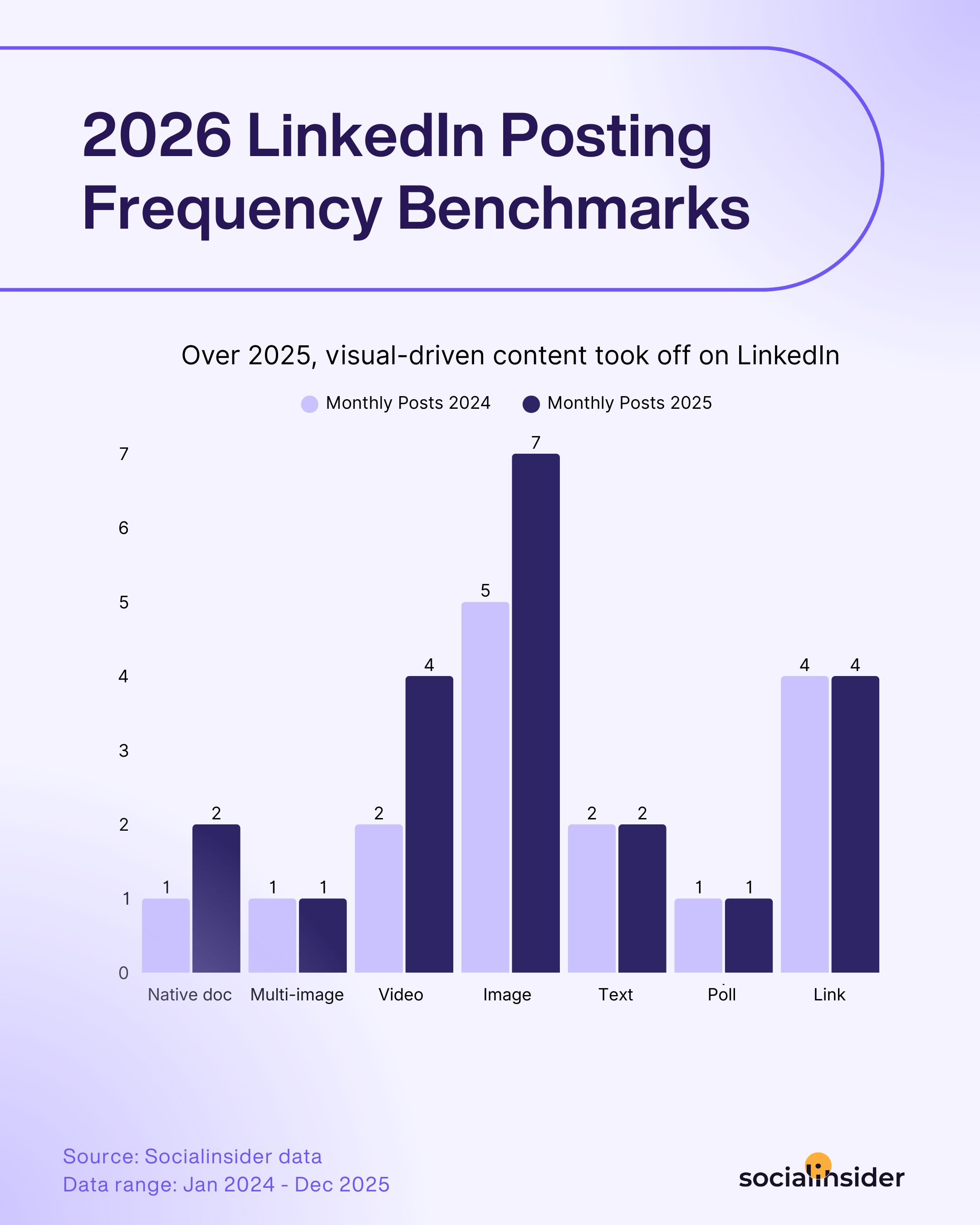
Si tu veux mon avis, cette tendance révèle une évolution plus globale : les marques investissent davantage dans des formats qui captent rapidement l’attention et incitent les utilisateurs à interagir.
Tactiques stratégiques pour créer une LinkedIn content strategy performante
- Crée ton contenu par lots à l’avance : Consacre certains jours chaque mois à la création et à la programmation de tes publications. Tu maintiendras ainsi plus facilement une fréquence régulière et plus élevée, sans stress de dernière minute.
- Documente tes processus et tes modèles: Crée des modèles pour différents types de publications (annonces, conseils, témoignages clients) et documente les bonnes pratiques pour permettre à toute ton équipe de produire rapidement du contenu.
- Tiens une « banque d'idées »: Crée un document partagé central ou un tableau numérique où chacun peut noter des idées de publications ou des sources d'inspiration dès qu'elles lui viennent. Tu y accéderas rapidement et réduiras la pression liée au brainstorming.
Benchmarks de croissance de l’audience LinkedIn
La croissance devient plus difficile sur toutes les plateformes social media, et LinkedIn ne fait pas exception. En 2025, les taux moyens de croissance des Followers LinkedIn ont nettement ralenti pour les pages de toutes tailles. Cette tendance est particulièrement marquée parmi les grands comptes.
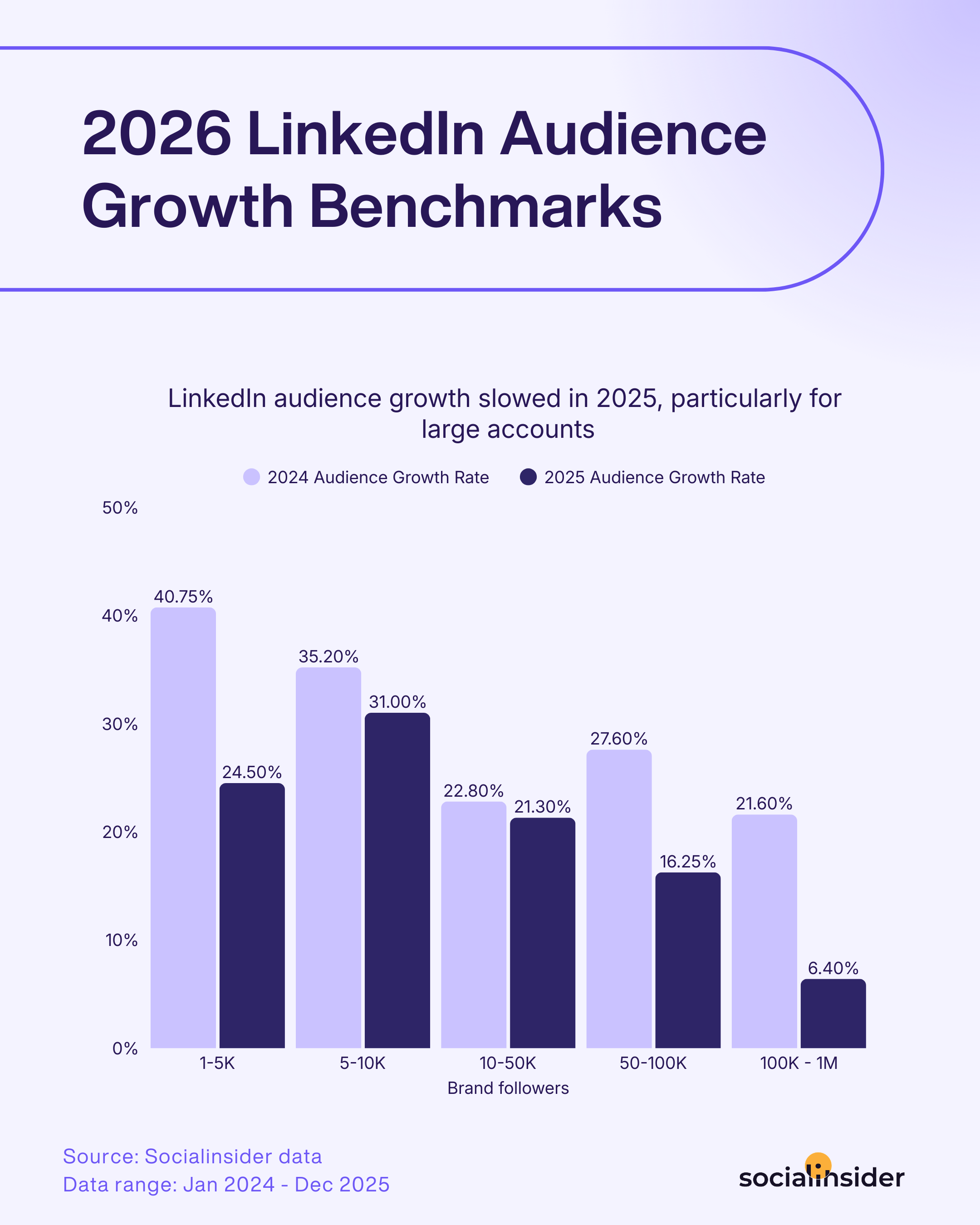
Alors que les pages plus petites (celles comptant 1 à 5K Followers) ont encore enregistré un taux de croissance moyen respectable de 24,5 %, celui des comptes comptant entre 100K et 1M Followers a fortement ralenti pour atteindre seulement 6,4 %.
Cette baisse est particulièrement frappante pour les communautés plus importantes. Elle montre que développer une audience déjà établie demande désormais plus d’efforts et de réflexion stratégique que jamais.
Les marques qui continuent à obtenir de bons résultats — tout en maintenant un taux de croissance sain sur LinkedIn — sont celles qui s’adaptent constamment, analysent leurs résultats et proposent du contenu en parfaite adéquation avec les centres d’intérêt de leur audience.
J’attribue ce ralentissement au fait que « la carrière comme contenu » devient de plus en plus un thème de contenu courant sur les plateformes grand public de social media. Les utilisateurs y intègrent leurs réussites professionnelles, leurs récits de carrière et leur leadership d’opinion, sur des plateformes autrefois réservées aux temps forts de leur vie personnelle. L’essor du contenu généré par les employés a brouillé la frontière entre ce qui est acceptable et ce qu’il vaut mieux éviter lorsqu’il s’agit de publier sur le monde du travail. Les audiences trouvent même des emplois et y sont recrutées directement depuis leurs pages « Pour toi » ou leurs fils d’actualité sur des plateformes comme TikTok et Instagram. Le monopole de LinkedIn en tant que plateforme de référence en ligne pour les carrières s’estompe, car les conversations et les opportunités professionnelles existent désormais sur d’autres géants des plateformes de social media. Les utilisateurs n’ont plus besoin d’affluer vers cette plateforme comme source unique. — Bronte Chandler, Associate Director of Social Media, Born Social
Stratégies ciblées pour développer ton audience sur LinkedIn
- Lance des événements LinkedIn Live ou des webinaires spécialisés : Organise des événements exclusifs et interactifs (sessions de questions-réponses, interviews, tables rondes sectorielles) et fais-en largement la promotion : le contenu en direct attire de nouvelles audiences et encourage les personnes qui ne te suivent pas encore à se connecter.
- Collabore avec des professionnels de ton secteur : Associe-toi à des marques ou à des professionnels complémentaires pour créer des publications co-brandées, des campagnes communes ou des mentions. Présentez vos réseaux respectifs pour développer naturellement votre nombre de Followers.
- Propose des mini-séries récurrentes ou des conseils d’experts : Lance une série éducative hebdomadaire ou bimensuelle avec des conseils pratiques. Donne ainsi aux visiteurs une bonne raison de te suivre régulièrement pour ne pas manquer le prochain épisode.
Méthodologie
Les résultats de cette étude reposent sur l’analyse de 2 450 610 publications LinkedIn provenant de marques comptant entre 1K et 1M de Followers, actives sur la plateforme de janvier 2025 à décembre 2026 et issues de différents secteurs.
L’échantillon de l’étude était composé de :
- 371 633 publications provenant de 7 016 pages d’entreprise LinkedIn comptant moins de 5 000 Followers
- 266 084 publications provenant de 3 909 pages d’entreprise LinkedIn comptant entre 5 000 et 10 000 Followers.
- 725,916 publications provenant de 7,952 pages LinkedIn d’entreprises comptant entre 10000 et 50000 abonnés.
- 319,839 publications provenant de 2,804 pages LinkedIn d’entreprises comptant entre 50000 et 100000 abonnés.
- 767,138 publications provenant de 4,433 pages LinkedIn d’entreprises comptant 100000 abonnés.
Les comptes comptant moins de 1 000 Followers ou plus de 100 000 Followers ont été exclus, car ils faussent généralement les données. Ce sont les tailles de compte les plus courantes à générer des valeurs aberrantes.
L’échantillon de cette analyse comprend uniquement des publications organiques.
Les formats de contenu référencés dans cette analyse sont les suivants :
- Documents natifs : le type de publication composé d’un PDF importé directement sur LinkedIn, similaire à un carrousel.
- Images multiples : l’importation de plusieurs photos à la fois, affichées comme dans un album.
- Publications textuelles : les publications LinkedIn composées d’un bloc de texte.
- Sondages : questions ouvertes au vote.
- Image : publications incluant le téléversement d'une image.
- Vidéo : publications incluant le téléversement d'une vidéo.
Le taux d'engagement moyen par publication (par Impressions) se calcule en divisant l'engagement total d'une publication (la somme des Reactions, Comments et Shares) par le nombre d'Impressions reçues, puis en multipliant le résultat par 100. Le résultat est ensuite moyenné sur l'ensemble des publications pour chaque format de contenu et période.
Les likes moyens par publication correspondent au nombre moyen de réactions reçues par une publication.
Les Impressions moyennes par publication représentent le nombre moyen de fois qu’une publication s’affiche sur les écrans des utilisateurs. Une personne peut générer plusieurs Impressions.
Les Views moyennes par vidéo représentent le nombre moyen de vues qu’une vidéo reçoit, selon les données de LinkedIn.
La fréquence de publication correspond au nombre moyen de publications qu’une page publie chaque mois, pour chaque format de contenu.
Le taux moyen de croissance des Followers se calcule en divisant le nombre de Followers gagnés par une page au cours de l’année par le nombre de Followers qu’elle avait au début de l’année, puis en multipliant le résultat par 100. Le résultat est ensuite calculé en moyenne pour toutes les pages de chaque tranche de taille.
REMARQUE : cette étude contient des données de 2025, présentées comme celles de 2026, car au moment de sa publication, l’année commençait à peine et les données disponibles n’étaient pas suffisantes pour l’analyse. C’est pourquoi nous proposons des mises à jour trimestrielles, au fil de l’année et de la disponibilité de nouvelles données.
Accède à des métriques détaillées sur tes performances LinkedIn
Réalise une analyse LinkedIn approfondie et obtiens des idées stratégiques pour optimiser ton contenu !
Prêt à améliorer ta social media strategy grâce à des insights en temps réel ?
Obtiens des insights stratégiques, analyse les performances social media sur tous les canaux, compare les métriques de différentes périodes et télécharge des rapports en quelques secondes.